10-Q
Q2False--12-310002091349one yearone yearhttp://fasb.org/srt/2026#ChiefExecutiveOfficerMember0002091349trax:ExternalExpensesMemberus-gaap:OperatingSegmentsMember2026-04-012026-06-300002091349us-gaap:OperatingSegmentsMembertrax:PreclinicalAndOtherUnallocatedCostsMember2026-01-012026-06-300002091349trax:InternalExpensesMemberus-gaap:OperatingSegmentsMember2025-04-012025-06-300002091349trax:ANB033Memberus-gaap:OperatingSegmentsMember2025-04-012025-06-300002091349trax:FirstTracksEquityPlanMemberus-gaap:ResearchAndDevelopmentExpense2026-04-012026-06-300002091349trax:FDARegulatoryApprovalForMarketingOfFirstLicensedProductInTheUSAForTheTreatmentOfActiveFlaresInGPPMembertrax:VandaPharmaceuticalsIncMember2026-01-012026-06-3000020913492026-08-070002091349trax:EmployeeStocksOptionMembersrt:MaximumMember2026-01-012026-06-300002091349us-gaap:MoneyMarketFundsMemberus-gaap:FairValueInputsLevel1Memberus-gaap:FairValueMeasurementsRecurringMember2026-06-300002091349us-gaap:EmployeeStockOptionMember2026-04-012026-06-300002091349us-gaap:FairValueInputsLevel1Membertrax:MutualFundsMemberus-gaap:FairValueMeasurementsRecurringMember2026-06-300002091349us-gaap:RetainedEarningsMember2026-01-012026-03-310002091349us-gaap:OperatingSegmentsMembertrax:PreclinicalAndOtherUnallocatedCostsMember2025-01-012025-06-300002091349trax:EmployeeStocksOptionMember2026-01-012026-06-300002091349us-gaap:AccumulatedOtherComprehensiveIncomeMember2025-01-012025-03-310002091349us-gaap:CollaborativeArrangementMembertrax:CentessaPharmaceuticalsUKLimitedCentessaMember2023-11-240002091349trax:ExternalExpensesMemberus-gaap:OperatingSegmentsMember2026-01-012026-06-300002091349trax:PerformanceStockUnitMember2026-04-212026-06-300002091349us-gaap:SubsidiaryOfCommonParentMember2025-01-012025-06-300002091349us-gaap:FairValueInputsLevel2Membertrax:CommercialAndCorporateObligationsMemberus-gaap:FairValueMeasurementsRecurringMember2025-12-3100020913492024-12-310002091349us-gaap:FairValueInputsLevel3Memberus-gaap:USTreasurySecuritiesMemberus-gaap:FairValueMeasurementsRecurringMember2025-12-310002091349trax:StockAwardsMember2025-04-012025-06-300002091349us-gaap:ParentMember2025-06-300002091349us-gaap:RetainedEarningsMember2026-03-310002091349us-gaap:MoneyMarketFundsMemberus-gaap:FairValueInputsLevel2Memberus-gaap:FairValueMeasurementsRecurringMember2026-06-300002091349us-gaap:RestrictedStockUnitsRSUMember2026-04-212026-06-300002091349us-gaap:FairValueInputsLevel3Membertrax:CommercialAndCorporateObligationsMemberus-gaap:FairValueMeasurementsRecurringMember2025-12-310002091349trax:InternalExpensesMemberus-gaap:OperatingSegmentsMember2025-01-012025-06-300002091349us-gaap:ParentMember2025-01-012025-03-310002091349trax:ANB033Memberus-gaap:OperatingSegmentsMember2025-01-012025-06-300002091349us-gaap:EmployeeStockOptionMember2025-04-012025-06-300002091349us-gaap:USTreasurySecuritiesMember2025-12-310002091349us-gaap:ParentMember2026-04-012026-06-300002091349trax:AnaptysBioSTwoThousandSeventeenPlanMemberus-gaap:GeneralAndAdministrativeExpense2026-04-012026-06-300002091349us-gaap:ResearchAndDevelopmentExpensetrax:AnaptysBioSTwoThousandSeventeenPlanMember2025-04-012025-06-300002091349trax:StockOptionsMember2026-06-300002091349us-gaap:AccumulatedOtherComprehensiveIncomeMember2026-01-012026-03-310002091349trax:InternalExpensesMemberus-gaap:OperatingSegmentsMember2026-04-012026-06-3000020913492026-01-012026-06-300002091349trax:LaboratoryEquipmentMember2025-12-310002091349us-gaap:OperatingSegmentsMembertrax:RosnilimabMember2025-04-012025-06-300002091349trax:InternalExpensesMemberus-gaap:OperatingSegmentsMember2026-01-012026-06-300002091349trax:ExternalExpensesMemberus-gaap:OperatingSegmentsMember2025-04-012025-06-300002091349us-gaap:OperatingSegmentsMembertrax:RosnilimabMember2026-01-012026-06-300002091349us-gaap:USTreasurySecuritiesMembersrt:MaximumMember2025-01-012025-12-310002091349us-gaap:OperatingSegmentsMembertrax:RosnilimabMember2026-04-012026-06-300002091349us-gaap:FairValueInputsLevel3Membertrax:MutualFundsMemberus-gaap:FairValueMeasurementsRecurringMember2026-06-300002091349trax:ANB032Memberus-gaap:OperatingSegmentsMember2026-04-012026-06-300002091349us-gaap:AdditionalPaidInCapitalMember2026-03-310002091349us-gaap:USTreasurySecuritiesMemberus-gaap:FairValueInputsLevel1Memberus-gaap:FairValueMeasurementsRecurringMember2025-12-310002091349trax:CommercialAndCorporateObligationsMember2025-12-310002091349us-gaap:OperatingSegmentsMember2025-04-012025-06-300002091349trax:AnaptysBioSTwoThousandSeventeenPlanMemberus-gaap:GeneralAndAdministrativeExpense2025-01-012025-06-300002091349us-gaap:AccumulatedOtherComprehensiveIncomeMember2025-12-310002091349trax:ANB101Memberus-gaap:OperatingSegmentsMember2025-01-012025-06-300002091349us-gaap:AdditionalPaidInCapitalMember2026-04-012026-06-300002091349us-gaap:RetainedEarningsMember2026-04-012026-06-300002091349trax:CommercialAndCorporateObligationsMemberus-gaap:FairValueInputsLevel1Memberus-gaap:FairValueMeasurementsRecurringMember2025-12-310002091349us-gaap:OperatingSegmentsMember2026-01-012026-06-300002091349us-gaap:ResearchAndDevelopmentExpensetrax:AnaptysBioSTwoThousandSeventeenPlanMember2025-01-012025-06-300002091349trax:ANB033Memberus-gaap:OperatingSegmentsMember2026-04-012026-06-300002091349trax:AnaptysBioMember2026-04-200002091349us-gaap:FairValueInputsLevel3Membertrax:MutualFundsMemberus-gaap:FairValueMeasurementsRecurringMember2025-12-310002091349trax:MilestonesYetToBeRecognizedMembertrax:VandaPharmaceuticalsIncMember2026-01-012026-06-300002091349us-gaap:OperatingSegmentsMember2025-01-012025-06-300002091349us-gaap:CommonStockMember2026-06-300002091349us-gaap:RestrictedStockUnitsRSUMember2026-01-012026-06-300002091349us-gaap:LeaseholdImprovementsMember2026-06-300002091349trax:StockOptionsMember2026-04-212026-06-3000020913492026-01-012026-03-310002091349trax:StockAwardsMember2026-01-012026-06-300002091349trax:FirstTracksEquityPlanMember2026-06-300002091349us-gaap:AccumulatedOtherComprehensiveIncomeMember2025-03-310002091349us-gaap:ParentMember2026-01-012026-03-310002091349us-gaap:AccumulatedOtherComprehensiveIncomeMember2026-06-300002091349trax:ANB101Memberus-gaap:OperatingSegmentsMember2025-04-012025-06-300002091349trax:StockAwardsMember2025-01-012025-06-300002091349us-gaap:FairValueInputsLevel3Memberus-gaap:MoneyMarketFundsMemberus-gaap:FairValueMeasurementsRecurringMember2026-06-300002091349us-gaap:RetainedEarningsMember2025-04-012025-06-300002091349trax:CumulativeMilestonesRecognizedMembertrax:VandaPharmaceuticalsIncMember2026-01-012026-06-3000020913492025-01-012025-03-310002091349us-gaap:AdditionalPaidInCapitalMember2026-01-012026-03-310002091349trax:PerformanceStockUnitMember2026-01-012026-06-300002091349us-gaap:RestrictedStockUnitsRSUMember2026-04-200002091349us-gaap:CommonStockMember2026-03-3100020913492025-12-310002091349us-gaap:AdditionalPaidInCapitalMember2026-06-300002091349us-gaap:PreferredStockMember2026-06-300002091349us-gaap:FairValueInputsLevel1Membertrax:MutualFundsMemberus-gaap:FairValueMeasurementsRecurringMember2025-12-310002091349trax:StockOptionsMember2026-04-012026-04-200002091349trax:SpinOffTransactionsMember2026-04-202026-04-200002091349us-gaap:RetainedEarningsMember2025-12-310002091349trax:VandaPharmaceuticalsIncMembertrax:CommercialSalesMilestoneMember2026-01-012026-06-300002091349trax:CommercialAndCorporateObligationsMembersrt:MinimumMember2025-01-012025-12-310002091349us-gaap:OperatingSegmentsMembertrax:InternalExpenseMember2026-01-012026-06-300002091349trax:CommercialAndCorporateObligationsMemberus-gaap:FairValueMeasurementsRecurringMember2025-12-3100020913492026-06-300002091349us-gaap:ParentMember2024-12-3100020913492026-04-012026-06-300002091349us-gaap:EmployeeStockOptionMember2025-01-012025-06-300002091349us-gaap:MoneyMarketFundsMemberus-gaap:FairValueInputsLevel1Memberus-gaap:FairValueMeasurementsRecurringMember2025-12-310002091349us-gaap:CommonStockMember2026-01-012026-03-310002091349us-gaap:AccumulatedOtherComprehensiveIncomeMember2025-06-300002091349us-gaap:CommonStockMember2026-04-012026-06-3000020913492026-06-152026-06-150002091349us-gaap:AccumulatedOtherComprehensiveIncomeMember2024-12-310002091349trax:ANB101Memberus-gaap:OperatingSegmentsMember2026-01-012026-06-300002091349us-gaap:FairValueInputsLevel2Memberus-gaap:USTreasurySecuritiesMemberus-gaap:FairValueMeasurementsRecurringMember2025-12-310002091349us-gaap:CommonStockMember2025-01-012025-03-310002091349us-gaap:AdditionalPaidInCapitalMember2025-12-310002091349trax:PerformanceStockUnitMember2026-06-300002091349us-gaap:OperatingSegmentsMembertrax:InternalExpenseMember2025-04-012025-06-300002091349us-gaap:CommonStockMember2026-06-300002091349trax:FirstTracksBiotherapeuticsMembertrax:AnaptysBioMember2026-04-200002091349us-gaap:OfficeEquipmentMember2026-06-300002091349trax:MutualFundsMemberus-gaap:FairValueMeasurementsRecurringMember2026-06-300002091349us-gaap:RetainedEarningsMember2026-06-300002091349trax:AnaptysBioSTwoThousandSeventeenPlanMember2025-01-012025-06-300002091349us-gaap:OperatingSegmentsMembertrax:PreclinicalAndOtherUnallocatedCostsMember2025-04-012025-06-300002091349trax:LaboratoryEquipmentMember2026-06-300002091349trax:PrivatePlacementSecondarySharesMember2026-04-200002091349us-gaap:ParentMember2025-12-310002091349trax:ANB033Memberus-gaap:OperatingSegmentsMember2026-01-012026-06-300002091349us-gaap:OperatingSegmentsMembertrax:PreclinicalAndOtherUnallocatedCostsMember2026-04-012026-06-300002091349trax:AnaptysBioSTwoThousandSeventeenPlanMember2025-04-012025-06-300002091349trax:FirstTracksEquityPlanMemberus-gaap:GeneralAndAdministrativeExpense2026-04-012026-06-300002091349us-gaap:OperatingSegmentsMembertrax:InternalExpenseMember2025-01-012025-06-300002091349trax:PerformanceStockUnitMember2026-04-200002091349us-gaap:ResearchAndDevelopmentExpensetrax:AnaptysBioSTwoThousandSeventeenPlanMember2026-01-012026-06-300002091349us-gaap:RetainedEarningsMember2024-12-310002091349trax:AnaptysBioSTwoThousandSeventeenPlanMember2026-01-012026-06-300002091349trax:ANB032Memberus-gaap:OperatingSegmentsMember2026-01-012026-06-300002091349us-gaap:USTreasurySecuritiesMembersrt:MinimumMember2025-01-012025-12-310002091349srt:DirectorMembertrax:EmployeeStocksOptionMember2026-01-012026-06-300002091349trax:FirstTracksEquityPlanMember2026-04-012026-06-300002091349us-gaap:RestrictedStockUnitsRSUMember2026-06-300002091349us-gaap:SubsidiaryOfCommonParentMember2026-01-012026-06-3000020913492025-06-300002091349trax:TwoThousandTwentySixEmployeeStockPurchasePlanMember2026-06-300002091349us-gaap:OperatingSegmentsMembertrax:RosnilimabMember2025-01-012025-06-300002091349trax:StockOptionsMember2026-04-200002091349us-gaap:CommonStockMember2025-12-310002091349us-gaap:ParentMember2026-03-310002091349us-gaap:AccumulatedOtherComprehensiveIncomeMember2025-04-012025-06-300002091349us-gaap:RetainedEarningsMember2025-06-300002091349trax:AnaptysBioSTwoThousandSeventeenPlanMemberus-gaap:GeneralAndAdministrativeExpense2026-01-012026-06-300002091349us-gaap:OfficeEquipmentMember2025-12-310002091349trax:RegulatoryApprovalForMarketingOfTheFirstLicensedProductInTheEUMembertrax:VandaPharmaceuticalsIncMember2026-01-012026-06-300002091349us-gaap:MoneyMarketFundsMemberus-gaap:FairValueMeasurementsRecurringMember2025-12-310002091349us-gaap:AccumulatedOtherComprehensiveIncomeMember2026-03-3100020913492026-06-150002091349us-gaap:CollaborativeArrangementMembertrax:CentessaPharmaceuticalsUKLimitedCentessaMember2026-06-300002091349us-gaap:RetainedEarningsMember2025-03-310002091349trax:ExternalExpensesMemberus-gaap:OperatingSegmentsMember2025-01-012025-06-300002091349us-gaap:LeaseholdImprovementsMember2025-12-310002091349us-gaap:ParentMember2025-04-012025-06-300002091349trax:FirstTracksEquityPlanMember2026-01-012026-06-300002091349us-gaap:AccumulatedOtherComprehensiveIncomeMember2026-04-012026-06-300002091349us-gaap:MoneyMarketFundsMemberus-gaap:FairValueInputsLevel2Memberus-gaap:FairValueMeasurementsRecurringMember2025-12-310002091349trax:AnaptysBioSTwoThousandSeventeenPlanMember2026-04-012026-06-300002091349us-gaap:RetainedEarningsMember2025-01-012025-03-310002091349us-gaap:SubsidiaryOfCommonParentMember2026-04-012026-06-300002091349trax:LicenseAgreementCentessaPharmaceuticalsUKLimitedMemberus-gaap:CollaborativeArrangementMembertrax:CentessaPharmaceuticalsUKLimitedCentessaMember2023-11-242023-11-240002091349trax:PrivatePlacementPrimarySharesMember2026-04-200002091349trax:StockAwardsMember2026-04-012026-06-300002091349us-gaap:MoneyMarketFundsMemberus-gaap:FairValueInputsLevel3Memberus-gaap:FairValueMeasurementsRecurringMember2025-12-310002091349trax:MutualFundsMemberus-gaap:FairValueMeasurementsRecurringMember2025-12-3100020913492026-03-310002091349trax:ANB101Memberus-gaap:OperatingSegmentsMember2026-04-012026-06-300002091349us-gaap:ResearchAndDevelopmentExpensetrax:AnaptysBioSTwoThousandSeventeenPlanMember2026-04-012026-06-300002091349us-gaap:FairValueInputsLevel2Membertrax:MutualFundsMemberus-gaap:FairValueMeasurementsRecurringMember2026-06-300002091349trax:ANB032Memberus-gaap:OperatingSegmentsMember2025-01-012025-06-3000020913492025-03-310002091349us-gaap:CommonStockMember2025-04-012025-06-300002091349us-gaap:OperatingSegmentsMember2026-04-012026-06-300002091349trax:CommercialAndCorporateObligationsMembersrt:MaximumMember2025-01-012025-12-310002091349us-gaap:OperatingSegmentsMembertrax:InternalExpenseMember2026-04-012026-06-300002091349us-gaap:RestrictedStockUnitsRSUMember2026-04-012026-04-200002091349us-gaap:SubsidiaryOfCommonParentMember2025-04-012025-06-3000020913492026-04-202026-04-200002091349us-gaap:ParentMember2025-03-310002091349us-gaap:ParentMember2026-06-300002091349us-gaap:FairValueInputsLevel2Membertrax:MutualFundsMemberus-gaap:FairValueMeasurementsRecurringMember2025-12-3100020913492025-04-012025-06-3000020913492025-01-012025-06-300002091349us-gaap:MoneyMarketFundsMemberus-gaap:FairValueMeasurementsRecurringMember2026-06-300002091349us-gaap:USTreasurySecuritiesMemberus-gaap:FairValueMeasurementsRecurringMember2025-12-310002091349us-gaap:EmployeeStockOptionMember2026-01-012026-06-300002091349trax:ANB032Memberus-gaap:OperatingSegmentsMember2025-04-012025-06-300002091349trax:AnaptysBioSTwoThousandSeventeenPlanMemberus-gaap:GeneralAndAdministrativeExpense2025-04-012025-06-30xbrli:pureutr:sqftxbrli:sharestrax:ReportableSegmentiso4217:USD
UNITED STATES
SECURITIES AND EXCHANGE COMMISSION
WASHINGTON, DC 20549
FORM 10-Q
(Mark One)
|
|
☒ |
QUARTERLY REPORT PURSUANT TO SECTION 13 OR 15(d) OF THE SECURITIES EXCHANGE ACT OF 1934 |
For the quarterly period ended June 30, 2026
OR
|
|
☐ |
TRANSITION REPORT PURSUANT TO SECTION 13 OR 15(d) OF THE SECURITIES EXCHANGE ACT OF 1934 |
For the transition period from to .
Commission File Number: 001-43177
FIRST TRACKS BIOTHERAPEUTICS, INC.
(Exact Name of Registrant as Specified in its Charter)
|
|
Delaware |
39-5003207 |
(State or other jurisdiction of incorporation or organization) |
(I.R.S. Employer
Identification No.) |
10770 Wateridge Circle, Suite 210 San Diego, CA |
92121 |
(Address of principal executive offices) |
(Zip Code) |
Registrant’s telephone number, including area code: (858) 362-6295
Securities registered pursuant to Section 12(b) of the Act:
|
|
|
|
|
Title of each class |
|
Trading Symbol(s) |
|
Name of each exchange on which registered |
Common Stock, par value $0.001 per share |
|
TRAX |
|
The Nasdaq Stock Market LLC |
Indicate by check mark whether the registrant (1) has filed all reports required to be filed by Section 13 or 15(d) of the Securities Exchange Act of 1934 during the preceding 12 months (or for such shorter period that the registrant was required to file such reports), and (2) has been subject to such filing requirements for the past 90 days. Yes ☒ No ☐
Indicate by check mark whether the registrant has submitted electronically every Interactive Data File required to be submitted pursuant to Rule 405 of Regulation S-T (§232.405 of this chapter) during the preceding 12 months (or for such shorter period that the registrant was required to submit such files). Yes ☒ No ☐
Indicate by check mark whether the registrant is a large accelerated filer, an accelerated filer, a non-accelerated filer, smaller reporting company, or an emerging growth company. See the definitions of “large accelerated filer,” “accelerated filer,” “smaller reporting company,” and “emerging growth company” in Rule 12b-2 of the Exchange Act.
|
|
|
|
|
|
|
Large accelerated filer |
|
☐ |
|
Accelerated filer |
|
☐ |
Non-accelerated filer |
|
☒ |
|
Smaller reporting company |
|
☒ |
Emerging growth company |
|
☒ |
|
|
|
|
If an emerging growth company, indicate by check mark if the registrant has elected not to use the extended transition period for complying with any new or revised financial accounting standards provided pursuant to Section 13(a) of the Exchange Act. ☐
Indicate by check mark whether the registrant is a shell company (as defined in Rule 12b-2 of the Exchange Act). Yes ☐ No ☒
As of August 7, 2026, there were 35,730,843 shares of the Registrant’s Common Stock outstanding.
First Tracks Biotherapeutics, Inc.
Table of Contents
PART I—FINANCIAL INFORMATION
Item 1. Financial Statements.
First Tracks Biotherapeutics, Inc.
Balance Sheets
(in thousands, except share and par value)
(unaudited)
|
|
|
|
|
|
|
|
|
|
|
June 30, 2026 |
|
|
December 31, 2025 |
|
ASSETS |
|
|
|
|
|
|
Current assets: |
|
|
|
|
|
|
Cash and cash equivalents |
|
$ |
168,018 |
|
|
$ |
238,196 |
|
Short-term investments |
|
|
— |
|
|
|
73,442 |
|
Prepaid expenses and other current assets |
|
|
9,727 |
|
|
|
4,762 |
|
Total current assets |
|
|
177,745 |
|
|
|
316,400 |
|
Property and equipment, net |
|
|
1,071 |
|
|
|
1,370 |
|
Operating lease right-of-use assets |
|
|
4,324 |
|
|
|
12,519 |
|
Other long-term assets |
|
|
— |
|
|
|
256 |
|
Total assets |
|
$ |
183,140 |
|
|
$ |
330,545 |
|
LIABILITIES AND STOCKHOLDERS’ EQUITY |
|
|
|
|
|
|
Current liabilities: |
|
|
|
|
|
|
Accounts payable |
|
$ |
2,553 |
|
|
$ |
3,111 |
|
Accrued expenses |
|
|
7,458 |
|
|
|
25,832 |
|
Current portion of operating lease liability |
|
|
2,436 |
|
|
|
2,080 |
|
Total current liabilities |
|
|
12,447 |
|
|
|
31,023 |
|
Operating lease liability, net of current portion |
|
|
1,897 |
|
|
|
12,032 |
|
Stockholders’ equity: |
|
|
|
|
|
|
Preferred stock $0.001 par value, 10,000,000 shares authorized and no shares outstanding at June 30, 2026 |
|
|
— |
|
|
|
— |
|
Common stock, $0.001 par value, 500,000,000 shares authorized and 35,390,679 shares issued and outstanding at June 30, 2026 and 100 shares authorized and no shares, issued or outstanding at December 31, 2025 |
|
|
35 |
|
|
|
— |
|
Additional paid-in capital |
|
|
193,337 |
|
|
|
— |
|
Accumulated other comprehensive loss |
|
|
— |
|
|
|
(24 |
) |
Accumulated deficit |
|
|
(24,576 |
) |
|
|
— |
|
Net former parent investment |
|
|
— |
|
|
|
287,514 |
|
Total stockholders’ equity |
|
|
168,796 |
|
|
|
287,490 |
|
Total liabilities and stockholders’ equity |
|
$ |
183,140 |
|
|
$ |
330,545 |
|
See accompanying notes to unaudited financial statements.
First Tracks Biotherapeutics, Inc.
Statements of Operations and Comprehensive Loss
(in thousands, except per share data)
(unaudited)
|
|
|
|
|
|
|
|
|
|
|
|
|
|
|
|
|
|
|
Three Months Ended
June 30, |
|
|
Six Months Ended
June 30, |
|
|
|
2026 |
|
|
2025 |
|
|
2026 |
|
|
2025 |
|
Operating expenses: |
|
|
|
|
|
|
|
|
|
|
|
|
Research and development |
|
|
25,644 |
|
|
|
39,272 |
|
|
|
59,599 |
|
|
|
80,737 |
|
General and administrative |
|
|
9,293 |
|
|
|
6,626 |
|
|
|
28,149 |
|
|
|
16,441 |
|
Total operating expenses |
|
|
34,937 |
|
|
|
45,898 |
|
|
|
87,748 |
|
|
|
97,178 |
|
Loss from operations |
|
|
(34,937 |
) |
|
|
(45,898 |
) |
|
|
(87,748 |
) |
|
|
(97,178 |
) |
Other income (expense), net: |
|
|
|
|
|
|
|
|
|
|
|
|
Interest income |
|
|
1,564 |
|
|
|
3,466 |
|
|
|
3,892 |
|
|
|
7,557 |
|
Other expense, net |
|
|
(1 |
) |
|
|
(13 |
) |
|
|
(2 |
) |
|
|
(20 |
) |
Total other income (expense), net |
|
|
1,563 |
|
|
|
3,453 |
|
|
|
3,890 |
|
|
|
7,537 |
|
Net loss |
|
|
(33,374 |
) |
|
|
(42,445 |
) |
|
|
(83,858 |
) |
|
|
(89,641 |
) |
Other comprehensive loss: |
|
|
|
|
|
|
|
|
|
|
|
|
Unrealized gain (loss) on available-for-sale securities |
|
|
146 |
|
|
|
(167 |
) |
|
|
24 |
|
|
|
(311 |
) |
Comprehensive loss |
|
$ |
(33,228 |
) |
|
$ |
(42,612 |
) |
|
$ |
(83,834 |
) |
|
$ |
(89,952 |
) |
Net loss per common share: |
|
|
|
|
|
|
|
|
|
|
|
|
Basic and diluted |
|
$ |
(0.95 |
) |
|
$ |
(1.47 |
) |
|
$ |
(2.40 |
) |
|
$ |
(3.02 |
) |
Weighted-average number of shares outstanding: |
|
|
|
|
|
|
|
|
|
|
|
|
Basic and diluted |
|
|
35,003 |
|
|
|
28,810 |
|
|
|
35,003 |
|
|
|
29,722 |
|
See accompanying notes to unaudited financial statements.
First Tracks Biotherapeutics, Inc.
Statements of Stockholders Equity
(in thousands)
(unaudited)
|
|
|
|
|
|
|
|
|
|
|
|
|
|
|
|
|
|
|
|
|
|
|
|
|
|
|
|
|
|
|
Common Stock |
|
|
Additional
Paid-in |
|
|
Net Former Parent |
|
|
Accumulated
Other
Comprehensive |
|
|
Accumulated |
|
|
Total
Stockholders’ |
|
|
|
Shares |
|
|
Amount |
|
|
Capital |
|
|
Investment |
|
|
(Loss) Gain |
|
|
Deficit |
|
|
Equity |
|
Balance, December 31, 2025 |
|
|
— |
|
|
$ |
— |
|
|
$ |
— |
|
|
$ |
287,514 |
|
|
$ |
(24 |
) |
|
$ |
— |
|
|
$ |
287,490 |
|
Stock-based compensation |
|
|
— |
|
|
|
— |
|
|
|
— |
|
|
|
11,503 |
|
|
|
— |
|
|
|
— |
|
|
|
11,503 |
|
Net parent investment |
|
|
— |
|
|
|
— |
|
|
|
— |
|
|
|
9,077 |
|
|
|
— |
|
|
|
— |
|
|
|
9,077 |
|
Comprehensive loss, net |
|
|
— |
|
|
|
— |
|
|
|
— |
|
|
|
— |
|
|
|
(122 |
) |
|
|
— |
|
|
|
(122 |
) |
Net loss |
|
|
— |
|
|
|
— |
|
|
|
— |
|
|
|
(50,484 |
) |
|
|
— |
|
|
|
— |
|
|
|
(50,484 |
) |
Balance, March 31, 2026 |
|
|
— |
|
|
$ |
— |
|
|
$ |
— |
|
|
$ |
257,610 |
|
|
$ |
(146 |
) |
|
$ |
— |
|
|
$ |
257,464 |
|
Issuance of common stock from exercises of options |
|
|
441 |
|
|
|
— |
|
|
|
2,591 |
|
|
|
— |
|
|
|
— |
|
|
|
— |
|
|
|
2,591 |
|
Issuance of common stock upon vesting of restricted stock units and performance stock units |
|
|
57 |
|
|
|
— |
|
|
|
— |
|
|
|
— |
|
|
|
— |
|
|
|
— |
|
|
|
— |
|
Issuance of common stock in connection with the spin-off and reclassification of net parent investment |
|
|
29,101 |
|
|
|
29 |
|
|
|
109,214 |
|
|
|
(350,284 |
) |
|
|
— |
|
|
|
— |
|
|
|
(241,041 |
) |
Issuance of common stock, net of $5,309 of transaction costs |
|
|
5,792 |
|
|
|
6 |
|
|
|
74,685 |
|
|
|
— |
|
|
|
— |
|
|
|
— |
|
|
|
74,691 |
|
Stock-based compensation |
|
|
— |
|
|
|
— |
|
|
|
6,847 |
|
|
|
1,472 |
|
|
|
— |
|
|
|
— |
|
|
|
8,319 |
|
Transfers from former parent |
|
|
— |
|
|
|
— |
|
|
|
— |
|
|
|
100,000 |
|
|
|
— |
|
|
|
— |
|
|
|
100,000 |
|
Comprehensive income, net |
|
|
— |
|
|
|
— |
|
|
|
— |
|
|
|
— |
|
|
|
146 |
|
|
|
— |
|
|
|
146 |
|
Net loss |
|
|
— |
|
|
|
— |
|
|
|
— |
|
|
|
(8,798 |
) |
|
|
— |
|
|
|
(24,576 |
) |
|
|
(33,374 |
) |
Balance, June 30, 2026 |
|
|
35,391 |
|
|
$ |
35 |
|
|
$ |
193,337 |
|
|
$ |
— |
|
|
$ |
— |
|
|
$ |
(24,576 |
) |
|
$ |
168,796 |
|
|
|
|
|
|
|
|
|
|
|
|
|
|
|
|
|
|
|
|
Net Parent |
|
|
Accumulated
Other
Comprehensive |
|
|
Accumulated |
|
|
Total |
|
|
|
Investment |
|
|
Gain (Loss) |
|
|
Deficit |
|
|
Equity |
|
Balance, December 31, 2024 |
|
$ |
391,291 |
|
|
$ |
305 |
|
|
$ |
— |
|
|
$ |
391,596 |
|
Stock-based compensation |
|
|
7,746 |
|
|
|
— |
|
|
|
— |
|
|
|
7,746 |
|
Net parent investment |
|
|
5,716 |
|
|
|
— |
|
|
|
— |
|
|
|
5,716 |
|
Comprehensive loss, net |
|
|
— |
|
|
|
(144 |
) |
|
|
— |
|
|
|
(144 |
) |
Net loss |
|
|
(47,196 |
) |
|
|
— |
|
|
|
— |
|
|
|
(47,196 |
) |
Balance, March 31, 2025 |
|
$ |
357,557 |
|
|
$ |
161 |
|
|
$ |
— |
|
|
$ |
357,718 |
|
Stock-based compensation |
|
|
7,656 |
|
|
|
— |
|
|
|
— |
|
|
|
7,656 |
|
Net parent investment |
|
|
(52,105 |
) |
|
|
— |
|
|
|
— |
|
|
|
(52,105 |
) |
Comprehensive loss, net |
|
|
— |
|
|
|
(167 |
) |
|
|
— |
|
|
|
(167 |
) |
Net loss |
|
|
(42,445 |
) |
|
|
— |
|
|
|
— |
|
|
|
(42,445 |
) |
Balance, June 30, 2025 |
|
$ |
270,663 |
|
|
$ |
(6 |
) |
|
$ |
— |
|
|
$ |
270,657 |
|
See accompanying notes to unaudited financial statements.
First Tracks Biotherapeutics, Inc.
Statements of Cash Flows
(in thousands)
(unaudited)
|
|
|
|
|
|
|
|
|
|
|
Six Months Ended
June 30, |
|
|
|
2026 |
|
|
2025 |
|
CASH FLOWS FROM OPERATING ACTIVITIES: |
|
|
|
|
|
|
Net loss |
|
$ |
(83,858 |
) |
|
$ |
(89,641 |
) |
Adjustments to reconcile net loss to net cash used in operating activities: |
|
|
|
|
|
|
Depreciation and amortization |
|
|
230 |
|
|
|
288 |
|
Stock-based compensation |
|
|
19,822 |
|
|
|
15,402 |
|
Accretion/amortization of investments, net |
|
|
138 |
|
|
|
(3,264 |
) |
Amortization of right-of-use assets – operating |
|
|
102 |
|
|
|
919 |
|
Changes in operating assets and liabilities: |
|
|
|
|
|
|
Prepaid expenses and other assets |
|
|
(10,202 |
) |
|
|
639 |
|
Accounts payable and other liabilities |
|
|
9,382 |
|
|
|
(7,045 |
) |
Operating lease liabilities |
|
|
(93 |
) |
|
|
(941 |
) |
Net cash used in operating activities |
|
|
(64,479 |
) |
|
|
(83,643 |
) |
CASH FLOWS FROM INVESTING ACTIVITIES: |
|
|
|
|
|
|
Purchase of investments |
|
|
— |
|
|
|
(176,755 |
) |
Sales and maturities of investments |
|
|
35,000 |
|
|
|
228,079 |
|
Purchases of property and equipment |
|
|
(42 |
) |
|
|
(74 |
) |
Net cash provided by investing activities |
|
|
34,958 |
|
|
|
51,250 |
|
CASH FLOWS FROM FINANCING ACTIVITIES: |
|
|
|
|
|
|
Issuance of common stock in connection with the spin-off |
|
|
109,243 |
|
|
|
— |
|
Proceeds from public offerings |
|
|
75,200 |
|
|
|
— |
|
Proceeds from the issuance of common stock upon the exercise of stock options |
|
|
2,122 |
|
|
|
— |
|
Proceeds from former parent company with Spin-off |
|
|
100,000 |
|
|
|
— |
|
Payments for offering costs |
|
|
(26 |
) |
|
|
— |
|
Net parent investment |
|
|
(327,196 |
) |
|
|
(46,389 |
) |
Net cash used in financing activities |
|
|
(40,657 |
) |
|
|
(46,389 |
) |
Net decrease in cash and cash equivalents |
|
|
(70,178 |
) |
|
|
(78,782 |
) |
Cash and cash equivalents, beginning of period |
|
|
238,196 |
|
|
|
123,080 |
|
Cash and cash equivalents, end of period |
|
$ |
168,018 |
|
|
$ |
44,298 |
|
SUPPLEMENTAL DISCLOSURE OF CASH FLOW INFORMATION |
|
|
|
|
|
|
Non-cash investing and financing activities: |
|
|
|
|
|
|
Leased assets obtained in exchange for operating lease liabilities |
|
$ |
4,426 |
|
|
$ |
— |
|
Offering costs accrued |
|
$ |
483 |
|
|
$ |
— |
|
Non-cash transfer of assets and liabilities in connection with the spin-off |
|
$ |
14,011 |
|
|
$ |
— |
|
Receivable related to issuance of common stock, upon exercise of stock options |
|
$ |
469 |
|
|
$ |
— |
|
See accompanying notes to unaudited financial statements.
First Tracks Biotherapeutics, Inc.
Notes to Financial Statements
1. Description of the Business
Organization
First Tracks Biotherapeutics, Inc. (“First Tracks Biotherapeutics,” “we,” “us,” “our,” or the “Company”) is a clinical-stage biotechnology company advancing antibody therapies that modulate immune pathways implicated in autoimmune and inflammatory diseases. Our pipeline includes ANB033, a CD122 antagonist in development for celiac disease and eosinophilic esophagitis; rosnilimab, a pathogenic T cell depleter in development for rheumatoid arthritis; and ANB101, a BDCA2 modulator.
The Separation
Our financial support has been provided primarily by AnaptysBio, Inc. (“AnaptysBio”), our former parent company. In September 2025, AnaptysBio announced its intent, as approved by its board of directors on September 29, 2025, to separate our operations from AnaptysBio into a separate, independent, publicly traded company (the “Spin-Off”). The Spin-Off was completed on April 20, 2026 (the “Distribution Date”).
The Spin-Off was achieved through AnaptysBio’s pro rata distribution of 29,100,902 shares of common stock of First Tracks Biotherapeutics to holders of record of AnaptysBio’s common stock. Each holder of record of AnaptysBio’s common stock received one share of First Tracks Biotherapeutics’ common stock for every one share of AnaptysBio’s common stock held on April 6, 2026, the record date for the distribution. On April 20, 2026, First Tracks Biotherapeutics’ shares of common stock began trading on the Nasdaq Stock Market LLC under the ticker symbol “TRAX.”
On the Distribution Date, AnaptysBio distributed 29,100,902 shares of First Tracks Biotherapeutics common stock to its shareholders and the Company completed the previously announced private placement contemplated by that certain purchase agreement (the “Purchase Agreement”) by and among the Company, EcoR1 Capital Fund Qualified, L.P. (the “Selling Stockholder”) and certain third party investors (collectively, the “Investors”), pursuant to which the Company agreed to issue and sell an aggregate of 5,791,479 shares of the Company’s common stock (the “Primary Shares”), and the Selling Stockholder agreed to sell an aggregate of 4,705,575 shares of the Company’s common stock (the “Secondary Shares”) that the Selling Stockholder received in the Spin-Off, at a purchase price of $13.81 per share (the “Private Placement”). The aggregate gross proceeds to First Tracks Biotherapeutics from the sale of the Primary Shares were approximately $80 million, before deducting offering expenses. First Tracks Biotherapeutics did not receive any proceeds from the sale of the Secondary Shares.
In connection with the Spin-Off, we entered into a separation and distribution agreement (the “Separation and Distribution Agreement”) with AnaptysBio. The Separation and Distribution Agreement identifies the assets transferred to (including the contracts assigned) or retained by, and the liabilities assumed or retained by each of us, and AnaptysBio. Pursuant to the Separation and Distribution Agreement, on the Distribution Date, $100 million in cash and cash equivalents was allocated to us from AnaptysBio. Furthermore, all accounts payable and accrued liabilities were assumed by AnaptysBio.
Liquidity and Risks
Going forward, as we continue our expansion, we may seek additional financing and/or strategic investments. However, there can be no assurance that any additional financing or strategic investments will be available to us on acceptable terms, if at all. If events or circumstances occur such that we do not obtain additional funding, we will most likely be required to reduce our plans and/or certain discretionary spending, which could have a material adverse effect on our ability to achieve our intended business objectives. Our management believes our currently available resources will provide sufficient funds to enable us to meet our operating plans for at least the next 12 months from the issuance of our financial statements. The accompanying financial statements do not include any adjustments that might be necessary if we are unable to continue as a going concern.
2. Summary of Significant Accounting Policies
Basis of Presentation
We have historically operated as part of AnaptysBio and not as a separate, publicly traded company. For the periods prior to the Spin-Off, the accompanying unaudited financial statements have been derived from AnaptysBio’s historical accounting records of its Biopharma segment (“Biopharma”) and are presented on a carve-out basis. All revenues and costs as well as assets and liabilities directly associated with our business activity are included as a component of the financial statements. The financial statements also
include allocations of certain general, administrative, sales and marketing expenses and cost of sales from AnaptysBio’s corporate office and from other AnaptysBio businesses to us and allocations of related assets, liabilities, and retained earnings prior to the Spin-Off (“Net former parent investment”) which represents AnaptysBio’s interest in our recorded net assets, as applicable. The allocations have been determined on a reasonable basis; however, the amounts are not necessarily representative of the amounts that would have been reflected in the financial statements had we been an entity that operated independently of AnaptysBio.
Following the Spin-Off, the financial statements include the accounts of First Tracks Biotherapeutics and no longer include any allocations from AnaptysBio. Accordingly:
•The Balance Sheet as of June 30, 2026 consists of First Tracks Biotherapeutics’ stand-alone balance sheet, while the Balance Sheet as of December 31, 2025 consists of the combined balances of First Tracks Biotherapeutics and AnaptysBio.
•The Statements of Operations and Comprehensive Loss for the three and six months ended June 30, 2026 consist of the combined results of First Tracks Biotherapeutics for the period from January 1, 2026 through April 19, 2026, and the stand-alone results of First Tracks Biotherapeutics for the period from April 20, 2026 through June 30, 2026. The Statements of Operations and Comprehensive Loss for the three and six months ended June 30, 2025 consist of the combined results of First Tracks Biotherapeutics.
•The Statements of Equity for the three and six months ended June 30, 2026 consist of the combined results of First Tracks Biotherapeutics for the period from January 1, 2026 through April 19, 2026, and the stand-alone results of First Tracks Biotherapeutics for the period from April 20, 2026 through June 30, 2026. The Combined Statements of Equity for the three and six months ended June 30, 2025 consisted of the combined activity of First Tracks Biotherapeutics and AnaptysBio.
•The Statement of Cash Flows for the six months ended June 30, 2026 consists of the combined results of First Tracks Biotherapeutics for the period from January 1, 2026 through April 19, 2026, and the stand-alone results of First Tracks Biotherapeutics for the period from April 20, 2026 through June 30, 2026. The Statement of Cash Flows for the six months ended June 30, 2025 consisted of the combined results of First Tracks Biotherapeutics and AnaptysBio.
Prior to the Spin-Off, First Tracks Biotherapeutics was dependent upon AnaptysBio for all of its working capital and financing requirements under AnaptysBio’s centralized approach to cash management and financing of its operations. Because the Company was part of AnaptysBio during the six months ended June 30, 2026, only cash, cash equivalents, and borrowings clearly associated with First Tracks Biotherapeutics and related to the Spin-Off have been included in these financial statements. Other financial transactions relating to the business operations of the Company during the period January 1, 2026 through April 19, 2026 were accounted for through the Net former parent investment account of the Company.
All transactions between First Tracks Biotherapeutics and AnaptysBio have been included in the accompanying financial statements for the three and six months ended June 30, 2026 and June 30, 2025. Transactions with AnaptysBio are reflected in the accompanying Statements of Changes in Equity as “Net parent investment” and in the accompanying Balance Sheets within “Net former parent investment.”
All intercompany accounts and transactions between the operations comprising First Tracks Biotherapeutics have been eliminated in the accompanying Statements of Operations for the three and six months ended June 30, 2026 and June 30, 2025 and the Balance Sheets as of June 30, 2026 and December 31, 2025.
The accompanying unaudited financial statements have been prepared pursuant to the rules and regulations of the U.S. Securities and Exchange Commission (“SEC”). Certain information and note disclosures normally included in annual financial statements prepared in accordance with U.S. generally accepted accounting principles (“U.S. GAAP”) have been omitted. The accompanying unaudited financial statements include all known adjustments necessary for a fair presentation of the results of interim periods as required by U.S. GAAP. These adjustments consist primarily of normal recurring accruals and estimates that impact the carrying value of assets and liabilities. Operating results for the six months ended June 30, 2026 are not necessarily indicative of the results that may be expected for the year ending December 31, 2026. The financial statements should be read in conjunction with our audited financial statements for the year ended December 31, 2025 included in our Form 10, which was filed with the SEC on March 27, 2026.
During the periods presented prior to April 20, 2026, we were not a separate legal entity and did not directly own the Australian subsidiary, which was legally owned by AnaptysBio. The portions of the Australian subsidiary’s assets, liabilities, income, expenses and cash flows related to our business are included in these financial statements.
We operate in one reportable segment, and our functional and reporting currency is the U.S. dollar.
Use of Estimates
The preparation of the accompanying financial statements in conformity with U.S. GAAP requires our management to make estimates and assumptions that affect the reported amounts of assets and liabilities, disclosure of contingent assets and liabilities at the date of the financial statements, and reported amounts of expenses during the reporting periods. Actual results could differ from those estimates. We base our estimates and assumptions on historical experience when available and on various factors that we believe to be reasonable under the circumstances. Significant estimates relied upon in preparing these financial statements include estimates related to accrued research and development expenses, stock-based compensation, leases and the allocation of costs between AnaptysBio and First Tracks Biotherapeutics. We evaluate our estimates and assumptions on an ongoing basis. Our actual results could differ from these estimates under different assumptions or conditions.
Net Loss Per Common Share
Basic net loss per common share is computed by dividing net loss by the weighted-average number of common shares outstanding during the period. Diluted net loss per share is computed by dividing net loss by the weighted-average number of common equivalent shares outstanding for the period, as well as any dilutive effect from outstanding stock options and awards using the treasury stock method. For each period presented, there is no difference in the number of shares used to calculate basic and diluted net loss per share, as we are in a loss position for both periods and all shares are anti-dilutive.
The following table sets forth the weighted-average outstanding potentially dilutive securities that have been excluded in the calculation of diluted net loss per share because to do so would be anti-dilutive (in common stock equivalent shares):
|
|
|
|
|
|
|
|
|
|
|
|
|
|
|
|
|
|
|
For the Three Months
Ended June 30, |
|
|
Six Months Ended
June 30, |
|
(in thousands) |
|
2026 |
|
|
2025 |
|
|
2026 |
|
|
2025 |
|
Options to purchase common stock |
|
|
7,545 |
|
|
|
7,621 |
|
|
|
7,545 |
|
|
|
7,644 |
|
Stock awards |
|
|
1,752 |
|
|
|
854 |
|
|
|
1,752 |
|
|
|
873 |
|
Total |
|
|
9,297 |
|
|
|
8,475 |
|
|
|
9,297 |
|
|
|
8,517 |
|
Accounting Pronouncements
We have implemented all new accounting pronouncements that are in effect and may have an impact on our financial statements. Unless otherwise discussed, we believe the impact of any recently issued pronouncements will not have a material impact on our financial statements.
Recent Accounting Pronouncements Not Yet Adopted
In November 2024, the Financial Accounting Standards Board (“FASB”) issued Accounting Standard Update (“ASU”) No. 2024-03, Income Statement—Reporting Comprehensive Income—Expense Disaggregation Disclosures (Subtopic 220-40): Disaggregation of Income Statement Expenses, which requires disclosure about the types of costs and expenses included in certain expense captions presented on the income statement. The new disclosure requirements are effective for annual reporting periods beginning after December 15, 2026, and interim reporting periods beginning after December 15, 2027. Early adoption is permitted. We are currently evaluating the provisions of this guidance and assessing the potential impact on our financial statement disclosures.
In December 2025, the FASB issued ASU No. 2025-11, Interim Reporting (Topic 270): Narrow-Scope Improvements, which clarifies the guidance in Topic 270 to improve the consistency of interim financial reporting. The ASU provides a comprehensive list of required interim disclosures and introduces a disclosure principle requiring entities to disclose events since the end of the last annual period that have a material impact on the entity. ASU 2025-11 is effective for fiscal years beginning after December 15, 2027, including interim periods within those fiscal years, with early adoption permitted. We are currently evaluating the impact of adoption on our financial statement disclosures.
3. Balance Sheet Accounts and Supplemental Disclosures
Property and Equipment, Net
Property and equipment, net consist of the following:
|
|
|
|
|
|
|
|
|
(in thousands) |
|
June 30, 2026 |
|
|
December 31, 2025 |
|
Laboratory equipment |
|
$ |
6,765 |
|
|
$ |
6,723 |
|
Office furniture and equipment |
|
|
1,583 |
|
|
|
1,583 |
|
Leasehold improvements(1) |
|
|
— |
|
|
|
203 |
|
Property and equipment, gross |
|
|
8,348 |
|
|
|
8,509 |
|
Less: accumulated depreciation and amortization |
|
|
(7,277 |
) |
|
|
(7,139 |
) |
Total property and equipment, net |
|
$ |
1,071 |
|
|
$ |
1,370 |
|
(1)All leasehold improvements remained with AnaptysBio as part of the Spin-Off.
Accrued Expenses
Accrued expenses consist of the following:
|
|
|
|
|
|
|
|
|
(in thousands) |
|
June 30, 2026 |
|
|
December 31, 2025 |
|
Accrued compensation and related expenses |
|
$ |
1,969 |
|
|
$ |
10,636 |
|
Accrued professional fees and other expenses |
|
|
1,067 |
|
|
|
3,156 |
|
Accrued research, development and manufacturing expenses |
|
|
4,422 |
|
|
|
12,040 |
|
Total accrued expenses |
|
$ |
7,458 |
|
|
$ |
25,832 |
|
Pursuant to the Separation and Distribution Agreement, all accrued expenses prior to the Spin-Off were retained by AnaptysBio.
Prepaid Expenses and Other Current Assets
Prepaid expenses and other current assets consist of the following:
|
|
|
|
|
|
|
|
|
(in thousands) |
|
June 30, 2026 |
|
|
December 31, 2025 |
|
Receivable from AnaptysBio |
|
$ |
4,226 |
|
|
$ |
— |
|
Prepaid clinical development |
|
|
2,470 |
|
|
|
2,851 |
|
Receivable from option exercises |
|
|
848 |
|
|
|
29 |
|
Other current assets |
|
|
2,183 |
|
|
|
1,882 |
|
Total prepaid expenses and other current assets |
|
$ |
9,727 |
|
|
$ |
4,762 |
|
4. Collaborative Research and Development Agreements
Centessa
On November 24, 2023, we entered into an exclusive license agreement (as amended, the “Centessa Agreement”) with Centessa Pharmaceuticals (UK) Limited (“Centessa”), pursuant to which we acquired the exclusive global development and commercialization rights to a blood dendritic cell antigen 2 (BDCA2) modulator antibody portfolio, including lead asset CBS004 (renamed ANB101), and the related family of antibodies, for the treatment of autoimmune and inflammatory diseases.
In connection with the Centessa Agreement, we paid Centessa an up front cash payment of $4.0 million and an additional cash payment of $3.0 million as reimbursement to Centessa for manufacturing costs incurred. There were $0.3 million in transaction
costs incurred. The total transaction amount of $7.3 million was expensed as in-process research and development and classified as an operating activity in the statement of cash flows. We accounted for the transaction as an asset acquisition as the set of acquired assets did not constitute a business.
Under the terms of the Centessa Agreement, Centessa may be entitled to receive potential future payments of up to $10.0 million upon the achievement of a certain event-based milestone and would be entitled to receive on a product-by-product and country-by-country basis, a royalty of low single digits on annual net sales of any product in the territory in each calendar year. As of June 30, 2026, achievement of the milestone is not probable and, therefore, we have not recognized a liability for the associated $10.0 million contingent consideration.
Vanda
On January 31, 2025, AnaptysBio entered into an Exclusive License Agreement (the “Vanda License Agreement”) with Vanda pursuant to which Vanda was granted an exclusive, global license for the development and commercialization of imsidolimab (IL-36R antagonist mAb), which has completed two registration-enabling global Phase 3 trials, GEMINI-1 and GEMINI-2, evaluating the safety and efficacy of imsidolimab in patients with generalized pustular psoriasis (“GPP”). Pursuant to the Separation and Distribution Agreement, any and all rights to receive milestone payments under the Vanda License Agreement were transferred to us.
The following milestones are payable under the Vanda License Agreement:
|
|
|
|
|
Milestone Event |
|
Amount |
|
Quarter
Recognized |
FDA regulatory approval for marketing of first licensed product in the USA for the treatment of active flares in GPP |
|
$5.0M |
|
— |
Regulatory approval for marketing of the first licensed product in the EU |
|
$5.0M |
|
— |
Commercial sales first exceed $100.0 million |
|
$25.0M |
|
— |
|
|
|
|
|
Milestones recognized through June 30, 2026 |
|
— |
|
— |
Milestones that may be recognized in the future |
|
$35.0M |
|
— |
5. Related Party Transactions
We have historically operated as part of AnaptysBio and not as a stand-alone entity. Accordingly, the accompanying financial statements for periods prior to the Spin-Off were derived from the consolidated financial statements and accounting records of AnaptysBio. Following the Spin-Off, the financial statements no longer include allocations from AnaptysBio.
Cost Allocations
The financial statements through the date of the Spin-Off reflect allocations of certain expenses from the financial statements of AnaptysBio, including research and development expenses and administrative expenses. These allocations include, but are not limited to, executive management, employee compensation and benefits, facilities and operations, information technology, business development, financial services (such as accounting, audit, and tax), legal, insurance, and stock-based compensation.
Internal research and development costs that could not be specifically identified were allocated to the program level using the percentage of external research and development costs as the allocation driver. General and administrative expenses were allocated similarly to the allocation of internal research and development costs, with a portion allocated based on estimated employee headcount.
These allocations are reflected in the statements of operations as follows:
For the three and six months ended June 30, 2026 and 2025, transactions with AnaptysBio were as follows:
|
|
|
|
|
|
|
|
|
|
|
|
|
|
|
|
|
|
|
|
|
|
|
Three Months Ended
June 30, |
|
|
Six Months Ended
June 30, |
|
(in thousands) |
|
2026 |
|
|
2025 |
|
|
2026 |
|
|
2025 |
|
Research and development |
|
$ |
|
1,853 |
|
|
$ |
|
13,129 |
|
|
$ |
|
17,166 |
|
|
$ |
|
26,816 |
|
General and administrative |
|
$ |
|
3,664 |
|
|
$ |
|
6,626 |
|
|
$ |
|
22,520 |
|
|
$ |
|
16,441 |
|
Total allocated operating expenses |
|
$ |
|
5,517 |
|
|
$ |
|
19,755 |
|
|
$ |
|
39,686 |
|
|
$ |
|
43,257 |
|
The financial statements through the date of the Spin-Off reflect allocations of certain assets and liabilities from the financial statements of AnaptysBio. These allocations include, but are not limited to, prepaid expenses and other current assets, accounts payable, accrued expenses, and accumulated deficit. Amounts that could not be specifically identified were allocated using the percentage of external research and development costs as the allocation driver.
Management believes these cost allocation methods are reasonable and reflect the services provided to First Tracks Biotherapeutics during the periods presented. The allocations may not, however, be indicative of the actual expenses that would have been incurred had First Tracks Biotherapeutics operated as a stand-alone public company. Actual costs that may have been incurred if First Tracks Biotherapeutics had been a stand-alone public company would depend on a number of factors, including the organizational structure, whether functions were outsourced or performed by First Tracks Biotherapeutics employees, and decisions made in areas such as research and development, infrastructure, and information technology.
Net Investment from AnaptysBio
Related party transactions between First Tracks Biotherapeutics and AnaptysBio have been included within net former parent investment in the balance sheet as of December 31, 2025, as these related party transactions were not settled in cash. Net former parent investment, in the balance sheets and statements of equity, represents AnaptysBio’s investment in First Tracks Biotherapeutics, the net effect of transactions with, and allocations from AnaptysBio. The components of net transfers from AnaptysBio and the reconciliation to the corresponding amount presented on the statements of cash flows, for the six months ended June 30, 2026 and 2025, were as follows:
|
|
|
|
|
|
|
|
|
|
|
(in thousands) |
|
2026 |
|
|
2025 |
|
Allocations of AnaptysBio's corporate expenses |
|
$ |
|
9,077 |
|
|
$ |
|
(46,389 |
) |
Non-cash transfer of investments to AnaptysBio |
|
|
|
37,986 |
|
|
|
|
— |
|
Non-cash transfer of ROU assets to AnaptysBio |
|
|
|
12,886 |
|
|
|
|
— |
|
Non-cash transfer of lease liabilities to AnaptysBio |
|
|
|
(14,112 |
) |
|
|
|
— |
|
Non-cash transfer of other current assets to AnaptysBio |
|
|
|
6,048 |
|
|
|
|
— |
|
Non-cash transfer of accrued liabilities to AnaptysBio |
|
|
|
(28,797 |
) |
|
|
|
— |
|
Total |
|
$ |
|
23,088 |
|
|
$ |
|
(46,389 |
) |
6. Fair Value Measurements and Available-for-Sale Investments
Fair Value Measurements
Our financial instruments consist principally of cash, cash equivalents, short-term and long-term investments, receivables, and accounts payable. Certain of our financial assets and liabilities have been recorded at fair value in the balance sheet in accordance with the accounting standards for fair value measurements.
Fair value is defined as the price that would be received to sell an asset or paid to transfer a liability in an orderly transaction between market participants on the measurement date. Accounting guidance also establishes a fair value hierarchy that requires an entity to maximize the use of observable inputs and minimize the use of unobservable inputs when measuring fair value. The standard describes three levels of inputs that may be used to measure fair value:
Level 1—Observable inputs that reflect quoted prices (unadjusted) for identical assets or liabilities in active markets.
Level 2—Inputs are observable, unadjusted quoted prices in active markets for similar assets or liabilities, unadjusted quoted prices for identical or similar assets or liabilities in markets that are not active, or other inputs that are observable or can be corroborated by observable market data for substantially the full term of the related assets or liabilities; and
Level 3—Unobservable inputs that are supported by little or no market activities, therefore requiring an entity to develop its own assumptions.
Assets and Liabilities Measured at Fair Value on a Recurring Basis
The following table summarizes our assets and liabilities that require fair value measurements on a recurring basis and their respective input levels based on the fair value hierarchy:
|
|
|
|
|
|
|
|
|
|
|
|
|
|
|
|
|
|
|
Fair Value Measurements at End of Period Using: |
|
(in thousands) |
|
Fair Value |
|
|
Quoted Market
Prices for
Identical Assets
(Level 1) |
|
|
Significant
Other
Observable
Inputs (Level 2) |
|
|
Significant
Unobservable
Inputs (Level 3) |
|
At June 30, 2026 |
|
|
|
|
|
|
|
|
|
|
|
|
Money market funds(1) |
|
$ |
140,791 |
|
|
$ |
140,791 |
|
|
$ |
— |
|
|
$ |
— |
|
Mutual funds(1) |
|
|
26,186 |
|
|
|
26,186 |
|
|
|
— |
|
|
|
— |
|
At December 31, 2025 |
|
|
|
|
|
|
|
|
|
|
|
|
Money market funds(1) |
|
$ |
140,380 |
|
|
$ |
140,380 |
|
|
$ |
— |
|
|
$ |
— |
|
Mutual funds(1) |
|
|
91,359 |
|
|
|
91,359 |
|
|
|
— |
|
|
|
— |
|
U.S. Treasury securities(2) |
|
|
63,268 |
|
|
|
63,268 |
|
|
|
— |
|
|
|
— |
|
Commercial and corporate obligations(2) |
|
|
10,174 |
|
|
|
— |
|
|
|
10,174 |
|
|
|
— |
|
(1)Included in cash and cash equivalents in the accompanying balance sheets.
(2)Included in short-term investments in the accompanying balance sheets.
The following methods and assumptions were used to estimate the fair value of our financial instruments for which it is practicable to estimate that value:
Marketable Securities. For fair values determined by Level 1 inputs, which utilize quoted prices in active markets for identical assets, the level of judgment required to estimate fair value is relatively low. For fair values determined by Level 2 inputs, which utilize quoted prices in less active markets for similar assets, the level of judgment required to estimate fair value is also considered relatively low.
Fair Value of Other Financial Instruments
The carrying amounts of certain of our financial instruments, including cash and cash equivalents, accounts payable, and accrued expenses approximate fair value due to their short-term nature.
Available-for-Sale Investments
We invest our excess cash in agency securities, debt instruments of financial institutions and corporations, commercial obligations, and U.S. Treasury securities, which we classify as available-for-sale investments. These investments are carried at fair value and are included in the tables above. As of June 30, 2026, we did not have any available-for-sale investments by security type, classified in short-term or long-term investments.
The aggregate market value, cost basis, and gross unrealized gains and losses of available-for-sale investments by security type, classified in cash equivalents, short-term and long-term investments as of December 31, 2025 are as follows:
|
|
|
|
|
|
|
|
|
|
|
|
|
(in thousands) |
|
Amortized
Cost |
|
|
Gross
Unrealized
Gains |
|
|
Total
Fair Value |
|
Commercial and corporate obligations(1) |
|
|
10,152 |
|
|
|
22 |
|
|
|
10,174 |
|
U.S. Treasury securities(2) |
|
|
63,107 |
|
|
|
161 |
|
|
|
63,268 |
|
Total available-for-sale investments |
|
$ |
73,259 |
|
|
$ |
183 |
|
|
$ |
73,442 |
|
(1)Of our outstanding commercial and corporate obligations, $10.2 million have maturity dates of less than one year and $0.0 million have a maturity date of between one to two years as of December 31, 2025.
(2)Of our outstanding U.S. Treasury securities, $63.3 million have maturity dates of less than one year and $0.0 million have a maturity date of between one to two years as of December 31, 2025.
There were no available-for-sale investments in an unrealized loss position as of June 30, 2026 or December 31, 2025. Accordingly, no allowance for credit losses was recorded.
7. Stockholders’ Equity
Preferred Stock
The Company has authorized up to 10,000,000 shares of preferred stock, $0.001 par value per share, for issuance. There were no preferred shares outstanding as of June 30, 2026.
Common Stock
The Company has authorized up to 500,000,000 shares of common stock, $0.001 par value per share, for issuance. There were 35,390,679 shares of common stock issued and outstanding as of June 30, 2026.
Private Placement
On April 20, 2026, the Company completed the previously announced private placement contemplated by that certain purchase agreement (the “Purchase Agreement”) by and among the Company, EcoR1 Capital Fund Qualified, L.P. (the “Selling Stockholder”) and certain third party investors (collectively, the “Investors”), pursuant to which the Company agreed to issue and sell an aggregate of 5,791,479 shares of the Company’s common stock (the “Primary Shares”), and the Selling Stockholder agreed to sell an aggregate of 4,705,575 shares of the Company’s common stock (the “Secondary Shares”) that the Selling Stockholder received in the Spin-Off, at a purchase price of $13.81 per share (the “Private Placement”). The aggregate gross proceeds to First Tracks Biotherapeutics from the sale of the Primary Shares were approximately $80 million, before deducting offering expenses. First Tracks Biotherapeutics did not receive any proceeds from the sale of the Secondary Shares.
8. Equity Incentive Plans
Prior to the Spin-Off, First Tracks Biotherapeutics had no stock-based compensation plans; however, certain of its employees were eligible to participate in AnaptysBio’s 2017 Equity Incentive Plan (the “AnaptysBio Equity Plan”) which provided grants of restricted stock units (“RSUs”) and performance stock units (“PSUs”) (collectively, “Stock Awards”), stock options, or any other stock-based awards. All grants of stock options and Stock Awards prior to separation were made under the AnaptysBio Equity Plan.
In connection with the Spin-Off, the Company established the First Tracks Biotherapeutics 2026 Equity Incentive Plan (the “First Tracks Equity Plan”). The outstanding RSUs and stock options of AnaptysBio were all cancelled and reissued in both the AnaptysBio Equity Plan and the First Tracks Equity Plan. These equity awards were repriced based on a proportional allocation of the original award price, based on First Tracks Biotherapeutics and AnaptysBio’s closing prices on the Distribution Date. In doing so, these reissued awards maintained the economic value before and after the Spin-Off. The terms of the equity awards, such as the award period, exercisability, and vesting schedule, as applicable, generally remained unchanged. There was no incremental stock-based compensation expense recorded as a result of the equity award conversion.
In connection with the Spin-Off, each AnaptysBio PSU was replaced with a number of First Tracks Biotherapeutics PSUs with a value equal to the AnaptysBio common stock covered by the cancelled award, rounded down to the nearest share. The replacement awards are subject to substantially equivalent conditions and restrictions as the AnaptysBio cancelled PSUs, except that the stock-price hurdles therein were equitably adjusted such that each hurdle retains the same ratio from the First Tracks Biotherapeutics stock price following the Spin-Off as related to the AnaptysBio stock price prior to the Spin-Off and, following the Spin-Off, performance is based on the First Tracks Biotherapeutics stock price.
Under the First Tracks Equity Plan, 4,169,861 shares (plus the shares subject to substitution awards granted pursuant to the Separation and Distribution Agreement) are reserved for issuance and 347,488 shares are reserved for issuance under the 2026
Employee Stock Purchase Plan. As of June 30, 2026, 2,187,351 shares were available for future issuance under the First Tracks Equity Plan.
Stock Options
Stock options granted to employees and non-employees generally vest over a four-year period while stock options granted to directors generally vest over a one-year period. Each stock option award has a maximum term of 10 years from the date of grant, subject to earlier cancellation prior to vesting upon cessation of service to us. A summary of the activity related to stock option awards during the six months ended June 30, 2026 is as follows:
|
|
|
|
|
|
|
|
|
|
|
|
|
|
|
|
|
|
|
Shares
Subject to
Options |
|
|
Weighted-
Average
Exercise Price
per Share |
|
|
Weighted-
Average
Remaining
Contractual
Term (in years) |
|
|
Aggregate
Intrinsic
Value (in
thousands) |
|
Outstanding at April 20, 2026(1) |
|
|
6,641,885 |
|
|
$ |
6.81 |
|
|
|
7.14 |
|
|
$ |
78,934 |
|
Granted |
|
|
1,383,690 |
|
|
$ |
17.85 |
|
|
|
|
|
|
|
Exercises |
|
|
(440,896 |
) |
|
$ |
5.88 |
|
|
|
|
|
|
|
Forfeitures and cancellations |
|
|
— |
|
|
$ |
— |
|
|
|
|
|
|
|
Outstanding at June 30, 2026 |
|
|
7,584,679 |
|
|
$ |
8.88 |
|
|
|
7.55 |
|
|
$ |
85,742 |
|
Exercisable at June 30, 2026 |
|
|
3,708,578 |
|
|
$ |
7.02 |
|
|
|
6.15 |
|
|
$ |
49,037 |
|
(1)As part of the Spin-Off, 6,641,885 substitute options were issued related to options from the AnaptysBio Equity Plan.
Total cash received from the exercise of stock options was approximately $2.1 million during the six months ended June 30, 2026.
Time-Based Restricted Stock Units
Each RSU represents one equivalent share of our common stock to be issued after satisfying the applicable continued service-based vesting criteria over a specified period. The fair value of these RSUs is based on the closing price of our common stock on the date of the grant. We measure compensation expense over the expected vesting period on a straight-line basis. The RSUs do not entitle the participants to the rights of holders of common stock, such as voting rights, until the shares are issued.
|
|
|
|
|
|
|
|
|
|
|
|
|
|
|
|
|
|
|
Number of
Restricted
Stock Units |
|
|
Weighted-
Average
Grant Date
Fair Value |
|
|
Weighted-
Average
Remaining
Contractual
Term (in years) |
|
|
Aggregate
Intrinsic
Value (in
thousands) |
|
Outstanding at April 20, 2026(1) |
|
|
1,514,446 |
|
|
$ |
17.62 |
|
|
|
1.59 |
|
|
$ |
28,169 |
|
Granted |
|
|
598,820 |
|
|
$ |
17.75 |
|
|
|
|
|
|
|
Released |
|
|
(57,402 |
) |
|
$ |
12.95 |
|
|
|
|
|
|
|
Forfeitures and cancellations |
|
|
— |
|
|
$ |
— |
|
|
|
|
|
|
|
Outstanding at June 30, 2026 |
|
|
2,055,864 |
|
|
$ |
17.79 |
|
|
|
1.65 |
|
|
$ |
41,364 |
|
RSU expected to vest at June 30, 2026 |
|
|
2,055,864 |
|
|
$ |
17.79 |
|
|
|
1.65 |
|
|
$ |
41,364 |
|
(1)As part of the Spin-Off, 1,514,446 substitute awards were issued related to awards from the AnaptysBio Equity Plan.
Performance Stock Units
A PSU represents one equivalent share of our common stock to be issued after achievement of the performance metrics specified in the grant. The following table presents a summary of activity with respect to our PSUs:
|
|
|
|
|
|
|
|
|
|
|
|
|
|
|
Number of Performance
Stock Units |
|
|
Weighted-Average
Grant Date
Fair Value |
|
|
Weighted-Average Remaining Contractual Term (in years) |
|
Outstanding at April 20, 2026(1) |
|
|
1,109,394 |
|
|
$ |
6.07 |
|
|
|
2.22 |
|
Granted |
|
|
— |
|
|
$ |
— |
|
|
|
|
Released |
|
|
— |
|
|
$ |
— |
|
|
|
|
Forfeitures |
|
|
— |
|
|
$ |
— |
|
|
|
|
Outstanding at June 30, 2026 |
|
|
1,109,394 |
|
|
$ |
6.07 |
|
|
|
2.03 |
|
(1)As part of the Spin-Off, 1,109,394 substitute awards were issued related to awards from the AnaptysBio Equity Plan.
The fair value of our PSUs is estimated as of the grant date of July 22, 2024, based upon the expected achievement of the performance metrics specified in the grant and the closing market price of our common stock on the date of grant. The grant date fair value is estimated using a Monte Carlo simulation using the following assumptions:
|
|
|
|
|
|
|
Six Months Ended
June 30, |
|
|
|
2026 |
|
Volatility of common stock |
|
|
59.0 |
% |
Risk-free interest rate |
|
|
4.1 |
% |
Contract term (in years) |
|
|
3.9 |
|
The compensation expense for the awards is recognized over the requisite service period regardless of whether the market conditions are achieved and will only be adjusted for pre-vesting forfeitures due to the termination of the recipient’s employment with the Company prior to the expiration of the requisite service period. The requisite service period over which the compensation expense will be recognized is July 22, 2024 through July 1, 2028.
Stock-Based Compensation Expense
We recognize stock-based compensation expense for awards issued to employees and non-employees over the requisite service period based on the estimated grant-date fair value of such awards. The estimated fair values of stock option awards granted were determined on the date of grant using the Black-Scholes option valuation model with the following weighted-average assumptions:
|
|
|
|
|
|
|
|
|
|
|
Six Months Ended
June 30, |
|
|
|
2026 |
|
|
2025 |
|
Risk-free interest rate |
|
|
4.3 |
% |
|
|
4.5 |
% |
Expected volatility |
|
|
83.3 |
% |
|
|
81.8 |
% |
Expected dividend yield |
|
|
— |
|
|
|
— |
|
Expected term (in years) |
|
|
6.78 |
|
|
|
6.35 |
|
Weighted average grant date fair value per share |
|
$ |
13.57 |
|
|
$ |
10.95 |
|
We determine the appropriate risk-free interest rate, expected term for employee stock-based awards, contractual term for non-employee stock-based awards, and volatility assumptions. The weighted-average expected option term for employee and non-employee stock-based awards reflects the historical option term. Expected volatility incorporates the historical volatility of our stock price. The risk-free interest rate is based upon U.S. Treasury securities with remaining terms similar to the expected or contractual term of the stock-based payment awards. The assumed dividend yield is based on our expectation of not paying dividends in the foreseeable future.
Prior to the Distribution Date, stock-based compensation expense was allocated to us using a proportionate cost allocation method, which management believes is consistent and reasonable. For the research and development portion, costs were allocated using the percentage of external research and development costs as the allocation driver. For the general and administrative portion, costs were allocated similarly to the allocation of research and development costs, with a portion allocated based on estimated employee headcount.
Stock-based compensation expense under AnaptysBio’s 2017 Plan allocated to us and included within our statements of operations consisted of the following (in thousands):
|
|
|
|
|
|
|
|
|
|
|
|
|
|
|
|
|
|
|
Three Months Ended
June 30, |
|
|
Six Months Ended
June 30, |
|
(in thousands) |
|
2026 |
|
|
2025 |
|
|
2026 |
|
|
2025 |
|
Research and development |
|
$ |
734 |
|
|
$ |
9,058 |
|
|
$ |
5,280 |
|
|
$ |
4,620 |
|
General and administrative |
|
|
738 |
|
|
|
6,344 |
|
|
|
7,695 |
|
|
|
3,036 |
|
Total |
|
$ |
1,472 |
|
|
$ |
15,402 |
|
|
$ |
12,975 |
|
|
$ |
7,656 |
|
Stock-based compensation expense under the First Tracks Equity Plan that was recognized in the statements of operations and comprehensive loss is as follows:
|
|
|
|
|
|
|
Three Months Ended
June 30, |
|
(in thousands) |
|
2026 |
|
Research and development |
|
$ |
3,596 |
|
General and administrative |
|
|
3,251 |
|
Total |
|
$ |
6,847 |
|
At June 30, 2026, there was $48.2 million of unrecognized compensation cost related to unvested stock options, which is expected to be recognized over a remaining weighted average vesting period of 2.87 years, $33.3 million of unrecognized cost related to unvested RSU awards, which is expected to be recognized over a period of 2.63 years, and $3.0 million of unrecognized cost related to unvested PSU awards, which is expected to be recognized over a period of 2.03 years.
9. Commitments and Contingencies
Operating Leases
On June 15, 2026, we entered into a Sublease Agreement with AnaptysBio (the “Sublease Agreement”), with respect to facilities in the building at 10770 Wateridge Circle, San Diego, California 92121. Under the Sublease Agreement, we agreed to sublease approximately 45,000 square feet of space for a term of 24 months, beginning on April 20, 2026.
Under the Sublease Agreement, the monthly base rent is initially $4.87 per rentable square foot and is increased by 3% annually. We are also responsible for our pro rata share of real estate taxes, building insurance, maintenance, direct expenses, and utilities. The terms of the Sublease Agreement do not provide us with an option to extend the term of the lease, but do provide us with an option to terminate the lease early on December 31, 2027, by delivery of written notice provided at least six months in advance. The exercise of this option is at our sole discretion, which we do not anticipate exercising at this time. Upon lease commencement, on April 20, 2026, we recognized a right of use (“ROU”) asset and a corresponding lease liability of $4.4 million each, on the balance sheet. There were no lease incentives, prepayments or direct costs as part of the sublease agreement.
Our lease payments are fixed, and we recognize lease expense for leases on a straight-line basis over the lease term. Operating lease ROU assets and lease liabilities are recorded based on the present value of the future minimum lease payments over the lease term at commencement date. As our lease does not provide an implicit rate, we used our incremental borrowing rate based on the information available at the lease commencement date in determining the present value of future payments. The weighted-average discount rate used was 9.5% and the weighted-average remaining lease term is approximately 1.8 years.
The following non-cancellable office lease costs are included in our statements of cash flow (in thousands):
|
|
|
|
|
|
|
|
|
|
|
|
|
|
|
Six Months Ended June 30, |
|
Leases |
|
Classification on the Cash Flow |
|
2026 |
|
|
2025 |
|
Operating lease cost |
|
Operating |
|
$ |
524 |
|
|
$ |
— |
|
Cash paid for amounts included in the measurement of lease liabilities |
|
Operating |
|
|
— |
|
|
|
— |
|
At June 30, 2026, the future minimum annual obligations for the Company’s operating lease liabilities are as follows:
|
|
|
|
|
Years Ending December 31, (in thousands) |
|
|
|
2026 |
|
$ |
1,833 |
|
2027 |
|
|
2,174 |
|
2028 |
|
|
708 |
|
Total minimum payments required |
|
$ |
4,715 |
|
Less: imputed interest |
|
|
(382 |
) |
Total |
|
$ |
4,333 |
|
10. Segment Reporting
We operate as one reportable segment focused on research and development activities to deliver immunology therapeutics for autoimmune and inflammatory diseases. Segment profit or loss is measured as the net loss reported on our Statements of Operations and Comprehensive Loss and net loss is used to monitor results. The measure of segment assets is reported on our Balance Sheets as total assets.
The chief operating decision maker (“CODM”) is our Chief Executive Officer. The CODM manages the business activities on a combined basis in making decisions regarding resource allocation and performance assessment.
The following table is a summary of segment loss and our significant expenses (in thousands):
|
|
|
|
|
|
|
|
|
|
|
|
|
|
|
|
|
|
|
Three Months Ended
June 30, |
|
|
Six Months Ended
June 30, |
|
|
|
2026 |
|
|
2025 |
|
|
2026 |
|
|
2025 |
|
Operating expenses: |
|
|
|
|
|
|
|
|
|
|
|
|
External R&D |
|
|
|
|
|
|
|
|
|
|
|
|
ANB033 |
|
|
8,837 |
|
|
|
3,926 |
|
|
|
18,136 |
|
|
|
7,729 |
|
Rosnilimab |
|
|
1,217 |
|
|
|
15,613 |
|
|
|
5,811 |
|
|
|
30,639 |
|
ANB101 |
|
|
687 |
|
|
|
2,040 |
|
|
|
2,171 |
|
|
|
3,521 |
|
ANB032 |
|
|
5 |
|
|
|
108 |
|
|
|
(26 |
) |
|
|
3,644 |
|
Preclinical and other unallocated costs |
|
|
4,451 |
|
|
|
4,456 |
|
|
|
7,747 |
|
|
|
8,388 |
|
Total External R&D(1) |
|
|
15,197 |
|
|
|
26,143 |
|
|
|
33,839 |
|
|
|
53,921 |
|
Total Internal R&D(2) |
|
|
10,447 |
|
|
|
13,129 |
|
|
|
25,760 |
|
|
|
26,816 |
|
Total R&D |
|
|
25,644 |
|
|
|
39,272 |
|
|
|
59,599 |
|
|
|
80,737 |
|
|
|
|
|
|
|
|
|
|
|
|
|
|
External G&A(3) |
|
|
(459 |
) |
|
|
1,453 |
|
|
|
8,262 |
|
|
|
5,301 |
|
Internal G&A(2) |
|
|
9,752 |
|
|
|
5,173 |
|
|
|
19,887 |
|
|
|
11,140 |
|
Total G&A |
|
|
9,293 |
|
|
|
6,626 |
|
|
|
28,149 |
|
|
|
16,441 |
|
Total operating expenses |
|
|
34,937 |
|
|
|
45,898 |
|
|
|
87,748 |
|
|
|
97,178 |
|
Loss from operations |
|
|
(34,937 |
) |
|
|
(45,898 |
) |
|
|
(87,748 |
) |
|
|
(97,178 |
) |
|
|
|
|
|
|
|
|
|
|
|
|
|
Interest income |
|
|
1,564 |
|
|
|
3,466 |
|
|
|
3,892 |
|
|
|
7,557 |
|
Other expense, net |
|
|
(1 |
) |
|
|
(13 |
) |
|
|
(2 |
) |
|
|
(20 |
) |
Total other income, net |
|
|
1,563 |
|
|
|
3,453 |
|
|
|
3,890 |
|
|
|
7,537 |
|
|
|
|
|
|
|
|
|
|
|
|
|
|
Segment net loss |
|
$ |
(33,374 |
) |
|
$ |
(42,445 |
) |
|
$ |
(83,858 |
) |
|
$ |
(89,641 |
) |
(1)External R&D consists of costs associated with our research and development activities, including drug discovery efforts, preclinical and clinical development of our programs, manufacturing, and allocated facility-related costs.
(2)Internal R&D and G&A consist of salaries and wages, stock-based compensation, recruiting and other employee benefits.
(3)External G&A consists of general and administrative expenses including legal services, insurance, professional fees for auditing, tax, and market research, and allocated facility-related costs not otherwise included in research and development expenses.
SPECIAL NOTE REGARDING FORWARD-LOOKING STATEMENTS
This Quarterly Report on Form 10-Q (“Quarterly Report”) contains forward-looking statements within the meaning of Section 21E of the Securities Exchange Act of 1934, as amended (the “Exchange Act”), and Section 27A of the Securities Act of 1933, as amended (the “Securities Act”). The words “believe,” “may,” “will,” “potentially,” “estimate,” “continue,” “anticipate,” “intend,” “could,” “would,” “project,” “plan,” and “expect,” and similar expressions that convey uncertainty of future events or outcomes, are intended to identify forward-looking statements.
The forward-looking statements in this Quarterly Report include, among other things, statements about:
•the success, cost, and timing of our product candidate development activities and ongoing and planned clinical trials;
•our plans and ability to develop and commercialize antibodies;
•the likelihood that the clinical data generated in any study we performed, are performing, or plan to perform in a non-U.S. jurisdiction will be subsequently accepted by the U.S. Food and Drug Administration (the “FDA”) and/or by foreign regulatory authorities outside of the jurisdiction where the study was being performed;
•the potential benefits and advantages of our product candidates and approaches versus those of our competitors;
•the success of competing therapies that are or may become available;
•the timing of and the ability to obtain and maintain regulatory approvals for our product candidates;
•the rate and degree of market acceptance and clinical utility of any approved product candidates;
•the size and growth potential of the markets for any approved product candidates, and our ability to serve those markets;
•regulatory developments in the United States and foreign countries;
•the impact of political, economic or public health events on our business and the U.S. and global economies;
•our ability to attract and retain key scientific or management personnel;
•general macroeconomic factors, including volatility in equity markets, fluctuations in interest rates and foreign exchange rates and political and regulatory developments or changes in trade policy, including tariffs;
•our ability to obtain funding for our operations on favorable terms or at all, including funding necessary to complete further development and commercialization of our product candidates;
•the future benefits or costs of the Company’s recent separation from AnaptysBio, Inc. (“AnaptysBio”) into two independent, publicly traded companies;
•the risk of significant volatility in our stock price or an active trading market for shares of our common stock not developing or being sustained; and
•our estimates regarding expenses, future revenue, capital requirements, and needs for additional financing.
These forward-looking statements are subject to a number of risks, uncertainties, and assumptions, including those described in Part II, Item 1A, “Risk Factors,” and elsewhere in this Quarterly Report. Moreover, we operate in a competitive and rapidly changing environment, and new risks emerge from time to time. It is not possible for our management to predict all risks, nor can we assess the impact of all factors on our business or the extent to which any factor, or combination of factors, may cause actual results to differ materially from those contained in any forward-looking statements we may make. In light of these risks, uncertainties, and assumptions, the forward-looking events and circumstances discussed in this Quarterly Report may not occur, and actual results could differ materially and adversely from those anticipated or implied in the forward-looking statements.
You should not rely upon forward-looking statements as predictions of future events. Although we believe that the expectations reflected in the forward-looking statements are reasonable, we cannot guarantee that the future results, levels of activity, performance, or events and circumstances reflected in the forward-looking statements will be achieved or occur. We undertake no obligation to update publicly any forward-looking statements to conform these statements to actual results or to changes in our expectations, except as required by law.
You should read this Quarterly Report with the understanding that our actual future results, levels of activity, performance, and events and circumstances may be materially different from what we expect.
Unless the context indicates otherwise, as used in this Quarterly Report, when we refer to “we”, “us”, “our,” or the “Company,” we refer to First Tracks Biotherapeutics following the Spin-Off and the combined company with AnaptysBio prior to the Spin-Off. First Tracks Biotherapeutics is our common law trademark. This Quarterly Report contains additional trade names, trademarks, and service marks of other companies, which are the property of their respective owners. We do not intend our use or display of other companies’ trade names, trademarks, or service marks to imply a relationship with, or endorsement or sponsorship of us by, these other companies.
Item 2. Management’s Discussion and Analysis of Financial Condition and Results of Operations.
You should read the following discussion and analysis of our financial condition and results of operations in conjunction with our unaudited financial statements and related notes for the three months ended June 30, 2026, included in Part I, Item 1 of this Quarterly Report and with our audited combined financial statements and related notes thereto for the year ended December 31, 2025 included in our Form 10 filed with the Securities and Exchange Commission on March 27, 2026. This discussion and other sections of this Quarterly Report contain forward-looking statements that involve risks and uncertainties, such as our plans, objectives, expectations, intentions, and beliefs. Our actual results could differ materially from those discussed in these forward-looking statements. Factors that could cause or contribute to such differences include, but are not limited to, those identified below and those discussed in the section entitled “Risk Factors” included in Part II, Item 1A of this Quarterly Report. You should also carefully read “Special Note Regarding Forward-Looking Statements”.
Spin-Off from AnaptysBio
In September 2025, AnaptysBio announced its intention to separate its business into two independent, publicly traded companies (the “Spin-Off”). The spun-out company, First Tracks Biotherapeutics, would be a clinical-stage biotechnology company focused on the development and potential commercialization of innovative therapeutics for autoimmune and inflammatory diseases, including ANB033, rosnilimab and ANB101. AnaptysBio would hold and continue to manage the financial collaboration for Jemperli with GSK and for imsidolimab with Vanda, with a focus on protecting and returning value of the royalties to its stockholders. As part of the Spin-Off, AnaptysBio transferred the assets, liabilities and operations of its biopharma development business to First Tracks Biotherapeutics. The Spin-Off was approved by the AnaptysBio board of directors and completed on April 20, 2026.
First Tracks Biotherapeutics’ historical financial statements have been prepared on a standalone basis and are derived from AnaptysBio consolidated financial statements and accounting records. Therefore, these financial statements reflect, in conformity with U.S. generally accepted accounting principles (“U.S. GAAP”), First Tracks Biotherapeutics’ financial position, results of operations and cash flows as the business was historically operated as part of AnaptysBio prior to the Spin-Off. They may not be indicative of First Tracks Biotherapeutics’ future performance and do not necessarily reflect what First Tracks Biotherapeutics’ financial position, results of operations and cash flows would have been had First Tracks Biotherapeutics operated as a separate, publicly traded company during the periods presented, particularly because the Company expects that changes will occur in our operating structure and its capitalization as a result of the separation from AnaptysBio. Following the Spin-Off, the financial statements no longer include allocations from AnaptysBio.
First Tracks Biotherapeutics’ statements of operations through the date of the Spin-Off reflect allocations of certain expenses, including research and development expenses and administrative expenses, and allocations of certain assets and liabilities from the consolidated financial statements of AnaptysBio, Inc., as applicable. Management believes these cost allocation methods are reasonable and reflect the services provided to First Tracks Biotherapeutics during the periods presented. The allocations may not, however, be indicative of the actual expenses that would have been incurred had First Tracks Biotherapeutics operated as a standalone public company. Related party cost allocations are further described in Note 5. Related-Party Transactions to the financial statements. First Tracks Biotherapeutics expects to provide some of the services related to these general and administrative functions to AnaptysBio on a transitional basis following the Spin-Off. These services will be provided under the Transition Services Agreement.
We entered into a Separation and Distribution Agreement and a Transition Services Agreement with AnaptysBio to govern the Spin-Off and our relationship with AnaptysBio following the Spin-Off. These agreements will provide for the allocation between First Tracks Biotherapeutics and AnaptysBio of AnaptysBio’s assets, employees, liabilities and obligations (including its property, employee benefits and tax-related assets and liabilities) attributable to periods prior to, at and after the Spin-Off and will govern certain relationships between First Tracks Biotherapeutics and AnaptysBio after the Spin-Off.
Private Placement
Certain third-party investors (the “Private Placement Investors”) purchased shares of First Tracks Biotherapeutics common stock from First Tracks Biotherapeutics and EcoR1 Capital Fund Qualified, L.P. (the “Selling Stockholder”) in the private placement that closed on April 20, 2026 (the “Private Placement”). Pursuant to the purchase agreement by and between First Tracks Biotherapeutics, the Selling Stockholder and the Private Placement Investors, First Tracks Biotherapeutics issued and sold an aggregate of 5,791,479 shares of First Tracks Biotherapeutics common stock and the Selling Stockholder sold an aggregate of 4,705,575 shares of First Tracks Biotherapeutics common stock (the “Secondary Shares”) that the Selling Stockholder received in the Spin-Off to the Private Placement Investors in the Private Placement, at a purchase price of $13.81 per share. The aggregate gross proceeds to First Tracks Biotherapeutics from the sale of the Primary Shares were approximately $80 million, before deducting offering expenses. The Private Placement closed immediately after the closing of the Spin-Off. Leerink Partners LLC and Barclays Capital Inc. served as placement agents for the Private Placement and received a placement fee from the Company in connection therewith.
Overview
We are a clinical-stage biotechnology company advancing antibody therapies that modulate immune pathways implicated in autoimmune and inflammatory diseases. Our pipeline includes ANB033, a CD122 antagonist in development for celiac disease and eosinophilic esophagitis; rosnilimab, a pathogenic T cell depleter in development for rheumatoid arthritis; and ANB101, a BDCA2 modulator.
Our Wholly Owned Clinical-Stage Pipeline
Our antibodies are in development to treat autoimmune and inflammatory diseases. We believe these molecules have potential applicability across a broad range of autoimmune and inflammatory diseases, including in gastroenterology, rheumatology, dermatology, respiratory, and other therapeutic areas.
ANB033
ANB033 is an antagonist of CD122, the common beta subunit shared by the IL-15 and IL-2 receptors. IL-15 and IL-2 signaling mediate the proliferation and survival of subsets of CD8+ and CD4+ T cells, NK cells, as well as ILC2s. ANB033 is an antibody designed with an optimal epitope and affinity to CD122 that inhibits IL-15 and IL-2 signaling through both the intermediate affinity IL-2 receptor (comprised of CD122 and the common gamma subunit, CD132) expressed by cytolytic CD8 T cells as well as NK cells and the high affinity IL-2 receptor (comprised of CD122, CD132 and the alpha receptor subunit for IL-2, CD25) expressed by activated CD4 Th1 and Th2 T cells as well as ILC2. Antagonizing CD122 has the potential to achieve and maintain remission of inflammation through the reduction of disease-causing cytolytic CD8 T cell subsets, including intraepithelial lymphocytes (“IELs”), NK cells and reducing inflammatory cytokine secretion by activated CD4+ Th1 and Th2 cells, as well as ILC2 cells.
We announced top-line data from a healthy volunteer Phase 1a trial of ANB033 in October 2025 that demonstrated no safety concerns at any dose and a rapid and sustained PK profile. A total of 80 subjects were enrolled in the randomized, double-blind, placebo-controlled healthy volunteer Phase 1 trial, where SAD cohorts received SC or IV single doses of ANB033 or placebo, while MAD cohorts received four weekly SC doses of ANB033. ANB033 was generally well-tolerated and no SAE discontinuations or dose-limiting toxicities were observed in the study. ANB033 demonstrated an estimated two-to-three week half-life and full receptor occupancy for SC and IV routes of administration. A dose response was observed on relevant PD biomarkers. We observed responsive effects in the peripheral blood with both IV and SC modes of administration. In this trial, treatment with ANB033 resulted in: 1) a 70-75% reduction in CD122-expressing CD8 T cells, which did not result in a meaningful reduction in overall CD8 T cells; 2) elimination of effectively all CD122-expressing NK cells, but the overall NK cell count remained above the levels believed to be needed to maintain immune competency as not all NK cells in humans express CD122 and 3) no observed overall reductions of regulatory T cell counts.
We are conducting a randomized placebo-controlled ~70-patient, global Phase 1b trial cohort of ANB033 in celiac disease (“CeD”). This trial will assess both a cohort of patients with baseline villus height to crypt depth (“Vh:Cd”) ratio greater than 2.0 in a gluten-challenge to assess prevention of further mucosal damage, as well as a cohort of patients with a Vh:Cd ratio less than or equal to 2.5, who will not be subjected to a gluten-challenge, to assess the ability to heal mucosal damage in patients with active symptoms. The cohorts will each be randomized 1:1 between one dose level of subcutaneously administered ANB033 dose and placebo. Key assessments include safety and tolerability, efficacy assessments including the change in Vh:Cd ratio, IEL counts, and PROs, such as the Celiac Disease Symptom Diary (“CDSD”), as well as PK and immunogenicity.
The FDA granted Fast Track designation to ANB033 for the treatment of people with CeD on a gluten-free diet.
We are also conducting a global Phase 1b trial cohort of ANB033 in eosinophilic esophagitis (“EoE”). We intend the cohort to enroll 50 patients, randomized 1:1 between one dose level of subcutaneously administered ANB033 dose and placebo, who have histologic evidence of EoE with peak eosinophil count ≥15/hpf at the screening endoscopy and with symptomatic dysphagia. Key assessments include safety and tolerability, efficacy assessments including the DSQ and peak eos/hpf, as well as PK and immunogenicity.
Rosnilimab
Rosnilimab is an IgG1 antibody that directly targets pathogenic T cells, such as activated Tph/Tfh and T effector cells, in the periphery or inflamed tissue. These T cells, when activated, proliferate and migrate, and secrete the inflammatory cytokines that are the drivers of autoimmune and inflammatory diseases. Rosnilimab is designed to selectively deplete pathogenic T cells in both inflamed tissue and the periphery while sparing non-pathogenic T cells, including naïve T cells, to preserve overall immune function and restore immune homeostasis. This drives specific immunological outcomes, such as a reduction in T cell proliferation, migration
and cytokine secretion, and a reduction of plasma cell generation and autoantibody levels. We announced top-line data from a healthy volunteer Phase 1 trial of rosnilimab in November 2021 that supported advancement of rosnilimab into subsequent patient trials. A total of 144 subjects were enrolled in the randomized, double-blind, placebo-controlled healthy volunteer Phase 1 trial, where single ascending dose (“SAD”) cohorts received subcutaneous (“SC”) or intravenous (“IV”) single doses of rosnilimab up to 600mg or placebo, while multiple ascending dose (“MAD”) cohorts received four weekly subcutaneous doses of rosnilimab ranging up to 400mg or placebo. Rosnilimab was generally well-tolerated and no dose-limiting toxicities were observed. Rosnilimab demonstrated a sustained systemic exposure and dose-proportionality with an estimated two-week half-life for subcutaneous and IV routes of administration.
In February 2025, we announced initial data that was updated in June 2025, from rosnilimab’s randomized, placebo-controlled, global 424-patient, Phase 2b clinical trial for moderate-to-severe rheumatoid arthritis. Patients were randomized to receive either 100mg of subcutaneous rosnilimab every four weeks (“Q4W”), 400mg Q4W, 600mg every two weeks, or placebo.
During the three-month placebo-controlled period, the trial achieved its primary endpoint by observing the reduction of disease activity using the disease activity score, 28 joints (“DAS28”) C-Reactive Protein (“CRP”) score as well as ACR20 response (an accepted Phase 3 registrational endpoint), at Week 12 in all three doses of rosnilimab compared to placebo. Rosnilimab achieved its secondary endpoint by demonstrating statistical significance in at least one dose and numerical superiority at all doses, including once monthly administration, on ACR20, ACR50 and with respect to the clinical disease activity index (“CDAI”) low disease activity (“LDA”) score at Week 12. Specifically, at Week 12, ACR20 achieved statistical significance at 100 mg (p < 0.05), 400 mg (p < 0.01), and 600 mg (p < 0.001); ACR50 achieved statistical significance at 600 mg (p < 0.05); and CDAI LDA achieved statistical significance at 100 mg (p < 0.05) and 400 mg (p < 0.01).
Following completion of the Week 14 visit, 69% (or 220 of the 318) rosnilimab-treated patients who achieved CDAI LDA at this timepoint continued their assigned treatment through six months in a blinded, all-active treatment period. At six months, rosnilimab results demonstrated deepening of responses through six months on CDAI LDA, CDAI remission and ACR70 and independent of prior treatments, including anti-TNFα, anti-IL6R or JAK inhibitors. Importantly, this was particularly observed in b/tsDMARD-experienced patients for the 400mg Q4W and 600mg Q2W doses, showing a dose response relative to the 100mg Q4W dose. Furthermore, Week 28 clinical responses across multiple measures, including CDAI LDA, mean CDAI, mean DAS28-CRP and ACR50/70, were durable off-drug through at least three months after the last rosnilimab dose, results which we believe suggest the potential for extended dosing (e.g., Q8W/Q12W) after initial monthly dosing. Due to the trial design, max response rates for rosnilimab have not yet been observed as strict criteria at Week 14, which prevented additional patients with meaningful improvement from continuing treatment in the trial.
We completed an End-of-Phase 2 (“EOP2”) meeting with the FDA in the first quarter of 2026.
A table summarizing the results for primary and secondary endpoints follows:
|
|
|
|
|
|
|
|
|
|
|
|
|
|
|
|
|
|
Efficacy Measure |
|
Placebo |
|
|
Rosnilimab
100mg Q4W |
|
|
Rosnilimab
400mg Q4W |
|
|
Rosnilimab
600mg Q2W |
|
|
|
|
(N=106) |
|
|
(N=106) |
|
|
(N=107) |
|
|
(N=105) |
|
|
Primary Endpoint |
DAS28-CRP at Week 12 |
|
|
|
|
|
|
|
|
|
|
|
|
|
(mean change from baseline) |
|
-1.69 |
|
|
-2.06 |
|
** |
-2.12 |
|
** |
-2.06 |
|
** |
Select Secondary Endpoint^ (% of participants) |
ACR20 at Week 12^ |
|
|
52.8 |
|
|
|
68.9 |
|
* |
|
70.1 |
|
** |
|
75.2 |
|
*** |
ACR50 at Week 12^ |
|
|
33 |
|
|
|
44.3 |
|
|
|
36.4 |
|
|
|
46.7 |
|
* |
Week 28 |
|
|
— |
|
|
|
45.3 |
|
|
|
48.6 |
|
|
|
58.1 |
|
|
ACR70 at Week 12^ |
|
|
17.9 |
|
|
|
21.7 |
|
|
|
21.5 |
|
|
|
21.9 |
|
|
Week 28 |
|
|
— |
|
|
|
40.6 |
|
|
|
36.4 |
|
|
|
44.8 |
|
|
CDAI ≤10 (LDA) at Week 12^ |
|
|
31.1 |
|
|
46.2 |
|
* |
49.5 |
|
** |
|
38.1 |
|
|
Week 28 |
|
|
— |
|
|
|
52.8 |
|
|
|
54.2 |
|
|
|
62.9 |
|
|
Select Exploratory Endpoints (Mean Change from Baseline) |
DAS28-CRP |
|
|
|
|
|
|
|
|
|
|
|
|
|
Week 28 |
|
|
— |
|
|
-2.51 |
|
|
-2.51 |
|
|
-2.57 |
|
|
hs-CRP |
|
|
|
|
|
|
|
|
|
|
|
|
|
Week 12 |
|
-0.73 |
|
|
-9.67 |
|
*** |
|
-10.10 |
|
*** |
|
-7.60 |
|
** |
Week 28 |
|
|
— |
|
|
-7.23 |
|
|
-10.55 |
|
|
-5.98 |
|
|
Patient Global Assessment |
|
|
|
|
|
|
|
|
|
|
|
|
|
Week 12 |
|
-25.4 |
|
|
-30.1 |
|
|
-30.5 |
|
|
-34.7 |
|
** |
Week 28 |
|
|
— |
|
|
-35.9 |
|
|
-38.4 |
|
|
-40.7 |
|
|
HAQ-DI (range 0-3) |
|
|
|
|
|
|
|
|
|
|
|
|
|
Week 12 |
|
-0.56 |
|
|
-0.61 |
|
|
-0.59 |
|
|
|
-0.60 |
|
|
Week 28 |
|
|
— |
|
|
-0.74 |
|
|
-0.75 |
|
|
-0.78 |
|
|
Pain VAS |
|
|
|
|
|
|
|
|
|
|
|
|
|
Week 12 |
|
-29 |
|
|
-32.6 |
|
|
-35.3 |
|
|
-39.7 |
|
** |
Week 28 |
|
|
— |
|
|
-40 |
|
|
-44.5 |
|
|
-47.2 |
|
|
A p-value indicates the probability of observing the reported results if there is no difference without treatment (i.e., the null hypothesis is true). Smaller p-values indicate stronger evidence of statistical evidence.
*p<0.05
**p<0.01
***p<0.001
Clinical outcomes were further substantiated by objective translational data. An approximately 50% reduction in the mean CRP from baseline, an objective measure of inflammation, was observed through Week 28 in rosnilimab patients who entered the all-active period. Additionally, translational blood and synovial biopsy biomarker data showed differentiated and consistent immunological impact with on-target pharmacological activity in rosnilimab patients that was not observed on placebo. In blood, rosnilimab demonstrated rapid, deep and sustained reductions of approximately 90% in pathogenic T cells (largely Tph, Tfh and Teff cells), and an increase in total Tregs. Additionally, synovial biopsies of the most impacted joint taken at baseline and after six weeks showed a deep reduction of approximately 90% in pathogenic T cells (largely Tph cells) at the 400mg Q4W and 600mg Q2W doses, showing a dose response relative to the 100mg Q4W dose.
Consistent with prior rosnilimab studies, all rosnilimab doses through end-of-trial follow up at week 38 demonstrated no treatment-related serious adverse events (“SAEs”), malignancies, anaphylaxis or systemic hypersensitivity, and a low incidence of injection site reactions. Most adverse events (“AEs”) were mild to moderate in severity. Less than 2% of patients in the trial discontinued rosnilimab due to an AE, including only one patient after three months for a moderate headache treated with over-the-counter pain medication. Non-treatment related SAEs observed were consistent with known RA patient history and comorbidities.
ANB101
ANB101 is a blood dendritic cell antigen 2 (“BDCA2”) modulator antibody that targets plasmacytoid dendritic cells (“pDCs”) and inhibits interferon secretion and modulates antigen presentation for the treatment of autoimmune and inflammatory diseases. BDCA2 is a molecule specifically expressed on pDCs, a class of immune cells which, while found in relatively small numbers in healthy individuals, are enriched in patients with a variety of inflammatory diseases, that is critical to the regulation of toll-like receptor signaling and interferon secretion. pDCs are a key upstream node in the inflammatory cascade that serve as a bridge between innate and adaptive immunity. They have been shown to be prolific secretors of type I interferons, which drive activation of a variety of downstream cell types including T cells and monocytes. Together with their ability to present antigens to the adaptive immune system, this creates a pro-inflammatory environment for the establishment and perpetuation of autoimmune pathology. BDCA2 has been implicated in the pathophysiology of systemic lupus erythematosus (“SLE”), where there exists mechanistic clinical proof of concept for pDC modulation.
We initiated a Phase 1 clinical trial of ANB101 in healthy volunteers in March 2025 and completed the trial in August 2026. ANB101 preclinical data suggests it is a more potent antibody compared to litifilimab with a longer half-life that results in a deeper and more durable PD effect on pDC depletion.
Our Product Candidates
The following table summarizes certain key information about our wholly owned product candidates:
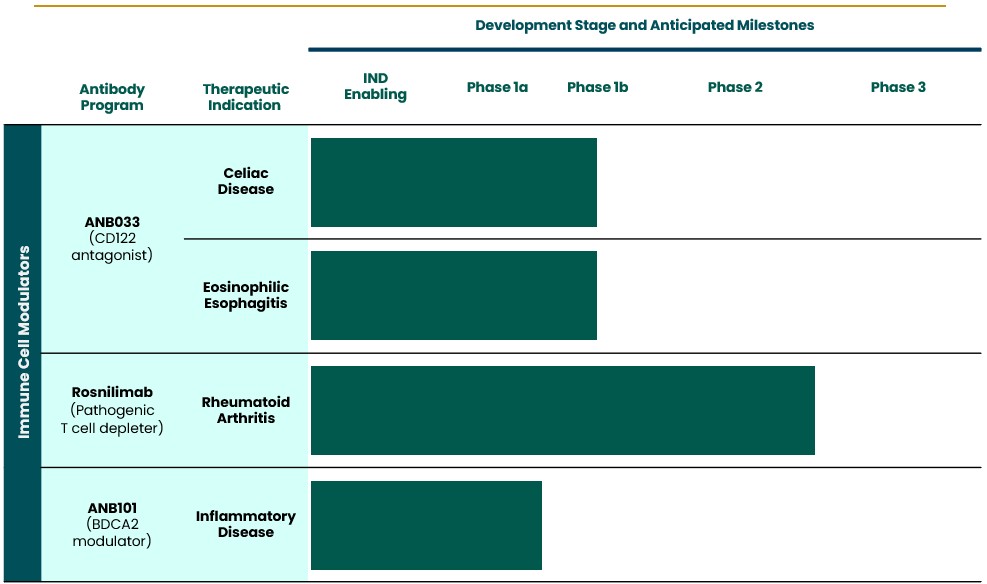
Components of Operating Results
Research and Development Expense
Research and development expenses consist of costs associated with our research and development activities, preclinical and clinical development of our programs, and manufacturing. Our research and development expenses include:
•External research and development expenses incurred under arrangements with third parties, such as contract research organizations (“CROs”), consultants, members of our scientific and therapeutic advisory boards, and contract manufacturing organizations (“CMOs”);
•Employee-related expenses, including salaries, benefits, travel, and stock-based compensation;
•Facilities, depreciation and other allocated expenses, which include direct and allocated expenses for rent and maintenance of facilities, depreciation of leasehold improvements and equipment, and laboratory supplies; and
•License and sub-license fees.
We may also incur in-process research and development expense as we acquire assets from other parties. Acquired in-process research and development costs that have no alternative future use are immediately expensed.
We expense research and development costs as incurred. We account for nonrefundable advance payments for goods and services that will be used in future research and development activities as expense when the service has been performed or when the goods have been received.
We are conducting research and development activities primarily on inflammation programs. We have a research and development team that conducts antibody characterization, translational studies, Investigational New Drug (“IND”)-enabling preclinical studies, and clinical development. We conduct some of our preclinical activities internally and plan to rely on third parties, such as CROs and CMOs, for the execution of certain of our research and development activities, such as in vivo toxicology and pharmacology studies, drug product manufacturing, and clinical trials.
We expect our research and development expenses to fluctuate for the foreseeable future as we continue to advance our product candidates.
General and Administrative Expense
General and administrative expenses consist primarily of salaries and related benefits, including stock-based compensation for our executive, finance, legal, business development, human resource, and support functions. Other general and administrative expenses include allocated facility-related costs not otherwise included in research and development expenses, travel expenses, transaction costs, and professional fees for auditing, tax, and legal services.
Interest Income
Interest income consists primarily of interest earned on our short-term and long-term investments and is recognized when earned.
Critical Accounting Policies and Use of Estimates
Our management’s discussion and analysis of our financial condition and results of operations are based on our financial statements, which have been prepared in accordance with U.S. GAAP. The preparation of these financial statements requires us to make judgments and estimates that affect the reported amounts of assets, liabilities, revenues, and expenses and the disclosure of contingent assets and liabilities in our financial statements. We base our estimates on historical experience, known trends and events, and various other factors that are believed to be reasonable under the circumstances. Actual results may differ from these estimates under different assumptions or conditions. On an ongoing basis, we evaluate our judgments and estimates in light of changes in circumstances, facts, and experience. We believe there have been no significant changes in our critical accounting policies as discussed in our Form 10 filed with the SEC on March 27, 2026.
JOBS Act Accounting Election and Smaller Reporting Company Status
We are an emerging growth company (“EGC”). The Jumpstart Our Business Startups Act (the “JOBS Act”) contains provisions that, among other things, reduce certain reporting requirements for an EGC. We have elected to use this extended transition period for complying with certain new or revised accounting standards that have different effective dates for public and private companies until the earlier of the date that we (i) are no longer an emerging growth company or (ii) affirmatively and irrevocably opt out of the extended transition period provided in the JOBS Act. As a result, our audited financial statements may not be comparable to companies that comply with the new or revised accounting pronouncements as of public company effective dates. Refer to Note 2 to
our financial statements included elsewhere in this Quarterly Report for additional information regarding new or revised accounting pronouncements.
We intend to rely on the other exemptions and reduced reporting requirements provided by the JOBS Act. Subject to certain conditions set forth in the JOBS Act, as an “emerging growth company” we are not required to, among other things, (i) provide an auditor’s attestation report on our system of internal control over financial reporting pursuant to Section 404 of the Sarbanes-Oxley Act; (ii) provide all of the compensation disclosure that may be required of non-emerging growth public companies; (iii) comply with certain types of new requirements adopted by the Public Company Accounting Oversight Board; and (iv) disclose certain executive compensation-related items, such as the correlation between executive compensation and performance and comparisons of the chief executive officer’s compensation to median employee compensation. We may remain an “emerging growth company” until the last day of the fiscal year following the fifth anniversary of the completion of the Spin-Off. However, if certain events occur prior to the end of such five-year period, including if we become a “large accelerated filer,” our annual gross revenue equals or exceeds $1.235 billion or we issue more than $1.0 billion of non-convertible debt in any three-year period, we will cease to be an “emerging growth company” prior to the end of such five-year period.
We are also a “smaller reporting company,” as defined by applicable rules of the SEC. We may continue to be a smaller reporting company even after we are no longer an emerging growth company. We intend to take advantage of certain of the scaled disclosures available to smaller reporting companies and will be able to take advantage of these scaled disclosures for so long as shares of our voting and non-voting common stock held by non-affiliates is less than $250.0 million measured on the last business day of our second fiscal quarter, or our annual revenue is less than $100.0 million during the most recently completed fiscal year and shares of our voting and non-voting common stock held by non-affiliates is less than $700.0 million measured on the last business day of our second fiscal quarter.
Results of Operations—Comparison of the Three and Six Months Ended June 30, 2026 and 2025
Research and Development Expenses
Research and development expenses were $25.6 million during the three months ended June 30, 2026 compared to $39.3 million during the three months ended June 30, 2025, a decrease of $13.7 million. The decrease is primarily attributable to a $11.1 million decrease in clinical and related expenses, and a $2.6 million decrease in salaries and related costs, including stock compensation expense.
Research and development expenses were $59.6 million during the six months ended June 30, 2026 compared to $80.7 million during the six months ended June 30, 2025, a decrease of $21.1 million. The decrease is primarily attributable to a $20.1 million decrease in clinical and related expenses, and a $1.0 million decrease in salaraies and related costs, including stock compensation.
We do not track fully burdened research and development costs separately for each of our product candidates. We review our research and development expenses by focusing on external development and internal development costs. External development expenses consist of costs associated with our external preclinical and clinical trials, including pharmaceutical development and manufacturing. Included in preclinical and other unallocated costs are external corporate overhead costs that are not specific to any one program. Internal costs consist of salaries and wages, stock-based compensation and benefits, which are not tracked by product candidate as several of our departments support multiple product candidate research and development programs. The following table summarizes the external costs attributable to each program and internal costs:
|
|
|
|
|
|
|
|
|
|
|
|
|
|
|
|
|
|
|
|
|
|
|
|
|
|
Three Months Ended
June 30, |
|
|
|
|
Six Months Ended
June 30, |
|
|
|
|
(in thousands) |
|
2026 |
|
|
2025 |
|
|
Increase/ (Decrease) |
|
2026 |
|
|
2025 |
|
|
Increase/ (Decrease) |
|
External Costs |
|
|
|
|
|
|
|
|
|
|
|
|
|
|
|
|
|
ANB033 |
|
$ |
8,837 |
|
|
$ |
3,926 |
|
|
$ |
4,911 |
|
$ |
18,136 |
|
|
$ |
7,729 |
|
|
$ |
10,407 |
|
Rosnilimab |
|
|
1,217 |
|
|
|
15,613 |
|
|
|
(14,396 |
) |
|
5,811 |
|
|
|
30,639 |
|
|
|
(24,828 |
) |
ANB101 |
|
|
687 |
|
|
|
2,040 |
|
|
|
(1,353 |
) |
|
2,171 |
|
|
|
3,521 |
|
|
|
(1,350 |
) |
ANB032 |
|
|
5 |
|
|
|
108 |
|
|
|
(103 |
) |
|
(26 |
) |
|
|
3,644 |
|
|
|
(3,670 |
) |
Preclinical and other unallocated costs |
|
|
4,451 |
|
|
|
4,456 |
|
|
|
(5 |
) |
|
7,747 |
|
|
|
8,388 |
|
|
|
(641 |
) |
Total External Costs |
|
$ |
15,197 |
|
|
$ |
26,143 |
|
|
$ |
(10,946 |
) |
$ |
33,839 |
|
|
$ |
53,921 |
|
|
$ |
(20,082 |
) |
Internal Costs |
|
|
|
|
|
|
|
|
|
|
|
|
|
|
|
|
|
Salaries and wages |
|
|
6,280 |
|
|
|
8,510 |
|
|
|
(2,230 |
) |
|
16,953 |
|
|
|
17,758 |
|
|
|
(805 |
) |
Stock compensation |
|
|
4,085 |
|
|
|
4,619 |
|
|
|
(534 |
) |
|
8,631 |
|
|
|
9,058 |
|
|
|
(427 |
) |
Other internal costs |
|
|
82 |
|
|
|
— |
|
|
|
82 |
|
|
176 |
|
|
|
— |
|
|
|
176 |
|
Total Internal Costs |
|
|
10,447 |
|
|
|
13,129 |
|
|
|
(2,682 |
) |
|
25,760 |
|
|
|
26,816 |
|
|
|
(1,056 |
) |
Total Costs |
|
$ |
25,644 |
|
|
$ |
39,272 |
|
|
$ |
(13,628 |
) |
$ |
59,599 |
|
|
$ |
80,737 |
|
|
$ |
(21,138 |
) |
General and Administrative Expenses
General and administrative expenses were $9.3 million during the three months ended June 30, 2026 compared to $6.6 million during the three months ended June 30, 2025, an increase of approximately $2.7 million. The increase is primarily due to a $2.0 million increase in personnel costs, an increase of $1.1 million in stock compensation expense, and a $1.0 million increase in legal expenses, offset by a $1.4 million decrease in other general and administrative expenses.
General and administrative expenses were $28.1 million during the six months ended June 30, 2026 compared to $16.4 million during the six months ended June 30, 2025, an increase of approximately $11.7 million. The increase is primarily due to a $2.6 million increase in personnel costs, an increase of $5.1 million in stock compensation expense, and a $5.0 million increase in legal expenses, offset by a $1.0 million decrease in other general and administrative expenses.
We expect that our general and administrative expenses may increase for the foreseeable future as we incur costs associated with stock compensation expense, legal, auditing and filing fees, additional insurance premiums, investor relations expenses and general compliance and consulting expenses.
Interest Income
Interest income was $1.6 million and $3.5 million during the three months ended June 30, 2026 and 2025, respectively, which primarily related to our short-term and long-term investments. The decrease in interest income is primarily due to the decrease in investment balances, as well as the timing of sales, maturities and purchases of our investments.
Interest income was $3.9 million and $7.6 million during the six months ended June 30, 2026 and 2025, respectively, which primarily related to our short-term and long-term investments. The decrease in interest income is primarily due to the decrease in investment balances, as well as the timing of sales, maturities and purchases of our investments.
Other Expense, Net
Other expense, net was less than $0.1 million during the three and six months ended June 30, 2026 and 2025, respectively.
Liquidity and Capital Resources
Our working capital requirements and capital expenditures have historically been satisfied as part of AnaptysBio’s corporate-wide cash management and centralized funding programs. This arrangement is not reflective of the manner in which we would have financed our operations had we been a standalone public company during the periods presented. Following the Spin-Off, we expect to incur significant expenses and operating losses for the foreseeable future as we continue the clinical development of our programs and our research activities. We have not yet commercialized any products and we do not expect to generate revenue from sales of products in the near future, if at all.
Private Placement
On March 26, 2026, First Tracks Biotherapeutics and EcoR1 Capital Fund Qualified, L.P. (“EcoR1”) entered into a securities purchase agreement (the “Purchase Agreement”) with certain third party investors (collectively, the “Selling Stockholders” and each, a “Selling Stockholder”), pursuant to which, following the closing of the Spin-Off, First Tracks Biotherapeutics issued and sold an aggregate 5,791,479 shares of First Tracks Biotherapeutics common stock (the “Primary Shares”), and EcoR1 sold an aggregate of 4,705,575 shares of First Tracks Biotherapeutics common stock (the “Secondary Shares”) that EcoR1 received in the to the Selling Stockholders, at a purchase price of $13.81 per share (the “Private Placement”). The aggregate gross proceeds to First Tracks Biotherapeutics from the sale of the Primary Shares was approximately $80 million, before deducting offering expenses. First Tracks Biotherapeutics did not receive any proceeds from the sale of the Secondary Shares.
Funding Requirements
We may seek to obtain additional financing in the future through equity or debt financings or through collaborations or partnerships with other companies. If we are unable to obtain additional financing on commercially reasonable terms, our business, financial condition and results of operations will be materially adversely affected.
Our primary uses of capital are, and we expect will continue to be, third-party clinical and preclinical research and development services, including manufacturing, laboratory and related supplies, compensation and related expenses, legal, patent and other regulatory expenses, and general overhead costs. We have entered into agreements with certain vendors for the provision of services, including services related to commercial manufacturing, that we are unable to terminate for convenience. Under such agreements, we are contractually obligated to make certain minimum payments to the vendors with the amounts to be based on the timing of the termination and the specific terms of the agreement.
Cash and cash equivalents totaled $168.0 million as of June 30, 2026, compared to $311.6 million as of December 31, 2025.
Based on our current plans, we believe that our existing cash, cash equivalents and investments will fund our current operating plan for at least the next 12 months from the issuance of our financial statements. We have based this estimate on assumptions that may prove to be wrong, and we could use our capital resources sooner than we expect and we may fail to complete development of one or more of our products. Additionally, the process of testing product candidates in clinical trials and seeking regulatory approval is costly, and the timing of progress and expenses in these trials is uncertain.
Cash Flows
The following table summarizes our cash flows for the six months ended June 30, 2026 and 2025:
|
|
|
|
|
|
|
|
|
|
|
Six Months Ended
June 30, |
|
(in thousands) |
|
2026 |
|
|
2025 |
|
Net cash provided by (used in): |
|
|
|
|
|
|
Operating activities |
|
$ |
(64,479 |
) |
|
$ |
(83,643 |
) |
Investing activities |
|
|
34,958 |
|
|
|
51,250 |
|
Financing activities |
|
|
(40,657 |
) |
|
|
(46,389 |
) |
Net decrease in cash and cash equivalents |
|
$ |
(70,178 |
) |
|
$ |
(78,782 |
) |
Operating Activities
Net cash used in operating activities during the six months ended June 30, 2026 of $64.5 million was primarily due to our net loss of $83.9 million, adjusted for addbacks for non-cash expenses of $20.3 million, which includes depreciation, stock-based compensation, amortization of operating right-of-use assets, income from marketable securities and net decreases in working capital of $0.9 million.
Net cash used in operating activities during the six months ended June 30, 2025 of $83.6 million was primarily due to our net loss of $89.6 million, adjusted for addbacks for non-cash expenses of $13.3 million, which includes depreciation, stock-based compensation, amortization of operating ROU assets, and income from marketable securities, and net decreases in working capital of $7.3 million.
Investing Activities
Cash provided by investing activities during the six months ended June 30, 2026 of $35.0 million, primarily relates to the sale and maturities of investments.
Cash provided by investing activities during the six months ended June 30, 2025 was $51.3 million, primarily due to the sale and maturities of investments of $228.1 million, offset by the acquisition of investments of $176.8 million.
Financing Activities
The net cash used in financing activities during the six months ended June 30, 2026 was $40.7 million, primarily due to the proceeds from our public offering and the separation from AnaptysBio offset by the net investment by AnaptysBio.
The net cash used in financing activities during the six months ended June 30, 2025 of $46.4 million was due to the net investment by AnaptysBio.
Contractual Obligations
We have entered into agreements with certain vendors for the provision of goods and services, which includes manufacturing services with contract manufacturing organizations and development services with contract research organizations. These agreements may include certain provisions for purchase obligations and termination obligations that could require payments for the cancellation of committed purchase obligations or for early termination of the agreements. The amount of the cancellation or termination payments vary and are based on the timing of the cancellation or termination and the specific terms of the agreement and therefore are cancellable contracts.
Item 3. Quantitative and Qualitative Disclosures About Market Risk.
As of June 30, 2026, there have been no material changes surrounding our market risk, including interest rate risk, inflation risk, and foreign currency exchange risk from the discussion provided in our amended Form 10 filed with the SEC on March 27, 2026.
Item 4. Controls and Procedures.
Evaluation of Disclosure Controls and Procedures
Our disclosure controls and procedures are designed to ensure that information required to be disclosed in the reports we file or submit under the Exchange Act is recorded, processed, summarized, and reported within the time periods specified in the Securities and Exchange Commission’s rules and forms and that such information is accumulated and communicated to our management, including the Chief Executive Officer and the Chief Financial Officer, to allow timely decisions regarding required disclosures. As of June 30, 2026, our management, with the participation of our Chief Executive Officer and Chief Financial Officer, performed an evaluation of the effectiveness of the design and operation of our disclosure controls and procedures as defined in Rules 13a-15(e) and 15d-15(e) of the Exchange Act. Based on this evaluation, our Chief Executive Officer and Chief Financial Officer concluded that the design and operation of our disclosure controls and procedures were effective at a reasonable assurance level.
Any controls and procedures, no matter how well designed and operated, can provide only reasonable assurance of achieving the desired control objective, and our management necessarily applies its judgment in evaluating the cost-benefit relationship of possible controls and procedures.
Changes in Internal Control over Financial Reporting
There were no changes in our internal control over financial reporting identified in connection with the evaluation required by Rules 13a-15(d) and 15d-15(d) of the Exchange Act that occurred during the quarter ended June 30, 2026 that have materially affected, or are reasonably likely to materially affect, our internal control over financial reporting.
PART II—OTHER INFORMATION
Item 1. Legal Proceedings.
From time to time, we may be involved in legal proceedings arising in the ordinary course of our business. We investigate these claims as they arise and accrue estimates for resolution of legal and other contingencies when losses are probable and estimable. Regardless of outcome, litigation can have an adverse impact on us due to defense and settlement costs, diversion of management resources, negative publicity and reputational harm, and other factors.
Item 1A. Risk Factors.
Investing in our common stock involves a high degree of risk. You should carefully consider the risks described below, as well as the other information in this Quarterly Report, including our financial statements and the related notes and “Management’s Discussion and Analysis of Financial Condition and Results of Operations,” before deciding whether to invest in our common stock. The occurrence of any of the events or developments described below could harm our business, financial condition, results of operations, and growth prospects. In such an event, the market price of our common stock could decline, and you may lose all or part of your investment.
Summary of Risk Factors
An investment in shares of our common stock involves various risks. Please carefully consider the matters discussed in the section titled “Risk Factors” of this Quarterly Report for a description of the principal risks that we face. These risks include, but are not limited to, the following:
•Our product candidates in development may fail or suffer delays that adversely affect their commercial viability. Results from our initial clinical trials may not be representative of the results we will experience in later clinical trials. If we or any future collaborators are unable to complete development of or commercialize our product candidates or experience significant delays in doing so, our business will be materially harmed.
•Our ongoing and planned clinical trials, or those of any future collaborators, may reveal significant adverse events, toxicities or other side effects and may result in a safety profile that could inhibit regulatory approval or market acceptance of any of our product candidates.
•We and any future collaborators may be unable to obtain, or may be delayed in obtaining, required regulatory approvals in the United States or in foreign jurisdictions, which would materially impair our ability to commercialize and generate revenue from our product candidates.
•Even if our product candidates receive regulatory approval, they will be subject to significant post-marketing regulatory requirements.
•We may not be successful in our efforts to expand our pipeline of product candidates and develop marketable products.
•We have no history of commercializing biotechnology products, which may make it difficult to evaluate the prospects for our future viability.
•We face significant competition, and if our competitors develop and market products that are more effective, safer or less expensive than our product candidates, our commercial opportunities will be negatively impacted.
•Our product candidates may not achieve adequate market acceptance among physicians, patients, health care payors and others in the medical community necessary for commercial success.
•We currently have no marketing and sales force. If we are unable to establish effective sales or marketing capabilities or enter into agreements with third parties to sell or market our product candidates, we may not be able to effectively sell or market our product candidates, if approved, or generate product revenue.
•The manufacture of biologics is complex, and our third-party manufacturers may encounter difficulties in production. If any of our third-party manufacturers encounter such difficulties, our ability to provide supply of our product candidates
for clinical trials, our ability to obtain marketing approval, or our ability to provide supply of our products for patients, if approved, could be delayed or stopped.
•Political, economic or public health events may have a material impact on the U.S. and global economies and could have a material adverse impact on our employees, contractors and patients, which could adversely and materially impact our business, financial condition and results of operations.
•We have no operating revenue and a history of operational losses and may not achieve or sustain profitability.
•We have no products approved for commercial sale, and to date we have not generated any revenue or profit from sales of our product candidates.
•We will require additional capital to finance our operations, which may not be available to us on acceptable terms, or at all. As a result, we may not complete the development and commercialization of our product candidates or develop new product candidates.
•We may not succeed in establishing and maintaining additional development and commercialization collaborations, which could adversely affect our ability to develop and commercialize product candidates, including for rosnilimab in RA or other indications.
•If we are unable to obtain or protect intellectual property rights in the U.S. and throughout the world, we may not be able to compete effectively in our market.
•We must attract and retain highly skilled employees in order to succeed.
•We may be unable to achieve some or all of the benefits that we expect to achieve from the Spin-Off.
•Our share price may fluctuate significantly, and you could lose all or part of your investment.
•We have no recent history of operating as a standalone public company, and our historical financial information may not necessarily reflect the results that we would have achieved as a standalone public company or what our results may be in the future.
•We share some of our directors and executive officers with AnaptysBio. This overlap may give rise to certain conflicts of interest.
Risks Related to Discovery and Development of Our Product Candidates
Our product candidates in development may fail or suffer delays that adversely affect their commercial viability. Results from our initial clinical trials may not be representative of the results we will experience in later clinical trials. If we or any future collaborators are unable to complete development of or commercialize our product candidates or experience significant delays in doing so, our business will be materially harmed.
We are developing therapeutic antibodies, including our wholly owned product candidates. However, all of our wholly owned product candidates are in various stages of development, and, for a wide variety of reasons discussed below, may fail in development or suffer delays that adversely affect their commercial viability.
A product candidate can unexpectedly fail at any stage of preclinical and clinical development. The historical failure rate for product candidates is high due to scientific feasibility, safety, efficacy, changing standards of medical care, and other variables. The results from preclinical testing or early clinical trials of a product candidate may not predict the results that will be obtained in later phase clinical trials of the product candidate.
Furthermore, we may conduct clinical trials of a product candidate in multiple indications based on assumptions about the product candidate’s mechanism of action. However, it is possible that our assumptions regarding the effectiveness of a product candidate’s mechanism of action may be incorrect and that the product candidate may be ineffective in certain diseases or disorders. If this were the case, then the results from any clinical trials of a product candidate that we conduct are less likely to be positive. For example, even though we showed positive data for rosnilimab in our Phase 2b clinical trial in rheumatoid arthritis, data from rosnilimab’s Phase 2 clinical trial in ulcerative colitis was not positive.
If our other ongoing or future clinical trials of any of our product candidates, including ANB033, rosnilimab or ANB101, are unsuccessful, whether for one of the reasons mentioned above or otherwise, our product candidates may be delayed in development or fail entirely, which would have a material adverse impact on our business.
The success of our current product candidates, and any other product candidates we may develop in the future, will depend on many factors, including the following:
•obtaining regulatory permission to initiate clinical trials;
•successful enrollment of patients in, and the completion of, our planned clinical trials;
•receiving marketing approvals from applicable regulatory authorities;
•establishing commercial manufacturing capabilities and/or making arrangements with third-party manufacturers;
•obtaining and maintaining patent and trade secret protection and non-patent exclusivity for our product candidates and their components;
•enforcing and defending intellectual property rights and claims;
•achieving desirable therapeutic properties for our product candidates’ intended indications;
•launching commercial sales of our product candidates, if and when approved, whether alone or in collaboration with third parties;
•acceptance of our product candidates, if and when approved, by patients, the medical community and third-party payors;
•effectively competing with other therapies; and
•maintaining an acceptable safety profile of our product candidates through clinical trials and following regulatory approval.
If we do not achieve one or more of these factors in a timely manner or at all, we could experience significant delays or an inability to successfully commercialize our product candidates, which would harm our business.
Furthermore, delays or difficulties in patient enrollment or difficulties in retaining trial participants can result in increased costs, longer development times, or termination of a clinical trial. Clinical trials of a new product candidate require the enrollment of a sufficient number of patients, including patients who are suffering from the disease the product candidate is intended to treat and who meet other eligibility criteria. Rates of patient enrollment are affected by many factors, including the size of the patient population, the eligibility criteria for the clinical trial, the age and condition of the patients, the stage and severity of disease, the nature of the protocol, the proximity of patients to clinical sites, and the availability of effective treatments for the relevant disease. We may not be able to initiate our planned clinical trials if we are unable to locate and enroll a sufficient number of eligible patients to participate in these trials as required by the FDA or foreign regulatory authorities.
Our ongoing and planned clinical trials or those of any future collaborators may reveal significant adverse events, toxicities or other side effects and may result in a safety profile that could inhibit regulatory approval or market acceptance of any of our product candidates.
In order to obtain marketing approval for any of our product candidates, we must demonstrate the safety and efficacy of the product candidate for the relevant clinical indication or indications through preclinical studies and clinical trials as well as additional supporting data. If our product candidates are associated with undesirable side effects in preclinical studies or clinical trials or have characteristics that are unexpected, we may need to interrupt, delay or abandon their development or limit development to more
narrow uses or subpopulations in which the undesirable side effects or other characteristics are less prevalent, less severe or more acceptable from a risk-benefit perspective.
It is not uncommon to observe results in human clinical trials that are unexpected based on preclinical testing, or to observe results in later stage clinical trials that are unexpected based on early clinical trials. Many product candidates fail in clinical trials despite promising preclinical and early clinical results. In addition, top-line results of a clinical trial, which generally reflect preliminary reviews of primary efficacy and/or safety results, do not necessarily predict final results, and any top-line findings or assessments are subject to change pending the completion of final data review procedures. Moreover, preclinical and clinical data are often susceptible to varying interpretations and analyses, and many companies that believed their product candidates performed satisfactorily in preclinical studies and clinical trials have nonetheless failed to obtain marketing approval for their products.
Some patients in our clinical trials have experienced adverse events, including SAEs. Subjects in our ongoing and planned clinical trials may in the future suffer significant adverse events or other side effects not observed in our preclinical studies or in our Phase 1, Phase 2 or Phase 3 clinical trials. The observed potency and kinetics of our product candidates in preclinical studies may not be observed in human clinical trials. We have tested the dosing frequency and route of administration of our product candidates in preclinical studies, which will inform our dosing strategy for future clinical trials, however such dose and route of administration may not result in sufficient exposure or pharmacological effect in humans and may lead to unforeseen toxicity not previously observed in preclinical testing. If preclinical studies of our product candidates fail to provide preliminary evidence of safety to the satisfaction of regulatory authorities or do not otherwise produce satisfactory results, we may incur additional costs or experience delays in initiating and/or advancing the development and commercialization of our product candidates. Further, if clinical trials of our product candidates fail to demonstrate safety and efficacy to the satisfaction of regulatory authorities or do not otherwise produce positive results, we or any future collaborators may incur additional costs or experience delays in completing, or ultimately be unable to complete, the development and commercialization of our product candidates.
If further significant adverse events or other side effects are observed in any of our current or future clinical trials, we may have difficulty recruiting patients to the clinical trial, patients may drop out of our trial, or we may be required to abandon the trial or our development efforts of that product candidate altogether. We, the FDA, or other applicable regulatory authorities, or an institutional review board or ethics committee, may suspend clinical trials of a product candidate at any time for various reasons, including a belief that subjects in such clinical trials are being exposed to unacceptable health risks or adverse side effects. Some potential therapeutics developed in the biotechnology industry that initially showed therapeutic promise in early-stage studies have later been found to cause side effects that prevented their further development. Even if the side effects do not preclude a product candidate from obtaining or maintaining marketing approval, undesirable side effects may inhibit market acceptance of the approved product due to its tolerability versus other therapies. Any of these developments could materially harm our business, financial condition and prospects.
Further, if any of our product candidates obtain marketing approval, toxicities associated with our product candidates may also develop after such approval and lead to a requirement to conduct additional clinical safety trials, additional warnings being added to the labeling, significant restrictions on the use of the product or the withdrawal of the product from the market. We cannot predict whether our product candidates will cause toxicities in humans that would preclude or lead to the revocation of regulatory approval based on preclinical studies or early-stage clinical testing.
We and/or any future collaborators may be unable to obtain, or may be delayed in obtaining, required regulatory approvals in the United States or in foreign jurisdictions, which would materially impair our ability to commercialize and generate revenue from our product candidates.
Our ability to continue to develop our product candidates, and to have the potential to achieve and sustain profitability, depends on the FDA and foreign regulatory authorities permitting us to conduct human clinical trials and, if our product candidates are safe and effective, obtaining approval from the FDA and foreign regulatory authorities to market them and subsequently successfully commercializing them, either alone or with any future collaborators. The research, testing, manufacturing, labeling, approval, selling, marketing and distribution of drug and biologic products are subject to extensive regulation by the FDA and foreign regulatory authorities. Before commencing clinical trials in the United States for any product candidate, we must submit an IND to the FDA; foreign regulatory authorities enforce similar requirements for initiation of clinical trials in other countries. An IND or foreign equivalent requires extensive preclinical studies, and there is no guarantee that the FDA or foreign regulatory authorities will allow clinical trials to proceed based on the IND or equivalent submission. For example, although we have initiated toxicology studies for our product candidates, the FDA in the United States, or other foreign regulatory authorities, as applicable, may not allow our clinical trials to proceed in the regulatory authority’s jurisdiction if we are unable to show safety margins acceptable to the particular regulatory authority in appropriate animal species in our preclinical toxicology studies.
Even if we or any future collaborators initiate and complete clinical trials for our product candidates, these product candidates will not be permitted to be marketed in the United States until approval of a Biologics License Application (“BLA”) from the FDA is
received, and will not be permitted to be marketed in other countries without marketing approval from foreign regulatory authorities. Obtaining approval of a BLA or other marketing approvals is often a lengthy, expensive and uncertain process over which the FDA and foreign regulatory authorities have substantial discretion. Other than submitting and receiving acceptance for initiation of our previous and current clinical trials in the United States and certain foreign jurisdictions, we have had only limited discussions with the FDA and no discussions with foreign regulatory authorities regarding the development plans for any of our product candidates or the designs of any of our later-stage clinical studies. We thus may not have the full benefit of the FDA’s or foreign regulatory authorities’ current thinking on clinical trial designs or product development for our target indications.
Preclinical studies and clinical trials are expensive, difficult to design and implement, can take many years to complete, and are uncertain as to outcome. Product candidates, on average, take 10 to 15 years to be developed from the time they are discovered to the time they are approved and available for treating patients. The start or end of a clinical trial is often delayed or halted for many reasons, including:
•imposition of a clinical hold for safety reasons or following an inspection of clinical trial operations or site by the FDA or other regulatory authorities;
•manufacturing challenges;
•insufficient supply or quality of product candidates or other materials necessary to conduct clinical trials;
•delays in reaching or failure to reach agreement on acceptable clinical trial contracts or clinical trial protocols with prospective trial sites and CROs or failure by such CROs or trials sites to carry out the clinical trial in accordance with our agreed-upon terms;
•non-clinical or clinical sites becoming unavailable due to political, economic, or public health events;
•clinical sites electing to terminate their participation in one of our clinical trials;
•inability or unwillingness of patients or medical investigators to follow clinical trial protocols;
•required clinical trial administrative actions;
•slower than anticipated patient enrollment;
•changing standards of care;
•availability or prevalence of use of a comparative drug or required prior therapy; or
•clinical outcomes or financial constraints.
Our product candidates may not be effective, may be only moderately effective, or may prove to have undesirable or unintended side effects, toxicities or other characteristics that may preclude our obtaining marketing approval or prevent or limit commercial use. Regulatory authorities may refuse to accept any application or may decide that our data are insufficient for approval and require additional preclinical or other studies or clinical trials. In addition, varying interpretations of the data obtained from preclinical and clinical testing could delay, limit or prevent marketing approval of a product candidate. Moreover, regulatory authorities may determine that the clinical and other benefits of a product candidate do not outweigh the safety or other risks. Changes in marketing approval policies during the development period, changes in or the enactment of additional statutes or regulations, or changes in regulatory review for each submitted product application may also cause delays in or prevent the approval of an application.
If we or any future collaborators experience any of the issues described above, or other similar or related issues, we or any future collaborators may:
•be delayed in obtaining marketing approval for our product candidates;
•not obtain marketing approval at all;
•obtain marketing approval in some countries and not in others;
•obtain approval for indications or patient populations that are not as broad as intended or desired;
•obtain approval with labeling that includes significant use or distribution restrictions or safety warnings, including boxed warnings;
•be subject to additional post-marketing testing requirements; or
•have the product removed from the market after obtaining marketing approval.
Further, in June 2024, the U.S. Supreme Court reversed its longstanding approach under the Chevron doctrine, which provided for judicial deference to regulatory agencies, including the FDA. As a result of this decision, we cannot be sure whether there will be increased challenges to existing agency regulations or how lower courts will apply the decision in the context of other regulatory schemes without more specific guidance from the U.S. Supreme Court. For example, this decision may result in more companies bringing lawsuits against the FDA to challenge longstanding decisions and policies of the FDA, which could undermine the FDA’s authority, lead to uncertainties in the industry, and disrupt the FDA’s normal operations, which could impact the timely review of any regulatory filings or applications we submit to the FDA.
Even if our product candidates receive regulatory approval, they will be subject to significant post-marketing regulatory requirements.
Any regulatory approvals that we or any future collaborators may receive for our product candidates will require surveillance to monitor the safety and efficacy of the product candidate, may contain significant limitations related to use restrictions for specified age groups, warnings, precautions or contraindications, and may include burdensome post-approval study or risk management requirements. For example, the FDA may require a risk evaluation and mitigation strategy in order to approve our product candidates, which could entail requirements for a medication guide, physician communication plans or additional elements to ensure safe use, such as restricted distribution methods, patient registries and other risk minimization tools. In addition, if the FDA or foreign regulatory authorities approve our product candidates, the manufacturing processes, labeling, packaging, distribution, adverse event reporting, storage, advertising, promotion, import, export and recordkeeping for our product candidates will be subject to extensive and ongoing regulatory requirements. These requirements include submissions of safety and other post-marketing information and reports, registration, as well as continued compliance with Current Good Manufacturing Practices (“cGMP”) regulations and good clinical practices for any clinical trials that we conduct post-approval. In addition, manufacturers of drug products and their facilities are subject to continual review and periodic inspections by the FDA and other regulatory authorities for compliance with cGMP regulations and standards. If we, any future collaborators or a regulatory agency discover previously unknown problems with a product, such as adverse events of unanticipated severity or frequency, or problems with the facilities where the product is manufactured, a regulatory agency may impose restrictions on that product, the manufacturing facility or us or any future collaborators, including requiring recall or withdrawal of the product from the market or suspension of manufacturing. In addition, failure to comply with FDA and foreign regulatory requirements may, either before or after product approval, if any, subject our company or any future collaborators to administrative or judicially imposed sanctions, including:
•restrictions on our ability to conduct clinical trials, including full or partial clinical holds on ongoing or planned trials;
•restrictions on the products, manufacturers or manufacturing process;
•warning or untitled letters;
•civil and criminal penalties;
•suspension or withdrawal of regulatory approvals;
•product seizures, detentions or import bans;
•voluntary or mandatory product recalls and publicity requirements;
•total or partial suspension of production;
•imposition of restrictions on operations, including costly new manufacturing requirements; and
•refusal to approve pending BLAs or supplements to approved BLAs.
The occurrence of any event or penalty described above may inhibit our ability, alone or with any future collaborators, to commercialize our product candidates and generate revenue.
Advertising and promotion of any product candidate that obtains approval in the United States will be heavily scrutinized by the FDA, the U.S. Department of Justice (“DOJ”), the U.S. Department of Health and Human Services (“HHS”) Office of Inspector General, state attorneys general, members of Congress and the public. Violations, including promotion of our products for unapproved (or off-label) uses, are subject to enforcement letters, inquiries and investigations, and civil and criminal sanctions by the government. Additionally, comparable foreign regulatory authorities will heavily scrutinize advertising and promotion of any product candidate that obtains approval outside of the United States.
In the United States, engaging in the impermissible promotion of our products for off-label uses can also subject us to false claims litigation under federal and state statutes, which can lead to civil and criminal penalties and fines and agreements that materially restrict the manner in which a company promotes or distributes drug products. These false claims statutes include the federal False Claims Act, which allows any individual to bring a lawsuit against a biotechnology company on behalf of the federal government alleging submission of false or fraudulent claims, or causing to present such false or fraudulent claims, for payment by a federal program such as Medicare or Medicaid. If the government prevails in the lawsuit, the individual will share in any fines or settlement funds. Such False Claims Act lawsuits against biotechnology companies have increased significantly in volume and breadth, leading to several substantial civil and criminal settlements regarding certain sales practices promoting off-label drug uses involving fines in excess of $1.0 billion. This growth in litigation has increased the risk that a biotechnology company will have to defend a false claim action, pay settlement fines or restitution, agree to comply with burdensome reporting and compliance obligations, and be excluded from Medicare, Medicaid and other federal and state health care programs. In addition, we may incur liability from claims initiated under the Lanham Act or other federal and state unfair competition laws with respect to how our products are marketed and promoted. Furthermore, the off-label use of our products may increase the risk of product liability claims. If we do not lawfully promote our approved products, we may become subject to such litigation and, if we do not successfully defend against such actions, those actions may have an adverse effect on our business, financial condition and results of operations.
We may not be successful in our efforts to expand our pipeline of product candidates and develop marketable products.
Because we have limited financial and managerial resources, our business depends on our successful development and commercialization of the limited number of internal product candidates we have in preclinical and clinical development. Even if we are successful in continuing to build our pipeline, development of the potential product candidates that we identify will require substantial investment in additional clinical development, management of clinical, preclinical and manufacturing activities, regulatory approval in multiple jurisdictions, building a commercial organization, and significant marketing efforts before we generate any revenue from product sales. Furthermore, such product candidates may not be suitable for clinical development, including as a result of their harmful side effects, limited efficacy or other characteristics that indicate that they are unlikely to be products that will receive marketing approval and achieve market acceptance. If we cannot successfully develop, partner and/or commercialize product candidates, we may not be able to obtain product or partnership revenue in future periods, which would adversely affect our business, prospects, financial condition and results of operations.
As a result of our current focus on our lead product candidates, we may forego or delay pursuit of opportunities with other product candidates or for other indications that later prove to have greater commercial potential. Our resource allocation decisions may cause us to fail to capitalize on viable commercial products or profitable market opportunities. Our spending on current and future research and development programs and product candidates for specific indications may not yield any commercially viable products. Our understanding and evaluation of biological targets for the discovery and development of new product candidates may fail to identify challenges encountered in subsequent preclinical and clinical development. If we do not accurately evaluate the commercial potential or target market for a particular product candidate, we may relinquish valuable rights to that product candidate through collaboration, licensing or other royalty arrangements in cases in which it would have been more advantageous for us to retain sole development and commercialization rights.
We have no history of commercializing biotechnology products, which may make it difficult to evaluate the prospects for our future viability.
Our operations to date have been largely limited to financing and staffing our company, and developing our wholly owned product candidates. We have only very limited experience conducting pivotal Phase 3 clinical trials and have not had previous experience commercializing product candidates, including submitting a BLA to the FDA. In part because of this lack of experience,
we cannot be certain that planned clinical trials will begin or be completed on time, if at all, that our planned development programs would be acceptable to the FDA or other regulatory authorities, or that, if approval is obtained, such product candidates can be successfully commercialized. Clinical trials and commercializing our wholly owned product candidates will require significant additional financial and management resources, and reliance on third-party clinical investigators, CROs, consultants or collaborators. Relying on third-party clinical investigators, third-party manufacturing, CROs or collaborators may result in delays that are outside of our control.
Furthermore, we may not have the financial resources to continue development of, or to enter into collaborations for, a product candidate if we experience any problems or other unforeseen events that delay or prevent regulatory approval of, or our ability to commercialize, product candidates, including:
•negative or inconclusive results from our clinical trials or the clinical trials of others for product candidates similar to ours, leading to a decision or requirement to conduct additional preclinical testing or clinical trials or abandon a program;
•a suspension or termination of a clinical trial once commenced;
•conditions imposed by the FDA or foreign regulatory authorities regarding the number, scope or design of our clinical trials;
•delays in enrolling research subjects in clinical trials;
•high drop-out rates of research subjects;
•inadequate supply or quality of clinical trial materials or other supplies necessary for the conduct of our clinical trials;
•greater than anticipated clinical trial costs;
•poor effectiveness of our product candidates during clinical trials;
•unfavorable FDA or other regulatory agency inspection and review of a clinical trial site;
•failure of our third-party contractors or investigators to comply with regulatory requirements or otherwise meet their contractual obligations in a timely manner, or at all;
•serious and unexpected, or otherwise unacceptable, drug-related side effects experienced by participants in our planned clinical trials or by individuals using drugs similar to our product candidates;
•delays and changes in regulatory requirements, policy and guidelines, including the imposition of additional regulatory oversight around clinical testing generally or with respect to our technology in particular; or
•varying interpretations of data by the FDA and foreign regulatory authorities.
Consequently, any predictions you make about our future success or viability based on our operating history may not be as accurate as they could be if we had an established track record in conducting clinical trials or commercializing products.
Further, as a clinical-stage business, we may encounter unforeseen expenses, difficulties, complications, delays, and other known and unknown factors. We will need to transition from a company with a research and development focus to a company capable of supporting commercial activities. We may not be successful in such a transition.
We face significant competition, and if our competitors develop and market products that are more effective, safer or less expensive than our product candidates, our commercial opportunities will be negatively impacted.
The biotechnology industry is highly competitive and subject to rapid and significant technological change. Products we may develop in the future are also likely to face competition from other drugs and therapies, some of which we may not currently be aware of. We have competitors both in the United States and internationally, including major multinational pharmaceutical and biotechnology companies, established biotechnology companies, specialty biotechnology companies, emerging and start-up companies, universities and other research institutions. Many of our competitors have significantly greater financial, manufacturing, marketing, drug development, technical and human resources and commercial expertise than we do. Large pharmaceutical and
biotechnology companies, in particular, have extensive experience in clinical testing, obtaining regulatory approvals, recruiting patients and manufacturing biotechnology products. These companies also have significantly greater research and marketing capabilities than we do and may also have products that have been approved or are in late stages of development and collaborative arrangements in our target markets with leading companies and research institutions. Established pharmaceutical and biotechnology companies may also invest heavily to accelerate discovery and development of novel compounds or to in-license novel compounds that could make the product candidates that we develop obsolete. As a result of all of these factors, our competitors may succeed in obtaining patent protection and/or approval from the FDA or foreign regulatory authorities or discovering, developing and commercializing products in our field before we do.
For our anti-CD122 antagonist antibody program, our clinical competitors include an anti-CD122 antagonist antibody, FB-102 (Forte Bioscience, acquisition by Argenyx BV expected to close in Q3 2026) in Phase 2a development for the treatment of CeD, Phase 1b development for the treatment of vitiligo, and Phase 1b development for the treatment of alopecia areata, and three anti-IL-15 monoclonal antibodies, GIA632 (Novartis) in Phase 2 development for atopic dermatitis, Phase 2 development for vitiligo, and with proof-of-concept, Phase 1b data for the treatment of CeD and EoE, TEV-53408 (Teva), in Phase 2 development for the treatment of CeD and vitiligo. To date, there are no FDA-approved therapies for the treatment of celiac disease and only one FDA-approved biologic, Dupixent, for the treatment of EoE.
For rosnilimab, our competitors include non-depleting PD-1 agonist antibodies, GS-0151 (Gilead) in Phase 1b development for the treatment of rheumatoid arthritis, and S-4321 (Seismic Therapeutics) in Phase 1 development. Our commercial-stage competitors in moderate-to-severe rheumatoid arthritis include monoclonal antibodies targeting anti-TNF (Humira; AbbVie), IL-6 (Actemra; Roche and Kevzara; Regeneron), CD-80/86 (Orencia; BMS), CD-20 (Rituxan; Roche), and Janus kinase inhibitors (Rinvoq; AbbVie, Olumiant; Eli Lilly, and Xeljanz; Pfizer).
For our anti-BDCA2 program, our competitors include another anti-BDCA2 antibody, litifilimab (Biogen) in Phase 3 development for SLE and cutaneous lupus erythematosus, and a bispecific fusion protein targeting BDCA2 and BAFF/APRIL, DNTH212 (Dianthus Therapeutics) in Phase 1 development, and an anti-ILT7 antibody, daxdilimab (Amgen) in Phase 2 development.
Our commercial opportunity could be reduced or eliminated if our competitors develop and commercialize products that are safer, more effective, have fewer or less severe effects, are more convenient, are less expensive or capture significant market share prior to or during our commercialization. Our competitors also may obtain FDA or other regulatory approval for their products more rapidly than we may obtain approval for ours, which could result in our competitors establishing a strong market position before we are able to enter the market. In addition, our ability to compete may be affected in many cases by insurers or other third-party payors seeking to encourage the use of biosimilar products. Even if our product candidates achieve marketing approval, they may be priced at a significant premium over competitive biosimilar products if any have been approved by then.
Smaller and other early-stage companies may also prove to be significant competitors, particularly through collaborative arrangements with large and established companies. These companies compete with us in recruiting and retaining qualified scientific and management personnel, establishing clinical trial sites and patient registration for planned clinical trials and acquiring technologies complementary to, or necessary for, our programs. In addition, the biotechnology industry is characterized by rapid technological change. If we fail to stay at the forefront of technological change, we may be unable to compete effectively. Technological advances or products developed by our competitors may render our technologies or product candidates obsolete, less competitive or not economical.
Our product candidates may not achieve adequate market acceptance among physicians, patients, health care payors and others in the medical community necessary for commercial success.
Even if our product candidates receive regulatory approval, they may not gain adequate market acceptance among physicians, patients, health care payors and others in the medical community. The degree of market acceptance of any of our approved product candidates will depend on a number of factors, including:
•the efficacy and safety profile as demonstrated in planned clinical trials;
•the timing of market introduction of the product candidate as well as competitive products;
•the clinical indications for which the product candidate is approved;
•restrictions on the use of our products, if approved, such as boxed warnings or contraindications in labeling or REMS, if any, which may not be required of alternative treatments and competitor products;
•acceptance of the product candidate as a safe and effective treatment by physicians, clinics and patients; the potential and perceived advantages of product candidates over alternative treatments, including any similar generic treatments;
•the cost of treatment in relation to alternative treatments;
•the availability of coverage and adequate reimbursement and pricing by third parties and government authorities;
•relative convenience and ease of administration;
•the frequency and severity of adverse events;
•the effectiveness of sales and marketing efforts; and
•unfavorable publicity relating to the product candidate.
If any product candidate is approved but does not achieve an adequate level of acceptance by physicians, hospitals, health care payors and patients, we may not generate or derive sufficient revenue from that product candidate and may not become or remain profitable.
We currently have no marketing and sales force. If we are unable to establish effective sales or marketing capabilities or enter into agreements with third parties to sell or market our product candidates, we may not be able to effectively sell or market our product candidates, if approved, or generate product revenue.
We currently do not have a marketing or sales team for the marketing, sales and distribution of any of our product candidates that are able to obtain regulatory approval. In order to commercialize any product candidates, we must build on a territory-by-territory basis marketing, sales, distribution, managerial and other non-technical capabilities or make arrangements with third parties to perform these services, and we may not be successful in doing so. If our product candidates receive regulatory approval, we may decide to establish an internal sales or marketing team with technical expertise and supporting distribution capabilities to commercialize our product candidates, which will be expensive and time-consuming and will require significant attention of our management team to manage. Any failure or delay in the development of our internal sales, marketing and distribution capabilities would adversely impact the commercialization of any of our product candidates that we obtain approval to market. With respect to the commercialization of all or certain of our product candidates, we may choose to collaborate, either globally or on a territory-by-territory basis, with third parties that have direct sales forces and established distribution systems, either to augment our own sales force and distribution systems or in lieu of our own sales force and distribution systems. If we are unable to enter into such arrangements when needed on acceptable terms, or at all, we may not be able to successfully commercialize any of our product candidates that receive regulatory approval, or any such commercialization may experience delays or limitations. If we are not successful in commercializing our product candidates, either on our own or through collaborations with one or more third parties, our future product revenue will suffer and we may incur significant additional losses.
The manufacture of biologics is complex, and our third-party manufacturers may encounter difficulties in production. If any of our third-party manufacturers encounter such difficulties, our ability to provide supply of our product candidates for clinical trials, our ability to obtain marketing approval, or our ability to provide supply of our products for patients, if approved, could be delayed or stopped.
The process of manufacturing biologics is complex, highly regulated and subject to multiple risks, and requires significant expertise and capital investment, including the development of advanced manufacturing techniques and process controls. Manufacturing biologics is highly susceptible to product loss due to contamination, equipment failure, improper installation or operation of equipment, vendor or operator error, inconsistency in yields, variability in product characteristics and difficulties in scaling the production process. Even minor deviations from normal manufacturing processes could result in reduced production yields, product defects and other supply or supply chain disruptions. If microbial, viral or other contaminations are discovered at the facilities of our manufacturer, such facilities may need to be closed for an extended period of time to investigate and remedy the contamination, which could delay clinical trials and adversely harm our business. We rely, and expect to continue to rely, on third parties, including manufacturers based in China, for the manufacture of our product candidates and future product candidates. We and our contract manufacturers must comply with cGMP for the manufacturing of biologics used in clinical trials and, if approved, marketed products. Moreover, if the FDA determines that our manufacturer is not in compliance with FDA laws and regulations, including cGMP, the FDA may deny BLA approval until the deficiencies are corrected or we replace the manufacturer in our BLA with a manufacturer that is in compliance.
Furthermore, all of our therapeutic antibodies are manufactured by starting with cells which are stored in a cell bank. We have one master cell bank for each antibody manufactured in accordance with cGMP and create working cell banks to support cGMP
manufacturing, and believe we would have adequate backup should any cell bank be lost in a catastrophic event. However, it is possible that we could lose multiple cell banks and have our manufacturing severely impacted by the need to replace the cell banks.
Scaling up a biologic manufacturing process is a difficult and uncertain task, and we may not be successful in transferring our production system or the manufacturer may not have the necessary capabilities to complete the implementation and development process. If we are unable to adequately validate or scale-up the manufacturing process with our current manufacturers, we will need to transfer to other manufacturers and complete the manufacturing validation process, which can be lengthy and costly. Even if we are able to adequately validate and scale-up the manufacturing process for our product candidates with contract manufacturers, we will still need to negotiate with such contract manufacturers agreements for commercial supply, and it is not certain we will be able to come to agreement on terms acceptable to us. Accordingly, failures or difficulties faced at any level of our manufacturing process could adversely affect our business and delay or impede the development and commercialization of our product candidates or products and could have an adverse effect on our business, prospects, financial condition and results of operations.
In addition, there are risks associated with large scale manufacturing for clinical trials or commercial scale including, among others, cost overruns, potential problems with process scale-up, process reproducibility, stability issues, compliance with good manufacturing practices, lot consistency and timely availability of raw materials. Even if we or any future collaborators obtain regulatory approval for any of our product candidates, there is no assurance that manufacturers will be able to manufacture the approved product to specifications acceptable to the FDA or other regulatory authorities, to produce it in sufficient quantities to meet the requirements for the potential launch of the product or to meet potential future demand. Moreover, we source certain of the raw materials needed for our product candidates from outside the United States. Although we have not experienced any material supply interruptions to date, it is possible that political, economic or public health events could cause such interruptions in the future. Further, legislation has been introduced in Congress to limit certain U.S. biotechnology companies from using equipment or services produced or provided by select Chinese biotechnology companies, although such legislation has not yet advanced. We cannot predict what actions may ultimately be taken with respect to trade relations between the United States and China or other countries, what products and services may be subject to such actions or what actions may be taken by the other countries in retaliation. Any unfavorable government policies on international trade, such as export controls, capital controls or tariffs, new legislation or regulations, renegotiation of existing trade agreements, or any retaliatory trade actions due to recent or future trade tension, may impede, delay, limit, or increase the cost of manufacturing our product candidates. Such events could result in our clinical or commercial supply of drug, packaging and other services being interrupted or limited, which could harm our business. If our manufacturers are unable to produce sufficient quantities for clinical trials or for commercialization, commercialization efforts would be impaired, which would have an adverse effect on our business, financial condition, results of operations and growth prospects. Any delay or interruption in the supply of clinical trial supplies could delay the completion of planned clinical trials, increase the costs associated with maintaining clinical trial programs and, depending upon the period of delay, require us to commence new clinical trials at additional expense or terminate clinical trials completely. Any adverse developments affecting clinical or commercial manufacturing of our product candidates or products may result in shipment delays, inventory shortages, lot failures, product withdrawals or recalls, or other interruptions in the supply of our product candidates or products.
Some of our suppliers may experience disruption to their respective supply chain due to the effects of macroeconomic conditions, which could delay, prevent or impair our development or commercialization efforts.
We obtain certain drug intermediates of our drug candidate supply from countries affected by macroeconomic events and conditions, including inflation, interest rate fluctuations, uncertainty with respect to the federal budget and debt ceiling and existing or potential government shutdowns related thereto, increasing financial market volatility and uncertainty, the impact of war or military conflict, including regional conflicts around the world, and public health pandemics. Supply chain disruptions and delays as a result of any new tariff policies or trade restrictions could also negatively impact our cost of materials, production processes, and ability to conduct clinical trials. If we are unable to obtain certain drug intermediates of our drug candidate supply in sufficient quantity and in a timely manner due to disruptions in the global supply chain caused by macroeconomic events and conditions, the development, testing and clinical trials of that drug candidate may be delayed or infeasible, and regulatory approval or commercial launch of any resulting product may be delayed or not obtained, which could significantly harm our business.
The macroeconomic and geopolitical environment may have a material impact on the U.S. and global economies and could materially impact our business, financial condition and results of operations.
The macroeconomic and geopolitical environment, including inflation, increased volatility in interest rates, tariffs and the debt and equity markets, instability in the global banking system, global health crises and pandemics and geopolitical conflict have had, and may continue to have, an adverse impact on global economic conditions, which could have an adverse effect on our business and financial condition, including impairing our ability to raise capital on favorable terms. The extent to which any such factors impact our business and operations will depend on future developments that are highly uncertain and cannot be predicted, including new information that may emerge concerning the severity of the event and the actions to contain its impact.
We are subject to risks associated with foreign trade policy, including recent tariffs imposed or proposed by the United States on its trading partners, as well as retaliatory actions that have or may be imposed by other countries in response. The recent U.S. tariffs and other trade restrictions against trading partners and specific sectors of the global economy may have an adverse effect on our business and financial condition. The United States has imposed many country-specific tariffs at a rate higher than the 10% global baseline on all foreign countries and continues to impose increased tariffs on China in particular. At this time, the impact of the recently imposed and proposed tariff actions with respect to our operations remains uncertain given ongoing bilateral negotiations between the United States and trading partners, changes in U.S. policy, and an ongoing Section 232 investigation by the U.S. Department of Commerce, which may result in the imposition of an additional tariff rate on U.S. imports of pharmaceuticals and pharmaceutical ingredients. Our products involve pharmaceutical ingredients that are partially sourced from outside of the United States, including China, the cost of which may increase due to additional tariff rates. Higher material costs may negatively impact our gross margins and operating results and our ability to be competitive in the global market.
Changes in government trade policies, including changes to tariffs and other non-tariff barriers, may have a material impact on our results of operations.
Risks Related to Our Financial Position and Capital Needs
We have no operating revenue and a history of operational losses and may not achieve or sustain profitability. We have no products approved for commercial sale, and to date we have not generated any revenue or profit from sales of our product candidates.
We are a clinical-stage biotechnology company with a limited operating history. We have no approved products. Our ability to generate revenue and become profitable depends upon our ability, alone or with any future collaborators, to successfully complete the development of our product candidates for our target indications and to obtain necessary regulatory approvals. Further, following the Spin-Off, we no longer generate revenue from the potential royalty revenue streams held by AnaptysBio (i.e., the financial collaboration for Jemperli with GSK and for imsidolimab with Vanda).
We have incurred, and expect to continue to incur, operating losses. We had a net loss of $33.4 million and $83.9 million for the three and six months ended June 30, 2026, respectively, and a net loss of $42.4 million and $89.6 million for the three and six months ended June 30, 2025, respectively.
We have devoted substantially all of our efforts to research and development. Across our development portfolio, we expect to continue to incur significant expenses and increasing operating losses for the foreseeable future, and the net losses we incur may fluctuate significantly from quarter to quarter. Our ability to generate future product revenue from our current or future product candidates depends on a number of additional factors, including our ability (or as applicable any future collaborators’ ability) to:
•continue research and preclinical development of our product candidates;
•identify additional product candidates;
•enter into new collaboration agreements;
•conduct additional preclinical studies and initiate clinical trials for our product candidates;
•obtain approvals for the product candidates that we develop or are developed under future collaboration arrangements;
•establish a sales, marketing and distribution infrastructure to commercialize any product candidates for which we may obtain marketing approval;
•maintain, expand and protect our intellectual property portfolio;
•hire additional executive, clinical, quality control and scientific personnel;
•add operational, financial and management information systems and personnel, including personnel to support our product development and commercialization efforts;
•establish and maintain supply and manufacturing relationships with third parties and ensure adequate and legally compliant manufacturing of our product candidates;
•obtain coverage and adequate product reimbursement from third-party payors, including government payors;
•acquire or in-license other product candidates and technologies; and
•achieve market acceptance for our or any future collaborators’ products, if any.
We are unable to predict the timing or amount of increased expenses, or when, or if, we will be able to achieve or maintain profitability because of the numerous risks and uncertainties associated with product development. In addition, our expenses could increase significantly beyond expectations if we are required by the FDA or other regulatory authorities to perform studies or clinical trials in addition to those that we currently anticipate. Even if any of our product candidates are approved for commercial sale, we anticipate incurring significant costs associated with the commercial launch of any product candidate.
We are currently only in the clinical development stages for our most advanced product candidates. In order to become and remain profitable, we must, alone or with any future collaborators, develop and eventually commercialize a product or products with significant market potential. This may require us to be successful in a range of challenging activities, including completing clinical trials of our product candidates, successfully developing companion diagnostics, obtaining marketing approval for these product candidates and manufacturing, marketing and selling those products for which we may obtain marketing approval. We may never succeed in these activities and, even if we do, may never generate revenues that are significant or large enough to achieve profitability. If we do achieve profitability, we may not be able to sustain or increase profitability on a quarterly or annual basis. Our failure to become and remain profitable would decrease the value of our company and could impair our ability to raise capital, maintain or expand our research and development efforts, expand our business or continue our operations. A decline in the value of our company would also cause you to lose part or even all of the value of your shares of our common stock.
We will require additional capital to finance our operations, which may not be available to us on acceptable terms, or at all. As a result, we may not complete the development and commercialization of our product candidates or develop new product candidates.
As a research and development company, our operations have consumed substantial amounts of cash. We expect our research and development expenses to increase in connection with our ongoing activities, which expenses may substantially increase if we conduct Phase 3 clinical trials or seek marketing approval for our product candidates without any partnerships. In addition, if we obtain marketing approval for any of our product candidates, we expect to incur significant commercialization expenses related to product sales, marketing, manufacturing and distribution. For more information on these expenses, see “Management’s Discussion and Analysis of Financial Condition and Results of Operations—Funding Requirements.” Furthermore, we expect to incur additional costs associated with operating as a public company. We believe that our existing cash, cash equivalents and investments will fund our current operating plan for at least the next 12 months. However, circumstances may cause us to consume capital more rapidly than we currently anticipate. For example, as we continue to move our product candidates into and through clinical trials, we may have adverse results requiring us to find new product candidates. Any of these events may increase our development costs more than we expect. We may need to raise additional funds or otherwise obtain funding through future collaboration agreements to continue development of our product candidates.
In addition, we cannot guarantee that future financing will be available in sufficient amounts or on terms acceptable to us, if at all. If we do not raise additional capital when required or on acceptable terms, we may need to:
•significantly delay, scale back or discontinue the development or commercialization of our product candidates or cease operations altogether;
•seek strategic alliances for research and development programs at an earlier stage than we would otherwise desire or on terms less favorable than might otherwise be available;
•relinquish, or license on unfavorable terms, our rights to technologies or future product candidates that we otherwise would seek to develop or commercialize ourselves; or
•eliminate staff to conserve resources.
If we need to conduct fundraising activities and we do not raise additional capital in sufficient amounts or on terms acceptable to us, we may be prevented from pursuing development and commercialization efforts, which will have a material adverse effect on our business, operating results and prospects. Adverse macroeconomic conditions, including volatility in equity capital markets, fluctuating interest rates, tariffs, actual or perceived instability in the U.S. and global banking systems, and fluctuations in
foreign exchange rates, could prevent us from raising capital in sufficient amounts or on terms acceptable to us or at all. Our forecast of the period of time through which our financial resources will adequately support our operations is a forward-looking statement and involves risks and uncertainties, and actual results could vary as a result of a number of factors, including the factors discussed elsewhere in this “Risk Factors” section. We have based this estimate on assumptions that may prove to be wrong, and we could use our available capital resources sooner than we currently expect. Our future funding requirements, both short and long term, will depend on many factors, including:
•the initiation, progress, timing, costs and results of preclinical studies and clinical trials for our product candidates and future product candidates we may develop;
•the number and size of clinical trials needed to show safety, efficacy and an acceptable risk/benefit profile for any of our product candidates;
•the outcome, timing and cost of seeking and obtaining regulatory approvals from the FDA and foreign regulatory authorities, including the potential for such authorities to require that we perform more studies or trials than those that we currently expect;
•the commercial success or failure of products sold by any future collaborators and the timing thereof;
•our ability to enter into new collaboration agreements;
•the cost to establish, maintain, expand and defend the scope of our intellectual property portfolio, including the amount and timing of any payments we may be required to make, or that we may receive, in connection with licensing, preparing, filing, prosecuting, defending and enforcing of any patents or other intellectual property rights;
•the effect of competing technological and market developments;
•market acceptance of any approved product candidates;
•the costs of acquiring, licensing or investing in additional businesses, products, product candidates and technologies;
•the cost of recruiting and retaining key employees;
•the costs and fees associated with any delays or cancellations of forecasted manufacturing batches;
•the cost and timing of selecting, auditing and potentially validating manufacturing sites for commercial-scale manufacturing; and
•the cost of establishing sales, marketing and distribution capabilities for our product candidates for which we may receive regulatory approval and that we determine to commercialize ourselves or in collaboration with any future collaborators.
If we cannot expand our operations or otherwise capitalize on our business opportunities due to a lack of capital, our business, financial condition and results of operations could be adversely affected.
Raising capital may cause dilution to our stockholders, restrict our operations or require us to relinquish rights to our product candidates on unfavorable terms to us.
We may seek capital through a variety of means, including through public or private equity, debt financings or other sources, including up-front payments and milestone payments from strategic collaborations, license agreements and royalty agreements. To the extent that we raise capital through the sale of equity or convertible debt securities, your ownership interest will be diluted, and the terms may include liquidation or other preferences that adversely affect your rights as a stockholder. Such financing may result in dilution to stockholders, imposition of debt covenants, increased fixed payment obligations, or other restrictions that may affect our business. If we raise additional funds through up-front payments or milestone payments pursuant to strategic collaborations with third parties, we may have to relinquish valuable rights to our product candidates or grant licenses on terms that are not favorable to us. In addition, we may seek capital due to favorable market conditions or strategic considerations even if we believe we have sufficient funds for our current or future operating plans.
Risks Related to Our Dependence on Third Parties
We may not succeed in establishing and maintaining additional development and commercialization collaborations, which could adversely affect our ability to develop and commercialize product candidates.
A part of our strategy is to enter into strategic product development and commercialization collaborations in the future, including collaborations to broaden and accelerate clinical development and potential commercialization of our product candidates. We may face significant competition in seeking appropriate development partners, and the negotiation process is time-consuming and complex. Moreover, we may not succeed in our efforts to establish collaborations or other alternative arrangements for any of our existing or future product candidates and programs because our research and development pipeline may be insufficient, our product candidates and programs may be deemed to be at too early a stage of development for collaborative effort, and/or third parties may not view our product candidates and programs as having the requisite potential to demonstrate safety and efficacy or to be commercially viable. Even if we are successful in our efforts to establish new collaborations, the terms that we agree upon may not be favorable to us, and we may not be able to maintain such collaborations if, for example, development or approval of a product candidate is delayed or sales of an approved product candidate are disappointing. Any delay in entering into new collaboration agreements related to our product candidates could delay the development and commercialization of our product candidates and reduce their competitiveness if they reach the market.
Moreover, if we fail to establish and maintain collaborations related to our product candidates:
•the development of certain of our current or future product candidates may be terminated or delayed;
•our cash expenditures related to development of certain of our current or future product candidates would increase significantly and we may need to seek additional financing;
•we may be required to hire additional employees or otherwise develop expertise, such as sales and marketing expertise, for which we have not budgeted; and
•we will bear all of the risk related to the development and commercialization of any such product candidates.
If third parties on which we depend to conduct our planned preclinical studies and clinical trials do not perform as contractually required, fail to satisfy regulatory or legal requirements or miss expected deadlines, our development programs could be delayed with adverse effects on our business, financial condition, results of operations and prospects.
We rely on third-party clinical investigators, CROs, CMOs and consultants to design, conduct, supervise and monitor key activities relating to, discovery, manufacturing, non-clinical studies and clinical trials of our product candidates, and we intend to do the same for future activities relating to existing and future programs. Because we rely on third parties and do not have the ability to conduct all required discovery, manufacturing, preclinical studies or clinical trials independently, we have less control over the timing, quality and other aspects of discovery, manufacturing, preclinical studies and clinical trials than we would if we conducted them on our own. These investigators, CROs, CMOs and consultants are not our employees, and we have limited control over the amount of time and resources that they dedicate to our programs. These third parties may have contractual relationships with other entities, some of which may be our competitors, which may draw time and resources from our programs. The third parties we contract with might not be diligent, careful or timely in conducting our discovery, manufacturing, preclinical studies or clinical trials, resulting in discovery, manufacturing, preclinical studies or clinical trials being delayed or unsuccessful, in whole or in part.
If we cannot contract with acceptable third parties on commercially reasonable terms, or at all, or if these third parties do not carry out their contractual duties, satisfy legal and regulatory requirements for the conduct of preclinical studies or clinical trials or meet expected deadlines, our clinical development programs could be delayed and otherwise adversely affected. In all events, we are responsible for ensuring that each of our preclinical studies and clinical trials is conducted in accordance with the general investigational plan and protocols for the trial. Our reliance on third parties that we do not control does not relieve us of these responsibilities and requirements. Any such event could have an adverse effect on our business, financial condition, results of operations and prospects.
We rely completely on third parties to manufacture our nonclinical, clinical and future commercial drug supplies of any approved products.
We outsource the manufacture of our product candidates. We do not currently have the infrastructure or internal capability to manufacture supplies of our product candidates for use in development and commercialization. If we were to experience an
unexpected loss of supply of our product candidates for any reason, whether as a result of manufacturing, supply or storage issues or otherwise, our business would be harmed, and we could experience delays, disruptions, suspensions or terminations of, or be required to restart or repeat, any pending or ongoing clinical trials. Although we generally do not begin a clinical trial unless we believe we have a sufficient supply of a product candidate to complete the clinical trial, we may be required to manufacture additional supplies of our product candidates to the extent our estimates of the amounts required prove inaccurate, we suffer unexpected losses of product candidate supplies, or we are required to have fresh product candidate supplies manufactured to satisfy regulatory requirements or specifications. Any significant delay or discontinuation in the supply of a product candidate, or the raw material components thereof, due to the need to replace a contract manufacturer or other third-party manufacturer or otherwise, could considerably harm our business and ability to generate revenue and delay completion of our clinical trials, product testing and potential regulatory approval of our product candidates.
Any delays in our preclinical or clinical development could lead to delays or cancellations of forecasted manufacturing batches, which would typically result in significant fees owed by us to the manufacture and an uncertainty as to when the manufacturer will have the availability for a new time slot to manufacture the batch, which could lead to further delays in the development of the product candidate and have an adverse effect on our business.
Reliance on third-party manufacturers entails additional risks, including the possible breach of the manufacturing agreement by the manufacturer and the possible termination or nonrenewal of the agreement by the manufacturer at a time that is costly or inconvenient for us. If our contract manufacturers were to breach or terminate their manufacturing arrangements with us, the development or commercialization of the affected product candidates could be significantly delayed, which could have an adverse effect on our business. Any change in our manufacturers could be costly because the commercial terms of any new arrangement could be less favorable and because the expenses relating to the transfer of necessary technology and processes could be significant.
We depend on a small number of suppliers for the raw materials necessary to produce our product candidates. The loss of these suppliers, or their failure to supply us with these raw materials, would materially and adversely affect our business.
We depend on the availability of key raw materials for our product candidates from a small number of third-party suppliers. Because there are a limited number of suppliers for the raw materials that we use to manufacture our product candidates, we may need to engage alternate suppliers to prevent a possible disruption of the manufacture of the materials necessary to produce our product candidates for our clinical trials. We do not have any control over the availability of raw materials. If we or our manufacturers are unable to purchase these raw materials on acceptable terms, at sufficient quality levels, or in adequate quantities, if at all, the development of our product candidates would be delayed or there would be a shortage in supply, which would impair our ability to meet our development objectives for our product candidates or generate revenues from the sale of any approved products. If either we or any third parties in the supply chain for materials used in the production of our product candidates are disrupted, including by political, economic or public health events, it could limit our ability to manufacture our product candidates for our preclinical or clinical studies.
Risks Related to Regulatory Approval of Our Product Candidates and Other Legal Compliance Matters
The failure to obtain regulatory approval in international jurisdictions would prevent us or any future collaborators from marketing our product candidates outside the United States.
In order to market and sell our products in other jurisdictions, we or any future collaborators must obtain separate marketing approvals and comply with numerous and varying regulatory requirements. The approval procedure varies among countries and can involve additional testing. The time required to obtain approval may differ substantially from that required to obtain FDA approval. The regulatory approval process outside the United States generally includes all of the risks associated with obtaining FDA approval. In addition, in many countries outside the United States, we or any future collaborators must secure product reimbursement approvals before regulatory authorities will approve the product for sale in that country. Obtaining foreign regulatory approvals and compliance with foreign regulatory requirements could result in significant delays, difficulties and costs for us and could delay or prevent the introduction of our products in certain countries.
If we or any future collaborators fail to comply with the regulatory requirements in international markets and receive applicable marketing approvals, our target market will be reduced and our ability to realize the full market potential of our product candidates will be harmed, and our business will be adversely affected. We may not obtain foreign regulatory approvals on a timely basis, if at all. The failure to obtain approval of any of our product candidates by regulatory authorities in another country may significantly diminish the commercial prospects of that product candidate and our business prospects could decline.
Any drugs we develop may become subject to unfavorable third-party reimbursement practices and pricing regulations.
The availability and extent of coverage and adequate reimbursement by governmental and private payors is essential for most patients to be able to afford expensive treatments. Sales of any of our product candidates that receive marketing approval will depend substantially, both in the United States and internationally, on the extent to which the costs of our product candidates will be paid by health maintenance, managed care, pharmacy benefit and similar health care management organizations or reimbursed by government health administration authorities, private health coverage insurers and other third-party payors. If reimbursement is not available, or is available only to limited levels, we or any future collaborators may not be able to successfully commercialize our product candidates. Even if coverage is provided, the approved reimbursement amount may not be high enough to allow us to establish or maintain pricing sufficient to realize a sufficient return on our investment. Coverage and reimbursement may impact the demand for, or the price of, any product candidate for which marketing approval is obtained. If coverage and reimbursement are not available or reimbursement is available only at limited levels, we or any future collaborators may not successfully commercialize any product candidate for which marketing approval is obtained.
There is significant uncertainty related to the insurance coverage and reimbursement of newly approved products. In the United States, the principal decisions about reimbursement for new products are typically made by the Centers for Medicare & Medicaid Services, an agency within the U.S. Department of Health and Human Services, because CMS decides whether and to what extent a new product will be covered and reimbursed under Medicare. Private payors often follow CMS’s decisions regarding coverage and reimbursement to a substantial degree. However, one payor’s determination to provide coverage for a drug product does not assure that other payors will also provide coverage for the drug product. As a result, the coverage determination process is often a time-consuming and costly process that will require us or any future collaborators to provide scientific and clinical support for the use of our products to each payor separately, with no assurance that coverage and adequate reimbursement will be applied consistently or obtained in the first instance.
Increasingly, third-party payors are requiring that drug companies provide them with predetermined discounts from list prices and are challenging the prices charged for medical products. Further, such payors are increasingly examining the medical necessity and reviewing the cost effectiveness of medical drug products. There may be especially significant delays in obtaining coverage and reimbursement for newly approved drugs. Third-party payors may limit coverage to specific drug products on an approved list, known as a formulary, which might not include all FDA-approved drugs for a particular indication. We or any future collaborators may need to conduct expensive pharmaco-economic studies to demonstrate the medical necessity and cost effectiveness of our products. Nonetheless, our product candidates may not be considered medically necessary or cost effective. We cannot be sure that coverage and reimbursement will be available for any product that we or any future collaborators commercialize and, if reimbursement is available, what the level of reimbursement and the timing of achieving a reimbursement determination will be.
Outside the United States, international operations are generally subject to extensive governmental price controls and other market regulations, and we believe the increasing emphasis on cost containment initiatives in Europe, Canada and other countries has and will continue to put pressure on the pricing and usage of therapeutics, including our product candidates. In many countries, particularly the countries of the EU, the prices of medical products are subject to varying price control mechanisms as part of national health systems. In these countries, pricing negotiations with governmental authorities can take considerable time after the receipt of marketing approval for a product. To obtain reimbursement or pricing approval in some countries, we or any future collaborators may be required to conduct a clinical trial that compares the cost effectiveness of our product candidate to other available therapies. In general, the prices of products under such systems are substantially lower than in the United States. Other countries allow companies to fix their own prices for products but monitor and control company profits. Additional foreign price controls or other changes in pricing regulation could restrict the amount that we are able to charge for our product candidates. Accordingly, in markets outside the United States, the reimbursement for our product candidates may be reduced compared with the United States and may be insufficient to generate commercially reasonable revenue and profits.
Moreover, increasing efforts by governmental and third-party payors, in the United States and internationally, to cap or reduce health care costs may cause such organizations to limit both coverage and level of reimbursement for new products approved, and, as a result, they may not cover or provide adequate payment for our product candidates. We expect to experience pricing pressures in connection with the sale of any of our product candidates due to the trend toward managed health care, the increasing influence of health maintenance organizations and additional legislative changes. The downward pressure on health care costs in general, particularly prescription drugs and surgical procedures and other treatments, has become very intense. As a result, increasingly high barriers are being erected to the entry of new products into the health care market.
In addition to CMS and private payors, professional organizations such as the American Medical Association can influence decisions about reimbursement for new products by determining standards for care. In addition, many private payors contract with commercial vendors who sell software that provide guidelines that attempt to limit utilization of, and therefore reimbursement for, certain products deemed to provide limited benefit to existing alternatives. Such organizations may set guidelines that limit reimbursement or utilization of our product candidates.
If we or any future collaborators are unable to establish or sustain coverage and adequate reimbursement for any future product candidates from third-party payors, the adoption of those product candidates and sales revenue will be adversely affected, which, in turn, could adversely affect the ability to market or sell those product candidates, if approved. Coverage policies and third-party reimbursement rates may change at any time. Even if favorable coverage and reimbursement status is attained for one or more products for which we or any future collaborators receive regulatory approval, less favorable coverage policies and reimbursement rates may be implemented in the future.
Healthcare legislative reform measures may increase the difficulty and cost for us or any future collaborators to obtain marketing approval of and commercialize our product candidates and affect the pricing of our product candidates.
In the United States and some foreign jurisdictions, there have been a number of legislative and regulatory changes and proposed changes regarding the healthcare system that could, among other things, prevent or delay marketing approval of our product candidates, restrict or regulate post-approval activities and affect our or any future collaborators’ ability to profitably sell any product candidates for which marketing approval is obtained. The commercial potential for our product candidates, if any, could be affected by changes in healthcare spending and policy in the United States and abroad. New laws, regulations, or judicial decisions or new interpretations of existing laws, regulations, or decisions, related to healthcare availability, the method of delivery, or payment for healthcare products and services, could adversely affect our business, operations, and financial condition, if and when we or any future collaborators are able to obtain marketing approval and commercialize our product candidates.
For example, the Patient Protection and Affordable Care Act (the “ACA”) was enacted in 2010, which substantially changed the way healthcare is financed by both governmental and private insurers, and significantly impacts the U.S. pharmaceutical industry. While there have been legislative and judicial efforts to modify, repeal or otherwise invalidate all or certain aspects of the ACA or its implementing regulations, the ACA remains in effect in its current form. It is unclear how any such efforts in the future will impact the ACA or our business.
In addition, other legislative changes have been proposed and adopted at the United States federal and state levels to reduce healthcare expenditures. For example, several healthcare reform initiatives culminated in the enactment of the Inflation Reduction Act (“IRA”), in August 2022, which allows, among other things, HHS to negotiate the selling price of certain drugs and biologics that CMS reimburses under Medicare Part B and Part D, although this only applies to high-expenditure single-source drugs that have been approved for at least seven years (11 years for biologics). The negotiated prices, which will first become effective in 2026, will be capped at a statutory ceiling price. For 2026, the first year in which negotiated prices become effective, CMS selected 10 high-cost Medicare Part D products in 2023, negotiations began in 2024, and the negotiated maximum fair price for each product has been announced. These negotiations resulted in significant price reductions for the products from their 2023 list prices, ranging from 38 to 79 percent, with an average price reduction of 59.4 percent. CMS has selected 15 additional Medicare Part D drugs for negotiated maximum fair pricing in 2027. For 2028, an additional 15 drugs, which may be covered under either Medicare Part B or Part D, will be selected, and for 2029 and subsequent years, 20 Part B or Part D drugs will be selected. The negotiated prices have represented, and will continue to represent, a significant discount from average prices to wholesalers and direct purchasers. The IRA also imposes rebates on Medicare Part B and Part D drugs whose prices have increased at a rate greater than the rate of inflation. In addition, the law eliminated the “donut hole” under Medicare Part D beginning in 2025 by significantly lowering the beneficiary maximum out-of-pocket cost and requiring manufacturers to subsidize, through a newly established manufacturer discount program, 10% of Part D enrollees’ prescription costs for brand drugs below the out-of-pocket maximum, and 20% once the out-of-pocket maximum has been reached. The IRA permits the Secretary of HHS to implement many of these provisions through guidance, as opposed to regulation, for the initial years. Manufacturers that fail to comply with the IRA may be subject to various penalties, including civil monetary penalties. Further, in July 2025, the One Big Beautiful Bill Act (“OBBBA”) was signed into law, and restored immediate deductibility of domestic research and development expenditures, while foreign expenditures will continue to be capitalized and amortized over fifteen years. Further, the OBBBA is expected to reduce Medicaid spending and enrollment by implementing work requirements for some beneficiaries, capping state-directed payments, reducing federal funding, and limiting provider taxes used to fund the program. The OBBBA also narrows access to ACA marketplace exchange enrollment and declined to extend the enhanced subsidies for individuals purchasing health insurance coverage in ACA marketplaces which expired in 2025. It is likely these new laws will be challenged in multiple lawsuits. Thus, it is unclear how the IRA will be implemented but it will likely have a significant impact on the pharmaceutical industry and the pricing of our products and product candidates. The adoption of restrictive price controls in new jurisdictions, more restrictive controls in existing jurisdictions or the failure to obtain or maintain timely or adequate pricing could also adversely impact revenue. We expect pricing pressures will continue globally.
It is likely that federal and state legislatures within the United States and foreign governments will continue to consider changes to existing healthcare legislation. These laws may result in additional reductions in Medicare and other healthcare funding. We cannot predict the reform initiatives that may be adopted in the future or whether initiatives that have been adopted will be repealed or modified.
We expect that the ACA, the IRA, the OBBBA and other state or federal healthcare reform measures that may be adopted in the future, may result in more rigorous coverage criteria and in additional downward pressure on the price that we receive for any approved product. The implementation of cost containment measures or other healthcare reforms may prevent us from being able to generate revenue, attain profitability, or commercialize our products.
Our business entails a significant risk of product liability, and our ability to obtain sufficient insurance coverage could have an adverse effect on our business, financial condition, results of operations or prospects.
Our business exposes us to significant product liability risks inherent in the development, testing, manufacturing and marketing of therapeutic treatments. Product liability claims could delay or prevent completion of our development programs. If we or any future collaborators succeed in marketing any of our product candidates, such claims could result in an FDA investigation of the safety and effectiveness of our product candidates, our manufacturing processes and facilities or our marketing programs and potentially a recall of our products or more serious enforcement action, limitations on the approved indications for which they may be used or suspension or withdrawal of approvals. Regardless of the merits or eventual outcome, liability claims may also result in decreased demand for our products, injury to our reputation, costs to defend the related litigation, a diversion of management’s time and our resources, substantial monetary awards to trial participants or patients and a decline in our stock price. We currently have product liability insurance that we believe is appropriate for our stage of development and may need to obtain higher levels prior to marketing any of our product candidates. Any insurance we have or may obtain may not provide sufficient coverage against potential liabilities. Furthermore, clinical trial and product liability insurance is becoming increasingly expensive. As a result, we may be unable to obtain sufficient insurance at a reasonable cost to protect us against losses caused by product liability claims that could have an adverse effect on our business.
Our relationships with customers and third-party payors will be subject to applicable anti-kickback, fraud and abuse, transparency and other health care laws and regulations, which could expose us to, among other things, criminal sanctions, civil penalties, contractual damages, reputational harm, administrative burdens and diminished profits and future earnings.
Health care providers and third-party payors play a primary role in the recommendation and prescription of any product candidates for which we or any future collaborators obtain marketing approval. Our future arrangements with third-party payors and customers may expose us to broadly applicable fraud and abuse and other health care laws and regulations that may constrain the business or financial arrangements and relationships through which we or any future collaborators market, sell and distribute our product candidates for which marketing approval is obtained. Restrictions under applicable federal and state health care laws and regulations include the following:
•the federal Anti-Kickback Statute prohibits, among other things, persons and entities from knowingly and willfully soliciting, offering, receiving or providing remuneration, directly or indirectly, in cash or in kind, to induce or reward, or in return for, either the referral of an individual for, or the purchase, order or recommendation of, any good or service, for which payment may be made under a federal health care program such as Medicare and Medicaid;
•the federal false claims and civil monetary penalties laws, including the civil False Claims Act, impose criminal and civil penalties, including civil whistleblower or qui tam actions, against individuals or entities for, among other things, knowingly presenting, or causing to be presented, to the federal government, claims for payment that are false or fraudulent or making a false statement to avoid, decrease or conceal an obligation to pay money to the federal government;
•HIPAA imposes criminal and civil liability for, among other things, executing or attempting to execute a scheme to defraud any health care benefit program or making false statements relating to health care matters;
•HIPAA, as amended by the Health Information Technology for Economic and Clinical Health Act and its implementing regulations, also imposes obligations, including mandatory contractual terms, with respect to safeguarding the privacy, security and transmission of individually identifiable health information;
•the federal Physician Payments Sunshine Act requires applicable manufacturers of covered drugs, devices, biologics, and medical supplies for which payment is available under Medicare, Medicaid, or the Children’s Health Insurance Program, with specific exceptions, to report to CMS annually information regarding payments and other transfers of value to physicians and teaching hospitals as well as information regarding ownership and investment interests held by physicians and their immediate family members. The information was initially made publicly available on a searchable website in September 2014 and is disclosed on an annual basis; and
•analogous state and foreign laws and regulations, such as state anti-kickback and false claims laws, may apply to sales or marketing arrangements and claims involving health care items or services reimbursed by non-governmental third-party payors, including private insurers.
The ACA, among other things, amended the intent standard of the federal Anti-Kickback Statute and criminal health care fraud statutes to a stricter standard such that a person or entity no longer needs to have actual knowledge of this statute or specific intent to violate it. In addition, the ACA codified case law that a claim including items or services resulting from a violation of the federal Anti-Kickback Statute constitutes a false or fraudulent claim for purposes of the federal False Claims Act.
Some state laws require biotechnology companies to comply with the biotechnology industry’s voluntary compliance guidelines and the relevant compliance guidance promulgated by the federal government and may require drug manufacturers to report information related to payments and other transfers of value to physicians and other health care providers or marketing expenditures. For example, several states now require prescription drug companies to report certain expenses relating to the marketing and promotion of drug products and to report gifts and payments to individual health care practitioners in these states. Other states prohibit various marketing-related activities, such as the provision of certain kinds of gifts or meals. Still other states require the posting of information relating to clinical studies and their outcomes. Some states require the reporting of certain pricing information, including information pertaining to and justifying price increases. Some states further require pharmaceutical companies to implement compliance programs and/or marketing codes. Compliance with these laws is difficult and time consuming, and companies that do not comply with these state laws face civil penalties.
Our failure to comply with privacy and data security laws, regulations and standards may cause our business to be materially adversely affected.
We process a quantity of sensitive, confidential and/or regulated information, including confidential business and patient health information in connection with our clinical trials, and are subject to U.S. and international laws and regulations governing the privacy and security of such information. Each of these laws is subject to varying interpretations and constantly evolving. In the United States, there are numerous federal and state privacy and data security laws and regulations governing the collection, use, disclosure, processing and protection of personal information, including federal and state health information privacy laws, federal and state security breach notification laws, and federal and state consumer protection laws. In the EU and United Kingdom (“UK”), their respective General Data Protection Regulations (collectively, “GDPR”), which apply extraterritorially, impose several strict requirements for controllers and processors of personal information. These include higher standards for obtaining consent from individuals to process their personal information, increased requirements pertaining to the processing of special categories of personal information (such as health information) and pseudonymized (i.e., key-coded) data, and heightened transfer requirements of personal information from the European Economic Area/UK/Switzerland to countries not deemed to have adequate data protections laws (including the United States). Companies that must comply with the GDPR face increased compliance obligations and risk, including more robust regulatory enforcement of data protection requirements and potential fines for noncompliance of up to €20 million (approximately $22.6 million) or four percent of the annual global revenues of the noncompliant company, whichever is greater.
In the United States, in addition to HIPAA, various federal (for example, the Federal Trade Commission) and state regulators have adopted, or are considering adopting, laws and regulations concerning personal information and data security. Certain state laws may be more stringent or broader in scope, or offer greater individual rights, with respect to personal information than federal, international, or other state laws, and such laws may differ from each other, all of which may impact our compliance efforts. For example, California enacted the California Consumer Privacy Act (as amended, the “CCPA”). Failure to comply with the CCPA may result in significant civil penalties, injunctive relief, or statutory or actual damages as determined by the California Privacy Protection Agency or the California Attorney General. Following California’s lead, over a third of U.S. states have adopted comprehensive privacy and security laws and regulations, which govern the privacy, processing and protection of personal information, including certain specific requirements and laws with respect to health-related information. For example, Washington state has passed the My Health My Data Act, which is focused on the collection of consumer health data, has a broader scope than HIPAA and includes a private right of action. In addition, various comprehensive federal privacy bills have been proposed in Congress.
We cannot provide assurance that (i) current or future legislation will not prevent us from generating or maintaining personal information, or (ii) patients will consent to the use of their personal information (as necessary). Either of these circumstances may prevent us from undertaking or continuing essential research and development, manufacturing, and commercialization, which could have a material adverse effect on our business, results of operations, financial condition, and prospects.
Federal, state, and foreign government requirements include obligations to notify regulators and/or individuals of security breaches or other similar reportable incidents experienced by us, or our vendors, contractors, or organizations with whom we had specific contractual obligations to protect our data. Further, the improper access to, use of, or disclosure of our data or a third party’s personal information could subject us to individual or consumer class action litigation and governmental investigations and proceedings by federal, state, and local regulatory entities in the U.S. and by international regulatory entities. Compliance with these
and any other applicable privacy and data security laws and regulations is a rigorous and time-intensive process, and we may be required to put in place additional mechanisms ensuring compliance with existing and new data protection rules and possible government oversight.
In addition to government regulation, privacy advocates and industry groups have and may in the future propose self-regulatory standards from time to time. These and other industry standards may legally or contractually apply to us, or we may elect to comply with such standards. It is possible that if our practices are not consistent or viewed as not consistent with legal and regulatory requirements, including changes in laws, regulations and standards or new interpretations or applications of existing laws, regulations and standards, we may become subject to audits, inquiries, whistleblower complaints, adverse media coverage, investigations, loss of export privileges, or severe criminal or civil sanctions, all of which may have a material adverse effect on our business, operating results, reputation, and financial condition. All of these evolving compliance and operational requirements impose significant costs, such as costs related to organizational changes, implementing additional protection technologies, training employees and engaging consultants, which are likely to increase over time. In addition, such requirements may require us to modify our data processing practices and policies, distract management or divert resources from other initiatives and projects, all of which could have a material adverse effect on our business, financial condition, results of operations and prospects. Any failure or perceived failure by us to comply with any applicable federal, state, or similar foreign laws and regulations relating to data privacy and security could result in damage to our reputation, as well as proceedings or litigation by governmental agencies or other third parties, including class action privacy litigation in certain jurisdictions, which would subject us to significant fines, sanctions, awards, injunctions, penalties, or judgments. Any of the foregoing could have a material adverse effect on our business, results of operations, financial condition, and prospects.
Our employees may engage in misconduct or other improper activities, including noncompliance with regulatory standards and requirements and insider trading.
We are exposed to the risk of employee fraud or other misconduct. Misconduct by employees could include failures to comply with FDA regulations, to provide accurate information to the FDA, to comply with federal and state health care fraud and abuse laws and regulations, to report financial information or data accurately or to disclose unauthorized activities to us. In particular, sales, marketing and business arrangements in the health care industry are subject to extensive laws and regulations intended to prevent fraud, misconduct, kickbacks, self-dealing and other abusive practices. These laws and regulations may restrict or prohibit a wide range of pricing, discounting, marketing and promotion, sales commission, customer incentive programs and other business arrangements. Employee misconduct could also involve the improper use of information obtained in the course of clinical trials, which could result in regulatory sanctions and serious harm to our reputation. We have adopted a code of conduct prior to the closing of the Spin-Off, but it is not always possible to identify and deter employee misconduct. The precautions we take to detect and prevent this activity may not be effective in controlling unknown or unmanaged risks or losses or in protecting us from governmental investigations or other actions or lawsuits stemming from a failure to comply with these laws or regulations. If any such actions are instituted against us, and we are not successful in defending ourselves or asserting our rights, those actions could have a significant impact on our business, including the imposition of significant fines or other sanctions.
Risks Related to Intellectual Property
If we are unable to obtain or protect intellectual property rights, we may not be able to compete effectively in our market.
Our success depends in significant part on our and our licensors’ or any future collaborators’ ability to establish, maintain and protect patents and other intellectual property rights and operate without infringing the intellectual property rights of others. We have filed numerous patent applications both in the United States and in foreign jurisdictions to obtain patent rights to inventions we have discovered. We have also licensed from third parties rights to patent portfolios. Some of these licenses give us the right to prepare, file and prosecute patent applications and maintain and enforce patents we have licensed, and other licenses may not give us such rights. The patent prosecution process is expensive and time-consuming, and we and our current or future licensors or any future collaborators may not be able to prepare, file and prosecute all necessary or desirable patent applications at a reasonable cost or in a timely manner. It is also possible that we or our licensors or any future collaborators will fail to identify patentable aspects of inventions made in the course of development and commercialization activities before it is too late to obtain patent protection on them. Moreover, in some circumstances, we may not have the right to control the preparation, filing and prosecution of patent applications, or to maintain the patents, covering technology that we license from third parties and are reliant on our licensors or any future collaborators. Therefore, these patents and applications may not be prosecuted and enforced in a manner consistent with the best interests of our business. If our current or future licensors, licensees or any future collaborators fail to establish, maintain or protect such patents and other intellectual property rights, such rights may be reduced or eliminated. If our licensors or any future collaborators are not fully cooperative or disagree with us as to the prosecution, maintenance or enforcement of any patent rights, such patent rights could be compromised.
The patent position of biotechnology companies generally is highly uncertain, involves complex legal and factual questions and has in recent years been the subject of much litigation. As a result, the issuance, scope, validity, enforceability and commercial value of our and our current or future licensors’, licensees’ or any future collaborators’ patent rights are highly uncertain. Our and our licensors’ or any future collaborators’ pending and future patent applications may not result in patents being issued which protect our technology or products, in whole or in part, or which effectively prevent others from commercializing competitive technologies and products. The patent examination process may require us or our licensors or any future collaborators to narrow the scope of the claims of our or our licensors’ or any future collaborators’ pending and future patent applications, which may limit the scope of patent protection that may be obtained. In the past, we have not always been able to obtain the full scope of patent protection we have initially sought in our patent applications, and as described above and as is typical for most biotechnology patent prosecution, we have been required to narrow or eliminate patent claims as part of the patent prosecution process. Recent case law has increased uncertainty regarding the validity and enforceability of patents that contain broad antibody claims, including claims drafted in functional or genus form, even where examples are provided. As a result, patent claims that we obtain now or in the future could be narrowed during prosecution, or later held invalid or unenforceable. Our ability to obtain and maintain meaningful patent protection for our antibodies may depend on accurate and complete disclosure of technical characterizations of our antibodies, including biological sequence information. Any errors, omissions, inconsistencies, or later-developed scientific understanding that affects how our antibodies are characterized (including sequence information, epitope mapping, competition data, binding assays, or structure-function relationships) could impair our ability to obtain, maintain, or enforce patents, could provide a basis for third-party challenges, or could necessitate claim narrowing. In addition, some patent applications that we or our licensors have filed or will file in the future might not result in issued patents because we or our licensors have abandoned those patent applications as changes in business and/or legal strategies dictated.
We cannot assure you that all of the potentially relevant prior art relating to our patents and patent applications has been found. If such prior art exists, it can invalidate a patent or prevent a patent from issuing from a pending patent application. Even if patents do successfully issue and even if such patents cover our product candidates, third parties may initiate opposition, interference, re-examination, post-grant review, inter partes review, nullification or derivation action in court or before patent offices or similar proceedings challenging the validity, enforceability or scope of such patents, which may result in the patent claims being narrowed or invalidated. Our and our licensors’ or any future collaborators’ patent applications cannot be enforced against third parties practicing the technology claimed in such applications unless and until a patent issues from such applications, and then only to the extent the issued claims cover the technology.
Because patent applications in the United States and most other countries are confidential for a period of time after filing, and some remain so until issued, we cannot be certain that we or our licensors or any future collaborators were the first to file any patent application related to a product candidate. Furthermore, if third parties have filed such patent applications on or before March 15, 2013, an interference proceeding in the United States can be initiated by such third parties to determine who was the first to invent any of the subject matter covered by the patent claims of our applications. If third parties have filed such applications after March 15, 2013, a derivation proceeding in the United States can be initiated by such third parties to determine whether our invention was derived from theirs. Even where we have a valid and enforceable patent, we may not be able to exclude others from practicing our invention where the other party can show that they used the invention in commerce before our filing date or the other party benefits
from a compulsory license. In addition, patents have a limited lifespan. In the United States, if all maintenance fees are timely paid, the natural expiration of a patent is generally 20 years from its earliest U.S. filing date. Various extensions may be available, but the life of a patent, and the protection it affords, is limited. Even if patents covering our product candidates are obtained, once the patent life has expired for a product, we may be open to competition from competitive medications, including biosimilar or generic medications.
Furthermore, given the amount of time required for the development, testing and regulatory review of new product candidates, patents protecting such candidates might expire before or shortly after such candidates are commercialized. As a result, our owned and licensed patent portfolio may not provide us with sufficient rights to exclude others from commercializing products similar or identical to ours. We expect to seek extensions of patent terms where these are available in any countries where we are prosecuting patents. This includes in the United States under the Drug Price Competition and Patent Term Restoration Act of 1984, which permits a patent term extension of up to five years beyond the expiration of the patent. However, the applicable authorities, including the FDA and the U.S. Patent and Trademark Office (“USPTO”) in the United States, and any equivalent foreign regulatory authority, may not agree with our assessment of whether such extensions are available and may refuse to grant extensions to our patents or may grant more limited extensions than we request. If this occurs, our competitors may take advantage of our investment in development and clinical trials by referencing our clinical and preclinical data and launch their product earlier than might otherwise be the case.
We may not be able to protect our intellectual property rights throughout the world.
Filing, prosecuting, enforcing and defending patents on product candidates in all countries throughout the world would be prohibitively expensive, and our or our licensors’ licensees’ or any future collaborators’ intellectual property rights may not exist in some countries outside the United States or may be less extensive in some countries than in the United States. In addition, the laws of some foreign countries do not protect intellectual property rights to the same extent as federal and state laws in the United States. Consequently, we and our licensors or any future collaborators may not be able to prevent third parties from practicing our and our licensors’ or any future collaborators’ inventions in all countries outside the United States or from selling or importing products made using our and our licensors’ or any future collaborators’ inventions in and into the United States or other jurisdictions. Competitors may use our and our licensors’ or any future collaborators’ technologies in jurisdictions where we have not obtained patent protection to develop their own products and, further, may export otherwise infringing products to territories where we and our licensors or any future collaborators have patent protection but enforcement is not as strong as that in the United States. These products may compete with our product candidates, and our and our licensors’ or any future collaborators’ patents or other intellectual property rights may not be effective or sufficient to prevent them from competing.
Many companies have encountered significant problems in protecting and defending intellectual property rights in foreign jurisdictions. The legal systems of certain countries, particularly certain developing countries, do not favor the enforcement of patents and other intellectual property protection, particularly those relating to biotechnology, which could make it difficult for us and our licensors or any future collaborators to stop the infringement of our and our licensors’ or any future collaborators’ patents or marketing of competing products in violation of our and our licensors’ or any future collaborators’ proprietary rights generally. Proceedings to enforce our and our licensors’ or any future collaborators’ patent rights in foreign jurisdictions could result in substantial costs and divert our and our licensors’ or any future collaborators’ efforts and attention from other aspects of our business, could put our and our licensors’ or any future collaborators’ patents at risk of being invalidated or interpreted narrowly and our and our licensors’ or any future collaborators’ patent applications at risk of not issuing and could provoke third parties to assert claims against us or our licensors or any future collaborators. We or our licensors or any future collaborators may not prevail in any lawsuits that we or our licensors or any future collaborators initiate, and the damages or other remedies awarded, if any, may not be commercially meaningful. Furthermore, the European patent litigation landscape has changed with the advent of the Unified Patent Court (UPC), which may allow third parties to seek, or may allow us to obtain, certain forms of relief with pan-European effect. This could increase the risk that a single adverse decision could significantly narrow, invalidate, or render unenforceable one or more of our European patents across multiple jurisdictions, or that we could be subject to injunctive relief affecting multiple markets, if subjected to the jurisdiction of the UPC.
Changes in patent law could diminish the value of patents in general, thereby impairing our ability to protect our product candidates.
As is the case with other biopharmaceutical companies, our success is heavily dependent on intellectual property, particularly patents. Obtaining and enforcing patents in the biopharmaceutical industry involve technological and legal complexity, and obtaining and enforcing biopharmaceutical patents is costly, time-consuming, and inherently uncertain.
Patent reform legislation could increase the uncertainties and costs surrounding the prosecution of our and our licensors’, licensees’ or any future collaborators’ patent applications and the enforcement or defense of our or our licensors’, licensees’ or any future collaborators’ issued patents. On September 16, 2011, the Leahy-Smith America Invents Act (the “AIA”) was signed into law. The AIA includes a number of significant changes to U.S. patent law. These include provisions that affect the way patent applications are prosecuted and may also affect patent litigation.
An important change introduced by the AIA is that, as of March 16, 2013, the United States transitioned to a “first-to-file” system for deciding which party should be granted a patent when two or more patent applications are filed by different parties claiming the same invention. A third party that files a patent application in the USPTO after that date but before us could therefore be awarded a patent covering an invention of ours even if we had made the invention before it was made by the third party. This will require us to be cognizant going forward of the time from invention to filing of a patent application, but circumstances could prevent us from promptly filing patent applications on our inventions.
Among some of the other changes introduced by the AIA are changes that limit where a patentee may file a patent infringement suit and providing opportunities for third parties to challenge any issued patent in the USPTO. This applies to all of our U.S. patents, even those issued before March 16, 2013. Because of a lower evidentiary standard in USPTO proceedings compared to the evidentiary standard in United States federal courts necessary to invalidate a patent claim, a third party could potentially provide evidence in a USPTO proceeding sufficient for the USPTO to hold a claim invalid even though the same evidence would be insufficient to invalidate the claim if first presented in a district court action. Accordingly, a third party may attempt to use the USPTO procedures to invalidate our patent claims that would not have been invalidated if first challenged by the third party as a defendant in a district court action. The AIA and its implementation could increase the uncertainties and costs surrounding the prosecution of our patent applications and the enforcement or defense of our issued patents.
Moreover, future and recent past changes in the patent laws in the U.S. and abroad could impact or could increase the uncertainties and costs surrounding the prosecution of our and our licensors’ or any future collaborators’ patent applications and the enforcement or defense of our or our licensors’ or any future collaborators’ issued patents, which could have an impact on our business and financial conditions. For example, the U.S. Supreme Court and the U.S. Court of Appeals for the Federal Circuit rendered decisions in several patent cases such as Association for Molecular Pathology v. Myriad Genetics, Inc., BRCA1- & BRCA2-Based Hereditary Cancer Test Patent Litig., Mayo Collaborative Services v. Prometheus Laboratories, Inc., Alice Corporation Pty. Ltd. v. CLS Bank International, and Amgen v. Sanofi either narrowing the scope of patent protection available in certain circumstances or weakening the rights of patent owners in certain situations. In addition to increasing uncertainty with regard to our and our licensors’ or any future collaborators’ ability to obtain patents in the future, these types of changes in the patent laws have created uncertainty with respect to the value of patents, once obtained. Depending on decisions by Congress, the federal courts, and the USPTO, the laws and regulations governing patents could change in unpredictable ways that would weaken our and our licensors’ or any future collaborators’ ability to obtain new patents or to enforce existing patents and patents that we and our licensors or any future collaborators may obtain in the future.
Obtaining and maintaining our patent protection depends on compliance with various procedural, document submission, fee payment, and other requirements imposed by governmental patent agencies, and our patent protection could be reduced or eliminated for non-compliance with these requirements.
Periodic maintenance and annuity fees on any issued patent are due to be paid to the USPTO and foreign patent agencies in several stages over the lifetime of the patent. The USPTO and various foreign governmental patent agencies require compliance with a number of procedural, documentary, fee payment and other similar provisions during the patent application process. While an inadvertent lapse can in many cases be cured by payment of a late fee or by other means in accordance with the applicable rules, there are situations in which noncompliance can result in abandonment or lapse of the patent or patent application, resulting in partial or complete loss of patent rights in the relevant jurisdiction. Non-compliance events that could result in abandonment or lapse of a patent or patent application include failure to respond to official actions within prescribed time limits, non-payment of fees and failure to properly legalize and submit formal documents. If we or our licensors or any future collaborators fail to maintain the patents and patent applications covering our product candidates, our competitors might be able to enter the market, which would have an adverse effect on our business.
Our reliance on third parties requires us to share our trade secrets, which increases the possibility that a competitor will discover them or that our trade secrets will be misappropriated or disclosed.
Because we plan to collaborate with various collaborators on the development and commercialization of one or more of our product candidates and because we rely on third parties to manufacture our product candidates, we must, at times, share trade secrets with them. We seek to protect our wholly owned technology in part by entering into confidentiality agreements and, if applicable, material transfer agreements, consulting agreements or other similar agreements with our advisors, employees, third-party contractors
and consultants prior to disclosing proprietary information. These agreements typically limit the rights of the third parties to use or disclose our confidential information, including our trade secrets. Despite the contractual provisions employed when working with third parties, the need to share trade secrets and other confidential information increases the risk that such trade secrets become known by our competitors, are inadvertently incorporated into the technology of others, or are disclosed or used in violation of these agreements. Given that our proprietary position is based, in part, on our know-how and trade secrets, a competitor’s discovery of our trade secrets or other unauthorized use or disclosure would impair our competitive position and may have an adverse effect on our business.
In addition, these agreements typically restrict the ability of our advisors, employees, third-party contractors and consultants to publish data potentially relating to our trade secrets, although our agreements may contain certain limited publication rights. For example, any academic institution that we may collaborate with in the future may be granted rights to publish data arising out of such collaboration, provided that we are notified in advance and given the opportunity to delay publication for a limited time period in order for us to secure patent protection of intellectual property rights arising from the collaboration, in addition to the opportunity to remove confidential or trade secret information from any such publication. Any future collaborative research and development programs may require us to share trade secrets under the terms of our research and development collaborations or similar agreements. Despite our efforts to protect our trade secrets, our competitors may discover our trade secrets through breach of our agreements with third parties, independent development or publication of information by any of our future third-party collaborators. A competitor’s discovery of our trade secrets would impair our competitive position and have an adverse impact on our business.
We may become involved in lawsuits to protect or enforce our intellectual property, which could be expensive, time-consuming and unsuccessful and have an adverse effect on the success of our business.
Third parties may infringe our or our licensors’ or any future collaborators’ patents or misappropriate or otherwise violate our or our licensors’ or any future collaborators’ intellectual property rights. In the future, we or our licensors or any future collaborators may initiate legal proceedings to enforce or defend our or our licensors’ or any future collaborators’ intellectual property rights to protect our or our licensors’ or any future collaborators’ trade secrets or to determine the validity or scope of intellectual property rights we own or control. Also, third parties may initiate legal proceedings against us or our licensors or any future collaborators to challenge the validity or scope of intellectual property rights we own or control. These proceedings can be expensive and time-consuming, and many of our or our licensors’ or any future collaborators’ adversaries in these proceedings may have the ability to dedicate substantially greater resources to prosecuting these legal actions than we or our licensors or any future collaborators. In addition, in an infringement proceeding, a court may decide that a patent owned by or licensed to us is invalid or unenforceable, or may refuse to stop the other party from using the technology at issue on the grounds that our or our licensors’ or any future collaborators’ patents do not cover the technology in question. Furthermore, an adverse result in any litigation or administrative proceeding could put one or more of our or our licensors’ or any future collaborators’ patents at risk of being invalidated, held unenforceable or interpreted narrowly.
Accordingly, despite our or our licensors’ or any future collaborators’ efforts, we or our licensors, licensees or any future collaborators may not prevent third parties from infringing upon or misappropriating intellectual property rights we own or control, particularly in countries where the laws may not protect those rights as fully as in the United States. In addition, litigation and administrative proceedings could result in substantial costs and diversion of management resources, which could harm our business and financial results.
Within and outside of the United States, there has been a substantial amount of litigation and administrative proceedings regarding patent and other intellectual property rights in the pharmaceutical industry including opposition, derivation, reexamination, inter partes review or interference proceedings, or other preissuance or post-grant proceedings. Such proceedings may be provoked by third parties or by us or our licensors or any future collaborators to protect or enforce our or our licensors’ or any future collaborators’ patents or patent applications. Additionally, third-party preissuance submission of prior art to the USPTO or other foreign jurisdictions may jeopardize the issuance or scope of our or our licensors’ or any future collaborators’ patent applications. An unfavorable outcome in any such proceedings could require us or our licensors or any future collaborators to cease using the related technology, or to attempt to license rights to it from the prevailing party. Our business could be harmed if the prevailing party does not offer us or our licensors or any future collaborators a license on commercially reasonable terms or at all, and we could be forced to stop commercializing our product candidates. Even if we or our licensors or any future collaborators obtain a license, it may be non-exclusive, thereby giving our competitors access to the same technologies licensed to us or our licensors or any future collaborators.
In addition, if the breadth or strength of protection provided by our or our licensors’ or any future collaborators’ patents and patent applications is threatened, it could dissuade companies from collaborating with us to license, develop or commercialize current or future product candidates. Even if we successfully defend such litigation or proceeding, we may incur substantial costs, and it may distract our management and other employees. We could be found liable for monetary damages, including treble damages and attorneys’ fees, if we are found to have willfully infringed a patent.
Furthermore, because of the substantial amount of discovery required in connection with intellectual property litigation, there is a risk that some of our confidential information could be compromised by disclosure during this type of litigation. There could also be public announcements of the results of hearings, motions or other interim proceedings or developments. If securities analysts or investors perceive these results to be negative, it could have an adverse effect on the price of shares of our common stock.
If we breach the license agreements related to our product candidates, we could lose the ability to continue the development and commercialization of our product candidates.
Our commercial success depends upon our ability, and the ability of our licensors and collaborators to develop, manufacture, market and sell our product candidates and use our and our licensors’ or any future collaborators’ wholly owned technologies without infringing the proprietary rights of third parties. A third party may hold intellectual property, including patent rights that are important or necessary to the development of our products. As a result, we may enter into license agreements in the future with others in order to advance our existing or future research or allow commercialization of our existing or future product candidates. These licenses may not provide exclusive rights to use such intellectual property and technology in all relevant fields of use and in all territories in which we may wish to develop or commercialize our technology and product candidates in the future. In addition, we entered into an exclusive license agreement with Centessa Pharmaceuticals (UK) Limited (“Centessa”), which relates to our product candidate, ANB101, and are subject to certain obligations thereunder. If we fail to comply with the obligations under any such agreement, including payment and diligence terms, our licensors may have the right to terminate these agreements, in which event we may not be able to develop, manufacture, market or sell any product that is covered by these agreements or may face other penalties under the agreements. Such an occurrence could adversely affect the value of the product candidate being developed under any such agreement. Termination of these agreements or reduction or elimination of our rights under these agreements may result in our having to negotiate new or reinstated agreements, which may not be available to us on equally favorable terms, or at all, or cause us to lose our rights under these agreements, including our rights to intellectual property or technology important to our development programs.
Disputes may arise regarding intellectual property subject to a licensing agreement, including:
•the scope of rights granted under the license agreement and other interpretation-related issues;
•the extent to which our technology and processes infringe on intellectual property of the licensor that is not subject to the licensing agreement;
•the sublicensing of patent and other rights under any collaboration relationships we might enter into in the future;
•our diligence obligations under the license agreement and what activities satisfy those diligence obligations;
•the ownership of inventions and know-how resulting from the joint creation or use of intellectual property by us and our licensors or any future collaborators; and
•the priority of invention of patented technology.
If disputes over intellectual property that we have licensed prevent or impair our ability to maintain our current or any future licensing arrangements on acceptable terms, we may be unable to successfully develop and commercialize the affected product candidates.
Third parties may initiate legal proceedings against us alleging that we infringe their intellectual property rights, or we may initiate legal proceedings against third parties to challenge the validity or scope of intellectual property rights controlled by third parties, the outcome of which would be uncertain and could have an adverse effect on the success of our business.
Third parties may initiate legal proceedings against us or our licensors or any future collaborators alleging that we or our licensors or any future collaborators infringe their intellectual property rights or we or our licensors or any future collaborators may initiate legal proceedings against third parties to challenge the validity or scope of intellectual property rights controlled by third parties, including in oppositions, interferences, reexaminations, post-grant reviews, inter partes reviews or derivation proceedings in the United States or other jurisdictions. These proceedings can be expensive and time-consuming, and many of our or our licensors’ licensees’ or any future collaborators’ adversaries in these proceedings may have the ability to dedicate substantially greater resources to prosecuting these legal actions than we or our licensors or any future collaborators.
Parties making claims against us may obtain injunctive or other equitable relief, which could effectively block our ability to further develop and commercialize one or more of our product candidates. Defense of these claims, regardless of their merit, would
involve substantial litigation expense and would be a substantial diversion of management and employee resources from our business. An unfavorable outcome could require us or our licensors or any future collaborators to cease using the related technology, to cease developing or commercializing our product candidates or to attempt to license rights to it from the prevailing party. Our business could be harmed if the prevailing party does not offer us or our licensors or any future collaborators a license on commercially reasonable terms or at all. Even if we or our licensors or any future collaborators obtain a license, it may be non-exclusive, thereby giving our competitors access to the same technologies licensed to us or our licensors or any future collaborators. In addition, we could be found liable for monetary damages, including treble damages and attorneys’ fees, if we are found to have willfully infringed a patent. A finding of infringement could prevent us from commercializing our product candidates or force us to cease some of our business operations, which could harm our business.
We may be subject to claims by third parties asserting that our employees or we have misappropriated their intellectual property or claiming ownership of what we regard as our own intellectual property.
Many of our employees, including our senior management, were previously employed at universities or at other biopharmaceutical companies, including our competitors or potential competitors. Some of these employees executed proprietary rights, non-disclosure and non-competition agreements in connection with such previous employment. Although we try to ensure that our employees do not use the proprietary information or know-how of others in their work for us, we may be subject to claims that we or these employees have used or disclosed confidential information or intellectual property, including trade secrets or other proprietary information, of any such employee’s former employer. Litigation may be necessary to defend against these claims.
If we fail in prosecuting or defending any such claims, in addition to paying monetary damages, we may lose valuable intellectual property rights or personnel or sustain damages. Such intellectual property rights could be awarded to a third party, and we could be required to obtain a license from such third party to commercialize our technology or products, which license could be non-exclusive, thereby giving our competitors access to the same technologies licensed to us. Such a license may not be available on commercially reasonable terms or at all. Even if we successfully prosecute or defend against such claims, litigation could result in substantial costs and distract management.
Our inability to protect our confidential information and trade secrets would harm our business and competitive position.
In addition to seeking patents for some of our technology and products, we also rely on trade secrets, including unpatented know-how, technology and other proprietary information, to maintain our competitive position. We seek to protect these trade secrets, in part, by entering into non-disclosure and confidentiality agreements with parties who have access to them, such as our employees, corporate collaborators, outside scientific collaborators, contract manufacturers, consultants, advisors and other third parties. We also enter into confidentiality and invention or patent assignment agreements with our employees and consultants. Despite these efforts, any of these parties may breach the agreements and disclose our proprietary information, including our trade secrets, and we may not be able to obtain adequate remedies for such breaches. Enforcing a claim that a party illegally disclosed or misappropriated a trade secret is difficult, expensive and time-consuming, and the outcome is unpredictable. In addition, some courts both within and outside the United States may be less willing or unwilling to protect trade secrets. Furthermore, if a competitor lawfully obtained or independently developed any of our trade secrets, we would have no right to prevent such competitor from using that technology or information to compete with us, which could harm our competitive position. Additionally, if the steps taken to maintain our trade secrets are deemed inadequate, we may have insufficient recourse against third parties for misappropriating the trade secret.
If we do not obtain protection under the Hatch-Waxman Amendments and similar foreign legislation for extending the term of patents covering each of our product candidates, our business may be harmed.
Depending upon the timing, duration and conditions of FDA marketing approval of our product candidates, one or more of our U.S. patents may be eligible for limited patent term extension under the Drug Price Competition and Patent Term Restoration Act of 1984 (the “Hatch-Waxman Amendments”). The Hatch-Waxman Amendments permit a patent term extension of up to five years for a patent covering an approved product as compensation for the effective patent term lost during product development and the FDA regulatory review process. However, we may not receive an extension if we fail to apply within applicable deadlines, fail to apply prior to expiration of relevant patents or otherwise fail to satisfy applicable requirements. Moreover, the length of the extension could be less than we request. If we are unable to obtain patent term extension or the term of any such extension is less than we request, the period during which we can enforce our patent rights for that product will be shortened, and our competitors may obtain approval to market competing products sooner. As a result, our revenue from applicable products could be reduced, possibly materially.
Risks Related to Managing Growth, Operations and Macroeconomic Conditions
We must attract and retain highly skilled employees in order to succeed.
To succeed, we must recruit, retain, manage and motivate qualified clinical, scientific, technical and management personnel, and we face significant competition for experienced personnel. This is especially critical as we ramp up our hiring needs entering into later-stage product development of our product candidates. If we do not succeed in attracting and retaining qualified personnel, particularly at the management level, it could adversely affect our ability to execute our business plan, harm our operating results and adversely affect our ability to successfully commercialize our product candidates. In particular, we believe that our future success is highly dependent upon the contributions of our senior management, as well as our senior scientists. The loss of services of any of these individuals, who all have at-will employment arrangements with us, could delay or prevent the successful development of our product pipeline, completion of our planned clinical trials or the commercialization of our product candidates, if approved. Further, any additional obligations of our senior management team that occur in connection with the separation of our business may result in operational disruptions, and our business may be harmed as a result.
Many of the other biotechnology companies that we compete against for qualified personnel have greater financial and other resources, different risk profiles and a longer history in the industry than we do. They also may provide more diverse opportunities and better chances for career advancement. Some of these characteristics may be more appealing to high-quality candidates than what we have to offer. If we are unable to continue to attract and retain high-quality personnel, the rate and success at which we can discover and develop product candidates and our business will be limited.
We expect to expand our development and regulatory capabilities, and as a result, we may encounter difficulties in managing our growth, which could disrupt our operations.
We expect to experience growth in the number of our employees and the scope of our operations, particularly in the areas of product candidate development and growing our capability to conduct clinical trials. To manage our anticipated future growth, we must continue to implement and improve our managerial, operational and financial systems, expand our facilities and continue to recruit and train additional qualified personnel. Due to our limited financial resources and the limited experience of our management team in managing a company with such anticipated growth, we may not be able to effectively manage the expansion of our operations or recruit and train additional qualified personnel. The expansion of our operations may lead to significant costs and may divert our management and business development resources. Any inability to manage growth could delay the execution of our business plans or disrupt our operations.
Our internal computer systems, or those of our future third-party collaborators or other service providers, may fail or suffer security breaches and cyber-attacks, which could result in a material disruption of our development programs.
We are increasingly dependent on information technology systems, infrastructure and data to operate our business. In the ordinary course of our business, we collect, store, process and transmit large amounts of confidential and sensitive information. It is critical that we do so in a secure manner to maintain the confidentiality, integrity and availability of such information. We have established physical, electronic and organizational measures to safeguard and secure our systems which are designed to prevent data compromise, and rely on commercially available systems, software, tools and monitoring to provide security for our information technology systems and the processing, transmission and storage of our information. We have also outsourced elements of our information technology infrastructure, resulting in a number of third-party vendors that may or could have access to our information. Despite the implementation of security measures, any of the internal technology systems belonging to us, any future collaborators or our third-party service providers are vulnerable to damage from computer viruses, bugs, worms, malware, hacking, supply chain attacks and vulnerabilities, distributed denial-of-service attacks, credential stuffing or harvesting, unauthorized access, natural disasters, terrorism, war and telecommunication and electrical failure. Any system failure, accident or security breach that causes interruptions in our own, in any future collaborators’ or in third-party service providers’ operations could result in a material disruption of our drug discovery and development programs. For example, the loss of clinical trial data from completed or future clinical trials could result in delays in our or any future collaborators’ regulatory approval efforts and significantly increase our costs in order to recover or reproduce the lost data. To the extent that any disruption or security breach results in a loss or damage to our data or applications, or inappropriate disclosure of confidential, sensitive or proprietary information, we may incur liability as a result, our drug discovery programs and competitive position may be adversely affected, and the further development of our product candidates may be delayed. Furthermore, we may incur additional costs to remedy the damages caused by these disruptions or security breaches.
Our system protections may be ineffective or inadequate, or we could be impacted by software bugs or other technical malfunctions, as well as employee error or malfeasance. Additionally, laws and regulations regarding privacy and data protection are evolving, and it is possible that they may be interpreted and applied in a manner that is inconsistent with our data handling safeguards
and practices that could result in fines, lawsuits, and other penalties, and significant changes to our or any future collaborators or third-party service providers’ business practices and products and service offerings. To the extent that the measures we or any future collaborators or third-party service providers have taken prove to be insufficient or inadequate, we may become subject to litigation, breach notification obligations, or regulatory or administrative sanctions, which could result in significant fines, penalties, damages, harm to our reputation, or loss of customers. While we have not experienced any material losses as a result of any system failure, accident or security breach to date, we have been the subject of certain phishing attempts in the past. If such an event were to occur and cause interruptions in our operations, it could result in a material disruption of our development programs and our business operations, whether due to a loss of our trade secrets or other proprietary information or other similar disruptions. Additionally, a party who circumvents our security measures could, among other effects, appropriate proprietary data, cause interruptions in our operations, or expose any future collaborators to hacks, viruses, and other disruptions. For example, the loss of clinical trial data from completed or future clinical trials could result in delays in our regulatory approval efforts and significantly increase our costs to recover or reproduce the data. In addition, while we maintain cybersecurity insurance coverage, we cannot be sure that such coverage will be adequate or sufficient to compensate for any losses associated with such events, that such coverage will continue to be available on commercially reasonable terms or at all, or that such coverage will pay future claims. The development and maintenance of our information technology systems, controls and processes is costly and requires ongoing monitoring and updating as technologies change and efforts to overcome security measures become increasingly sophisticated.
Our operations, or the third parties upon whom we depend, are vulnerable to interruption by fire, earthquake, power loss, telecommunications failure, terrorist activity, health epidemics or pandemics and other events beyond our control, which could harm our business.
Our facilities are located in San Diego, California, which is a seismically active region, and has also historically been subject to wildfires and electrical blackouts as a result of a shortage of available electrical power. We have not undertaken a systematic analysis of the potential consequences to our business and financial results from a major earthquake, fire, power loss, terrorist activity, health epidemics or pandemics or other disasters, including those resulting from or amplified by climate change, and do not have a recovery plan for such disasters. In addition, we do not carry sufficient insurance to compensate us for actual losses from interruption of our business that may occur, and any losses or damages incurred by us could harm our business. We maintain multiple copies of each of our antibody sequences and electronic data records, most of which we maintain at our headquarters. If our facilities were impacted by a seismic or wildfire event, we could lose some, or all, of our antibody sequences, which would have an adverse effect on our ability to perform our obligations under any future collaborations and discover new targets.
Furthermore, integral parties in our supply chain are geographically concentrated and operating from single sites, increasing their vulnerability to natural disasters or other sudden, unforeseen and severe and/or material disruptions. If such an event were to affect the parties integral to our supply chain, it could have a material adverse effect on our business.
Risks Related to the Spin-Off
As an independent, publicly traded company, we may not enjoy the same benefits that we did as part of AnaptysBio.
As an independent, publicly traded company, we may become more susceptible to market fluctuations and other adverse events than we would have been if we were still a part of AnaptysBio. As part of AnaptysBio, we were able to enjoy certain benefits from AnaptysBio’s operating diversity, cost of capital and borrowing capacity, and opportunities to pursue integrated strategies with AnaptysBio’s other businesses. As an independent, publicly traded company, we may not have the same benefits. As an independent, publicly traded company, we will need to continue to develop new strategies, and it may be more difficult for us to recruit or retain key personnel.
We have very limited history of operating as a standalone public company, and our historical financial information may not necessarily reflect the results that we would have achieved as a standalone public company or what our results may be in the future.
Prior to the Spin-Off, we operated as part of AnaptysBio. The financial information included in this Quarterly Report through the date of the Spin-Off has been prepared from AnaptysBio’s historical accounting records and is derived from the consolidated financial statements of AnaptysBio to present First Tracks Biotherapeutics as if it had been operating on a standalone basis. Accordingly, this information may not necessarily reflect what our financial condition, results of operations or cash flows would have
been had we been a standalone company during the periods presented or what our financial condition, results of operations and cash flows may be in the future, primarily because of the following factors:
•We entered into a Transition Services Agreement pursuant to which we provide AnaptysBio with certain specified services for a limited time, to ensure an orderly transition following the Spin-Off. The services we provide consist of digital technology, business development, human resources, supply chain, and finance, among others.
•We entered into agreements and transactions with AnaptysBio that did not exist prior to the Spin-Off, such as our provision of transition and other services to AnaptysBio and have undertaken indemnification obligations, which may cause us to incur new costs.
•Our working capital requirements and capital expenditures were historically satisfied as part of AnaptysBio’s corporate-wide cash management and centralized funding programs, and our cost of capital may differ significantly from the historical amounts reflected in our historical financial statements.
•Our business was under common ownership with the other businesses of AnaptysBio, and we benefited from AnaptysBio’s existing collaborations and related royalty revenue streams, from which we no longer benefit.
Certain of our directors and employees may have actual or potential conflicts of interest because of their financial interests in, or because of their previous or continuing positions with, AnaptysBio or other entities with which we have commercial arrangements.
Certain of our executive officers and our directors have continued to serve as executive officers and directors of AnaptysBio following completion of the Spin-Off. In light of the substantial operational, scientific and development demands associated with First Tracks Biotherapeutics as a clinical-stage biotechnology business focused on the development and potential commercialization of innovative therapeutics for autoimmune and inflammatory diseases, including ANB033, rosnilimab and ANB101, we expect that our executive officers will devote a majority of their working time to First Tracks Biotherapeutics. Given their ongoing responsibilities to AnaptysBio, certain of our executive officers are not able to devote their full time, effort and attention exclusively to our company’s affairs. In addition, because of their current positions with AnaptysBio, certain of our executive officers and directors own equity interests in both us and AnaptysBio. Continuing ownership of AnaptysBio shares and equity awards could create, or appear to create, potential conflicts of interest if we and AnaptysBio face decisions that could have implications for both us and AnaptysBio. Potential conflicts of interest could arise in connection with the resolution of any dispute between us and AnaptysBio regarding the terms of the agreements governing the Spin-Off and our relationship with AnaptysBio following the Spin-Off. Potential conflicts of interest may also arise out of any commercial arrangements that we or AnaptysBio may enter into in the future. A dispute regarding a potential or actual conflict of interest involving us and AnaptysBio or any of such other companies could negatively impact our businesses, results of operations, cash flows, and financial condition. In addition, public perception of such an actual or apparent conflict of interest could pose reputational risks and expose us to increased scrutiny from investors and regulators. Although we have policies governing conflicts of interest, including a written Related Party Transaction Policy applicable to our executive officers, directors and nominees for director, they may not sufficiently protect against these risks.
Risks Related to Ownership of Shares of Our Common Stock
The market price of our stock may be volatile, and you could lose all or part of your investment.
The trading price of shares of our common stock may be highly volatile and subject to wide fluctuations in response to various factors, some of which we cannot control. In addition to the factors discussed in this “Risk Factors” section and elsewhere in this Quarterly Report, these factors include:
•the success of competitive products;
•regulatory actions with respect to our products or our competitors’ products;
•actual or anticipated changes in our growth rate relative to our competitors;
•announcements by us or our competitors of significant acquisitions, strategic collaborations, joint ventures or capital commitments;
•results of preclinical studies and clinical trials of our product candidates or those of our competitors;
•regulatory or legal developments in the United States and other countries;
•developments or disputes concerning patent applications, issued patents or other proprietary rights;
•the recruitment or departure of key personnel;
•the level of expenses related to any of our product candidates or clinical development programs;
•announcements of new collaboration agreements;
•disputes, breaches and terminations of our manufacturing agreements, collaborations agreements or other important agreements;
•the results of our efforts to in-license or acquire additional product candidates or products;
•actual or anticipated changes in estimates as to financial results, development timelines or recommendations by securities analysts;
•variations in our financial results or those of companies that are perceived to be similar to us;
•fluctuations in the valuation of companies perceived by investors to be comparable to us;
•share price and volume fluctuations attributable to inconsistent trading volume levels of our shares;
•announcement or expectation of additional financing efforts;
•sales of shares of our common stock by us, our insiders or our other stockholders;
•changes in the structure of health care payment systems;
•market conditions in the biotechnology sector; and
•general economic uncertainty and capital markets disruptions, which have been substantially impacted by geopolitical instability, actual or perceived instability in the U.S. and global banking systems, uncertainty with respect to the U.S. federal budget, and fluctuating interest rates, tariffs and inflation.
In addition, the stock market in general, and the Nasdaq Stock Market LLC (the “Exchange”) and biotechnology companies in particular, have experienced extreme price and volume fluctuations that have often been unrelated or disproportionate to the operating performance of these companies. Broad market and industry factors may negatively affect the market price of shares of our common stock, regardless of our actual operating performance. In the past, following periods of volatility in the overall market and the market price of a particular company’s securities, securities class action litigation has often been instituted against these companies. AnaptysBio has been subject to securities litigation in the past, and any future securities litigation could result in substantial costs and a diversion of our management’s attention and resources. The realization of any of the above risks or any of a broad range of other risks, including those described in this “Risk Factors” section, could have a dramatic and adverse impact on the market price of shares of our common stock.
We may be subject to securities litigation, which is expensive and could divert management attention.
The market price of shares of our common stock may be volatile and, in the past, companies that have experienced volatility in the market price of their stock have been subject to securities class action litigation. We may be the target of this type of litigation. Regardless of the outcome, future litigation against us could result in substantial costs and divert our management’s attention from other business concerns, which could seriously harm our business.
Substantial sales of shares of our common stock may occur in the future, which could cause our share price to decline or be volatile.
In connection with the Private Placement, we filed a resale registration statement registering the shares we issued in the Private Placement. The sales of significant amounts of shares of our common stock or the perception in the market that such sales might occur may decrease the market price of a share of our common stock.
We are an “emerging growth company” and will be able to take advantage of reduced disclosure requirements applicable to “emerging growth companies,” which could make shares of our common stock less attractive to investors.
We are an “emerging growth company,” as defined in the JOBS Act, and, for as long as we continue to be an “emerging growth company,” we intend to take advantage of certain exemptions from various reporting requirements applicable to other public companies but not to “emerging growth companies.” These exemptions include, but are not limited to: not being required to comply with the auditor attestation requirements of Section 404(b) of the Sarbanes-Oxley Act, not being required to communicate critical audit matters in the auditor’s report, permission to present only two years of audited financial statements and only two years of related “Management’s Discussion and Analysis of Financial Condition and Results of Operations” in our periodic reports and registration statements, including in this Quarterly Report, reduced disclosure obligations regarding executive compensation in our periodic reports and proxy statements and exemptions from the requirements of holding a nonbinding stockholder advisory vote on executive compensation (e.g., “say-on-pay” and “say-on-frequency”) and any golden parachute payments not previously approved. In addition, under the JOBS Act, “emerging growth companies” can delay adopting new or revised accounting standards until such time as those standards apply to private companies. While we have elected to avail ourselves of this exemption, we are permitted and may elect to early adopt certain new or revised accounting standards for which the respective standard allows for early adoption. For as long as we take advantage of the reduced reporting obligations, the information that we provide stockholders may be different from information provided by other similarly situated public companies.
We will be an “emerging growth company” until the earliest of (i) the last day of the first fiscal year in which our annual gross revenue equals or exceeds $1.235 billion; (ii) the date that we become a “large accelerated filer” as defined in Rule 12b-2 under the Exchange Act, with the market value of shares of our common stock held by non-affiliates equal to at least $700 million as of the last business day of our most recently completed second fiscal quarter; (iii) the last day of our fiscal year following the fifth anniversary of the date of the Spin-Off; and (iv) the date on which we have issued more than $1 billion in non-convertible debt during the preceding three-year period. We cannot predict if investors will find shares of our common stock less attractive if we choose to rely on these exemptions. If some investors find shares of our common stock less attractive as a result of any choices to reduce future disclosure, there may be a less active trading market for shares of our common stock, our stock price may decline or become more volatile and it may be difficult for us to raise capital if and when we need it.
We are a smaller reporting company and intend to elect to comply with reduced public company reporting requirements applicable to smaller reporting companies, which could make shares of our common stock less attractive to investors.
We are a “smaller reporting company,” meaning that we are not an investment company, an asset-backed issuer, or a majority-owned subsidiary of a parent company that is not a “smaller reporting company,” and have either: (i) a public float of less than $250 million as of our most recently completed second fiscal quarter or (ii) annual revenues of less than $100 million during the most recently completed fiscal year and (A) no public float or (B) a public float of less than $700 million as of our most recently completed second fiscal quarter. As a “smaller reporting company,” we will be subject to reduced disclosure obligations in our SEC filings compared to other issuers, including with respect to disclosure obligations regarding executive compensation in our periodic reports and proxy statements. Until such time as we cease to be a “smaller reporting company,” such reduced disclosure in our SEC filings may make it harder for investors to analyze our operating results and financial prospects.
If some investors find shares of our common stock less attractive as a result of any choices to reduce future disclosure we may make, there may be a less active trading market for shares of our common stock and our stock price may be more volatile.
The requirements of being a public company may strain our resources, divert management’s attention, and affect our ability to attract and retain additional executive management and qualified board members.
As a public company, we will continue to incur significant legal, accounting and other expenses, and these expenses may increase even more after we are no longer an “emerging growth company” or a “smaller reporting company.” We will continue to be subject to the reporting requirements of the Exchange Act, the Sarbanes-Oxley Act, the Dodd-Frank Wall Street Reform and Consumer Protection Act of 2010 as well as rules adopted, and to be adopted, by the SEC and the Exchange. Our management and other personnel devote a substantial amount of time to these compliance initiatives. In addition, changing laws, regulations, and standards relating to corporate governance and public disclosure are creating uncertainty for public companies, increasing legal and
financial compliance costs, and making some activities more time consuming. We intend to invest resources to comply with evolving laws, regulations, and standards, and this investment may result in general and administrative expenses and a diversion of management’s time and attention. If our efforts to comply with new laws, regulations, and standards differ from the activities intended by regulatory or governing bodies due to ambiguities related to their application and practice, regulatory authorities may initiate legal proceedings against us and our business may be adversely affected. For example, we expect these rules and regulations to make it more difficult and more expensive for us to obtain director and officer liability insurance, and we may be required to incur substantial costs to maintain sufficient coverage. We cannot predict or estimate the amount or timing of additional costs we may incur to respond to these and future requirements. The impact of these requirements could also make it more difficult for us to attract and retain qualified persons to serve on our board of directors (“Board”), our Board committees or as executive officers. After we are no longer an “emerging growth company,” and can no longer take advantage of the reporting exemptions available to “emerging growth companies” as discussed above, we expect to incur additional management time and cost to comply with the more stringent reporting requirements applicable to companies that are deemed accelerated filers or large accelerated filers, including complying with the auditor attestation requirements of Section 404 of the Sarbanes-Oxley Act. We cannot predict or estimate the amount of additional costs we may incur as a result of becoming a public company or the timing and materiality of such costs.
In addition, we are required to maintain internal control over financial reporting and to report any material weaknesses in such internal control. Section 404 of the Sarbanes-Oxley Act requires that we evaluate and determine the effectiveness of our internal control over financial reporting, after a transition period, and provide a management report on our internal controls on an annual basis. If we have material weaknesses in our internal control over financial reporting, we may not detect errors on a timely basis and our financial statements may be materially misstated. We may require additional management and staff resources to comply, maintain and enhance the systems, processes and documentation necessary to comply with Section 404 of the Sarbanes-Oxley Act. Additionally, even if we conclude our internal controls are effective for a given period, we may in the future identify one or more material weaknesses in our internal controls, in which case our management will be unable to conclude that our internal control over financial reporting is effective. Regardless of compliance with Section 404 of the Sarbanes-Oxley Act, any failure of our internal control over financial reporting could have a material adverse effect on our reported operating results and harm our reputation. Internal control deficiencies could also result in a restatement of our financial results.
Public company reporting and internal control obligations may strain resources and increase the risk of material weaknesses, restatements, and adverse market impact.
As a public company, we continue to be subject to significant requirements for enhanced financial reporting and internal controls. Effective internal control over financial reporting is necessary for us to provide reliable financial reports and, together with adequate disclosure controls and procedures, is designed to prevent fraud. The process of designing and implementing effective internal controls is a continuous effort that requires us to anticipate and react to changes in our business and the economic and regulatory environment, and to expend significant resources to maintain a system of internal controls that is adequate to satisfy our reporting obligations as a public company. Any failure to implement required new or improved controls, or difficulties encountered in their implementation, could cause us to fail to meet our reporting obligations on a timely basis, result in material misstatements in our financial statements and harm our results of operations. In addition, we will be required, pursuant to Section 404(a) of the Sarbanes-Oxley Act, to furnish a report by management on, among other things, the effectiveness of our internal control over financial reporting in the second annual report following the completion of the Spin-Off. This assessment will need to include disclosure of any material weaknesses identified by our management in our internal control over financial reporting. The rules governing the standards that must be met for our management to assess our internal control over financial reporting are complex and require significant documentation, testing, and possible remediation. Testing and maintaining internal controls may divert our management’s attention from other matters that are important to our business.
Our independent registered public accounting firm is not required to audit the effectiveness of our internal control over financial reporting until after we are no longer an “emerging growth company,” as defined in the JOBS Act, which at the latest would be the end of the fiscal year following the fifth anniversary of the Spin-Off. At such time, our internal control over financial reporting may be insufficiently documented, designed or operating, which may cause our independent registered public accounting firm to issue a report that is adverse. Undetected material weaknesses in our internal control over financial reporting could lead to financial statement restatements and require us to incur the expense of remediation, which could have a negative effect on the trading price of our stock.
If we fail to maintain an effective system of internal control over financial reporting, we may not be able to accurately report our financial results or prevent fraud.
If we fail to maintain an effective internal control environment, we could suffer material misstatements in our financial statements and fail to meet our reporting obligations, which would likely cause investors to lose confidence in our reported financial information. Additionally, ineffective internal control over financial reporting could expose us to increased risk of fraud or misuse of
corporate assets and subject us to potential delisting from the Exchange, regulatory investigations, civil or criminal sanctions and litigation, any of which would have a material adverse effect on our business, results of operations and financial condition.
Our disclosure controls and procedures may not prevent or detect all errors or acts of fraud.
We are subject to the periodic reporting requirements of the Exchange Act. We designed our disclosure controls and procedures to reasonably assure that information we must disclose in reports we file or submit under the Exchange Act is accumulated and communicated to management and recorded, processed, summarized and reported within the time periods specified in the rules and forms of the SEC. We believe that any disclosure controls and procedures or internal controls and procedures, no matter how well-conceived and operated, can provide only reasonable, not absolute, assurance that the objectives of the control system are met.
These inherent limitations include the realities that judgments in decision-making can be faulty and that breakdowns can occur because of simple error or mistake. Additionally, controls can be circumvented by the individual acts of some persons, by collusion of two or more people or by an unauthorized override of the controls. Accordingly, because of the inherent limitations in our control system, misstatements due to error or fraud may occur and not be detected.
We do not intend to pay dividends on shares of our common stock, so any returns will be limited to the value of our stock.
We do not anticipate that we will declare or pay any cash dividend on shares of our common stock. We currently anticipate that we will retain future earnings for the development, operation and expansion of our business and do not anticipate declaring or paying any cash dividends for the foreseeable future. Any return to stockholders would therefore be limited to the appreciation of their stock.
Our cash and investments could be adversely affected if the financial institutions in which we hold our cash and investments fail.
We regularly maintain cash balances at third-party financial institutions in excess of the Federal Deposit Insurance Corporation insurance limit. Further, if we enter into a credit, loan or other similar facility with a financial institution, certain covenants included in such facility may require as security that we keep a significant portion of our cash with the institution providing such facility. If a depository institution where we maintain deposits fails or is subject to adverse conditions in the financial or credit markets, we may not be able to recover all, if any, of our deposits, which could adversely impact our operating liquidity and financial performance.
Provisions in our amended and restated certificate of incorporation and bylaws and Delaware law might discourage, delay or prevent a change in control of our company or changes in our management and, therefore, depress the market price of shares of our common stock.
Our amended and restated certificate of incorporation and bylaws contain provisions that could depress the market price of shares of our common stock by acting to discourage, delay or prevent a change in control of our company or changes in our management that the stockholders of our company may deem advantageous. These provisions, among other things:
•establish a classified Board so that not all members of our Board are elected at one time;
•permit only the Board to establish the number of directors and fill vacancies on the Board;
•provide that directors may only be removed “for cause” and only with the approval of two-thirds of our stockholders;
•require super-majority voting to amend some provisions in our amended and restated certificate of incorporation and bylaws;
•authorize the issuance of “blank check” preferred stock that our Board could use to implement a stockholder rights plan (also known as a “poison pill”);
•eliminate the ability of our stockholders to call special meetings of stockholders;
•prohibit stockholder action by written consent, which requires all stockholder actions to be taken at a meeting of our stockholders;
•prohibit cumulative voting; and
•establish advance notice requirements for nominations for election to our Board or for proposing matters that can be acted upon by stockholders at annual stockholder meetings.
In addition, Section 203 of the DGCL may discourage, delay or prevent a change in control of our company. Section 203 of the DGCL imposes certain restrictions on mergers, business combinations and other transactions between us and holders of 15% or more of shares of our common stock.
The exclusive forum provisions in our organizational documents may limit a stockholder’s ability to bring a claim in a judicial forum that it finds favorable for disputes with us or any of our directors, officers, or employees, or the underwriters of any offering giving rise to such claim, which may discourage lawsuits with respect to such claims.
Our bylaws, to the fullest extent permitted by law, provide that the Court of Chancery of the State of Delaware is the exclusive forum for: any derivative action or proceeding brought on our behalf; any action asserting a breach of fiduciary duty; any action asserting a claim against us arising pursuant to the DGCL, our amended and restated certificate of incorporation, or our bylaws; or any action asserting a claim that is governed by the internal affairs doctrine. This exclusive forum provision does not apply to suits brought to enforce a duty or liability created by the Securities Exchange Act of 1934, as amended, or Exchange Act. It could apply, however, to a suit that falls within one or more of the categories enumerated in the exclusive forum provision.
This choice of forum provision may limit a stockholder’s ability to bring a claim in a judicial forum that it finds favorable for disputes with us or any of our directors, officers, or other employees, or the underwriters of any offering giving rise to such claims, which may discourage lawsuits with respect to such claims. Alternatively, if a court were to find the choice of forum provisions contained in our amended and restated certificate of incorporation to be inapplicable or unenforceable in an action, we may incur additional costs associated with resolving such action in other jurisdictions, which could harm our business, financial condition, results of operations and prospects.
Section 22 of the Securities Act creates concurrent jurisdiction for federal and state courts over all claims brought to enforce any duty or liability created by the Securities Act or the rules and regulations thereunder. Our bylaws provide that the federal district courts of the United States of America are, to the fullest extent permitted by law, the exclusive forum for resolving any complaint asserting a cause of action arising under the Securities Act, or the Federal Forum Provision, including for all causes of action asserted against any defendant named in such complaint. For the avoidance of doubt, this provision is intended to benefit and may be enforced by us, our officers and directors, the underwriters to any offering giving rise to such complaint, and any other professional entity whose profession gives authority to a statement made by that person or entity and who has prepared or certified any part of the documents underlying an offering of our securities. Our decision to adopt a Federal Forum Provision followed a decision by the Supreme Court of the State of Delaware holding that such provisions are facially valid under Delaware law. While federal or other state courts may not follow the holding of the Delaware Supreme Court or may determine that the Federal Forum Provision should be enforced in a particular case, application of the Federal Forum Provision means that suits brought by our stockholders to enforce any duty or liability created by the Securities Act must be brought in federal court and cannot be brought in state court, and our stockholders cannot waive compliance with the federal securities laws and the rules and regulations thereunder. Section 27 of the Exchange Act creates exclusive federal jurisdiction over all claims brought to enforce any duty or liability created by the Exchange Act or the rules and regulations thereunder. In addition, neither the exclusive forum provision nor the Federal Forum Provision applies to suits brought to enforce any duty or liability created by the Exchange Act. Accordingly, actions by our stockholders to enforce any duty or liability created by the Exchange Act or the rules and regulations thereunder must be brought in federal court, and our stockholders cannot waive compliance with the federal securities laws and the rules and regulations thereunder.
Any person or entity purchasing or otherwise acquiring or holding any interest in any of our securities shall be deemed to have notice of and consented to our exclusive forum provisions, including the Federal Forum Provision. These provisions may limit a stockholder’s ability to bring a claim, and may result in increased costs for a stockholder to bring such a claim, in a judicial forum of their choosing for disputes with us or our directors, officers, other employees or agents, which may discourage lawsuits against us and our directors, officers, other employees or agents.
If securities or industry analysts do not publish research or reports about our business, or if they issue an adverse or misleading opinion regarding our stock, our stock price and trading volume could decline.
The trading market for shares of our common stock will be influenced by the research and reports that industry or securities analysts publish about us or our business. If any of the analysts who will cover us issue an adverse or misleading opinion regarding us, our business model, our intellectual property or our stock performance, or if our clinical trial results or operating results fail to meet the expectations of analysts, our stock price would likely decline. If one or more of these analysts cease coverage of us or fail to
publish reports on us regularly, we could lose visibility in the financial markets, which in turn could cause our stock price or trading volume to decline.
Item 2. Unregistered Sales of Equity Securities, Use of Proceeds and Issuer Purchases of Equity Securities.
Use of Proceeds
On April 1, 2026, our registration statement on Form 10 (File No. 001-43177) (the “Form 10”) relating to the Spin-Off was declared effective by the SEC.
In connection with the closing of the Spin-Off on April 20, 2026, pursuant to that certain securities purchase agreement with certain third-party investors, we issued 5,791,479 shares of common stock at a public offering price of $13.81 per share (the “Private Placement”), resulting in net proceeds of approximately $80 million before deducting offering expenses payable by us.
There has been no material change in the planned use of proceeds from the Private Placement as described in the Information Statement filed with the Form 10. None of the expenses associated with our Spin-Off or the Private Placement were paid, directly or indirectly, to any of our directors or officers, any persons owning 10% or more of any class of equity securities, or to any of our affiliates.
Item 3. Defaults Upon Senior Securities.
Not applicable.
Item 4. Mine Safety Disclosures.
Not applicable.
Item 5. Other Information.
During the quarter ended June 30, 2026, none of our directors or officers adopted or terminated any contracts, instruction or written plan for the purchase or sale of our securities that was intended to satisfy the affirmative defense conditions of Rule 10b5-1(c) or any “non-Rule 10b5-1 trading arrangement,” as defined in Item 408(a) of Regulation S-K.
Item 6. Exhibits.
The exhibits filed or furnished as part of this Quarterly Report on Form 10-Q are set forth on the Exhibit Index, below.
EXHIBIT INDEX
|
|
|
|
|
|
|
|
|
Incorporated by Reference |
|
Exhibit Number |
Description |
Form |
File No. |
Exhibit |
Filing Date |
Filed Herewith |
2.1†‡ |
Separation and Distribution Agreement, dated as of April 20, 2026, by and between AnaptysBio, Inc. and First Tracks Biotherapeutics, Inc. |
8-K |
001-43177 |
2.1 |
April 20, 2026 |
|
10.1† |
Transition Services Agreement, dated as of April 20, 2026, by and between AnaptysBio, Inc. and First Tracks Biotherapeutics, Inc. |
8-K |
001-43177 |
10.1 |
April 20, 2026 |
|
10.2†‡ |
Registration Rights Agreement, dated as of April 20, 2026, by and among the Company and the Investors party thereto. |
8-K |
001-43177 |
10.2 |
April 20, 2026 |
|
10.3*+ |
Employment Agreement, effective April 20, 2026, by and between the Registrant and Daniel Faga. |
10-Q |
001-43177 |
10.3 |
May 14, 2026 |
|
10.4*+ |
Employment Agreement, effective April 20, 2026, by and between the Registrant and Paul Lizzul. |
10-Q |
001-43177 |
10.4 |
May 14, 2026 |
|
10.5*+ |
Employment Agreement, effective April 20, 2026, by and between the Registrant and Ajim Tamboli. |
10-Q |
001-43177 |
10.5 |
May 14, 2026 |
|
10.6*+ |
Employment Agreement, effective April 20, 2026, by and between the Registrant and Benjamin Stone. |
10-Q |
001-43177 |
10.6 |
May 14, 2026 |
|
10.7†+‡ |
License Agreement, dated November 24, 2023, by and between the Registrant and Centessa Pharmaceuticals (UK) Limited. |
10-Q |
001-43177 |
10.7 |
May 14, 2026 |
|
10.8†+‡ |
Amendment No. 1 to License Agreement, dated April 9, 2024, by and between the Registrant and Centessa Pharmaceuticals (UK) Limited. |
10-Q |
001-43177 |
10.8 |
May 14, 2026 |
|
10.9 |
Wateridge Sublease Agreement |
|
|
|
|
X |
10.10 |
Form of Indemnity Agreement. |
|
|
|
|
X |
31.1 |
Certification of Principal Executive Officer Pursuant to Rules 13a-14(a) and 15d-14(a) under the Securities Exchange Act of 1934, as Adopted Pursuant to Section 302 of the Sarbanes-Oxley Act of 2002. |
|
|
|
|
X |
31.2 |
Certification of Principal Financial Officer Pursuant to Rules 13a-14(a) and 15d-14(a) under the Securities Exchange Act of 1934, as Adopted Pursuant to Section 302 of the Sarbanes-Oxley Act of 2002. |
|
|
|
|
X |
32.1** |
Certification of Principal Executive Officer Pursuant to 18 U.S.C. Section 1350, as Adopted Pursuant to Section 906 of the Sarbanes-Oxley Act of 2002. |
|
|
|
|
X |
32.2** |
Certification of Principal Financial Officer Pursuant to 18 U.S.C. Section 1350, as Adopted Pursuant to Section 906 of the Sarbanes-Oxley Act of 2002. |
|
|
|
|
X |
101.INS |
Inline XBRL Report Instance Document – the instance document does not appear in the Interactive Data File because its XBRL tags are embedded within the Inline XBRL document. |
|
|
|
|
|
101.SCH |
Inline XBRL Taxonomy Extension Schema With Embedded Linkbase Documents |
|
|
|
|
|
104 |
Cover Page Interactive Data File (formatted in Inline XBRL document and contained in Exhibit 101) |
|
|
|
|
|
†Certain portions of this exhibit have been redacted pursuant to Item 601(b)(2)(ii) and Item 601(b)(10)(iv) of Regulation S-K, as applicable. The Company agrees to furnish supplementally an unredacted copy of the exhibit to the Securities and Exchange Commission upon its request.
* Executive compensation plan or agreement.
+ Certain portions of this exhibit have been redacted in accordance with Item 601(a)(6) of Regulation S-K.
‡ The schedules and exhibits to this agreement have been omitted pursuant to Item 601(a)(5) of Regulation S-K. The Company agrees to furnish supplementally a copy of any omitted schedule or exhibit to the Commission upon its request.
** This certification is deemed not filed for purpose of section 18 of the Exchange Act or otherwise subject to the liability of that section, nor shall it be deemed incorporated by reference into any filing under the Securities Act or the Exchange Act.
SIGNATURES
Pursuant to the requirements of the Securities Exchange Act of 1934, the registrant has duly caused this report to be signed on its behalf by the undersigned thereunto duly authorized.
|
|
|
|
|
|
First Tracks Biotherapeutics, Inc. |
|
|
|
|
Date: August 12, 2026 |
|
By: |
/s/ Daniel Faga |
|
|
|
Daniel Faga |
|
|
|
President and Chief Executive Officer |
|
|
|
(Principal Executive Officer) |
|
|
|
|
Date: August 12, 2026 |
|
By: |
/s/ Ajim Tamboli |
|
|
|
Ajim Tamboli |
|
|
|
Chief Financial Officer |
|
|
|
(Principal Financial and Accounting Officer) |